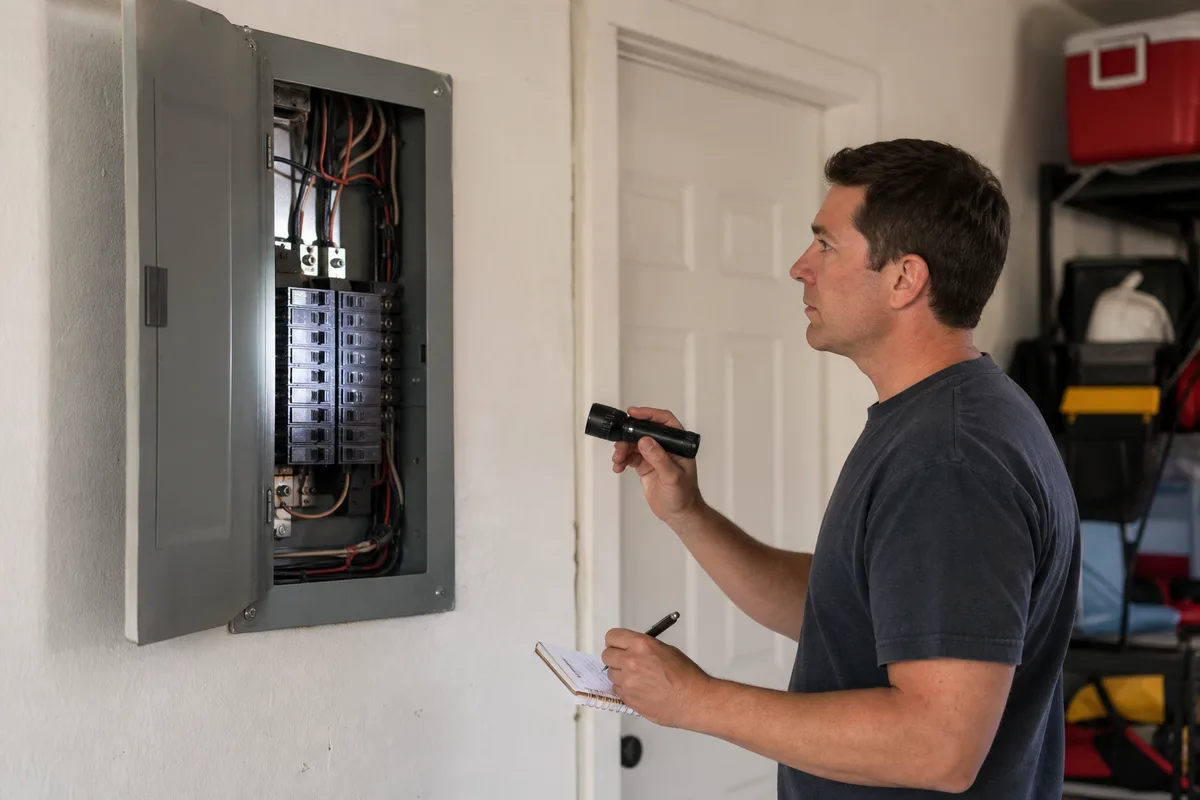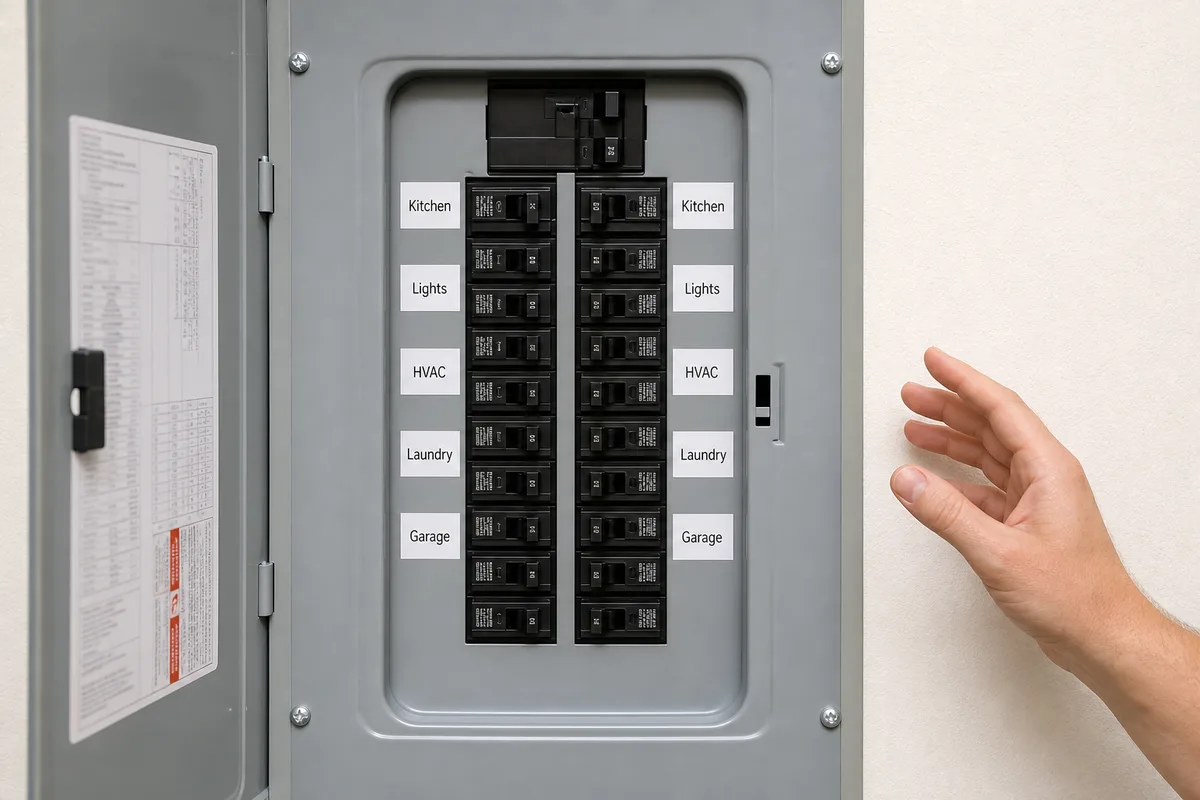
The first time I stood in front of an open breaker panel with a flashlight in my teeth, trying to figure out why the microwave and the toaster together kept killing the kitchen counter, I did not understand a single thing I was looking at. Thirty labeled switches, a couple of thick cables coming in from the meter, and a hum I could feel more than hear. I did what most people do. I flipped the tripped breaker back on, ran the microwave alone, and told myself the house was fine. It was fine. But I had learned nothing, and two weeks later I was back at the panel for the same reason.
This article is the explanation I wish someone had given me that night. It is not a wiring guide, and it will not tell you how to run a new circuit or replace a breaker. It is a mental model of where the electricity goes, what makes it too much, and why the little switches in that gray box do what they do. The goal is judgment: enough understanding that you can look at your own house and know what is safe to touch, what is a warning sign, and where the honest answer is to close the panel and call someone. Understanding the path is what turns a mystery into a decision.
The question every homeowner eventually asks
It usually starts with an annoyance, not curiosity. You plug a second thing into an outlet that was already busy and the room goes dark. You run a hair dryer in the bathroom and the outlet dies while the ceiling light stays on. You add a lamp to the bedroom and, three days later, a breaker you have never touched clicks off in the middle of the night. Every one of these is the same question wearing a different coat: how does the power actually get here, and why did it just stop?
Most of us grow up treating the outlet as an infinite well. You plug in, it works, and the only limit you have ever felt is the length of the cord. That model works right up until it doesn't, and then it fails in a way that feels random. The truth is that nothing about it is random. Every outlet in your house is the end of a specific chain that starts at the panel, and each link in that chain has a fixed, knowable limit. Once you can see the chain, the "random" trip becomes as predictable as a full glass overflowing when you keep pouring.
There is a second reason to care beyond convenience, and it is the one worth being plain about. Electricity is one of the few things in a house that can start a fire inside a wall where you cannot see it. That is not a reason to be afraid of your own outlets. It is a reason to understand the handful of signals the system gives you, so that a small problem stays small. Fear makes people either ignore warnings or overreact to them. Understanding lets you respond to the right ones.
The path: panel, wire, outlet, back again
Start at the street. Power comes from the utility into your meter, and from the meter into your main panel, that gray box with all the switches. In a typical US home, the utility delivers two 120-volt lines. Most everyday outlets and lights run on one of those 120-volt legs. Big appliances like an electric range, a dryer, or a central air unit use both legs together to get 240 volts, which is why those have the fat, differently shaped plugs.
Inside the panel, the incoming power hits the main breaker first, usually rated 100, 150, or 200 amps. That number is the total the whole house can draw at once. From the main breaker, the power splits out to the individual branch circuits, and each of those gets its own smaller breaker, typically 15 or 20 amps. One breaker feeds one circuit, and one circuit feeds a set of outlets and lights, often a room or two, wired together in a chain.
Here is the part that surprised me most when it finally clicked: electricity does not just flow out to your lamp and stop there. It needs a complete loop. Power leaves the panel on the hot wire, which is black. It flows through whatever you plugged in, doing its work there, and then it returns to the panel on the neutral wire, which is white. Break that loop anywhere, a switch, a bad connection, a cut wire, and everything on it goes dead, because the current has nowhere to return to. There is also a third wire, bare copper or green, called the ground. In normal use it carries nothing at all. It is a spare return path that exists only for the moment something goes wrong. It is the spare tire of the electrical system, quietly ignored right up until the day it earns its keep, and it is arguably the most important wire in the whole house for exactly that reason.
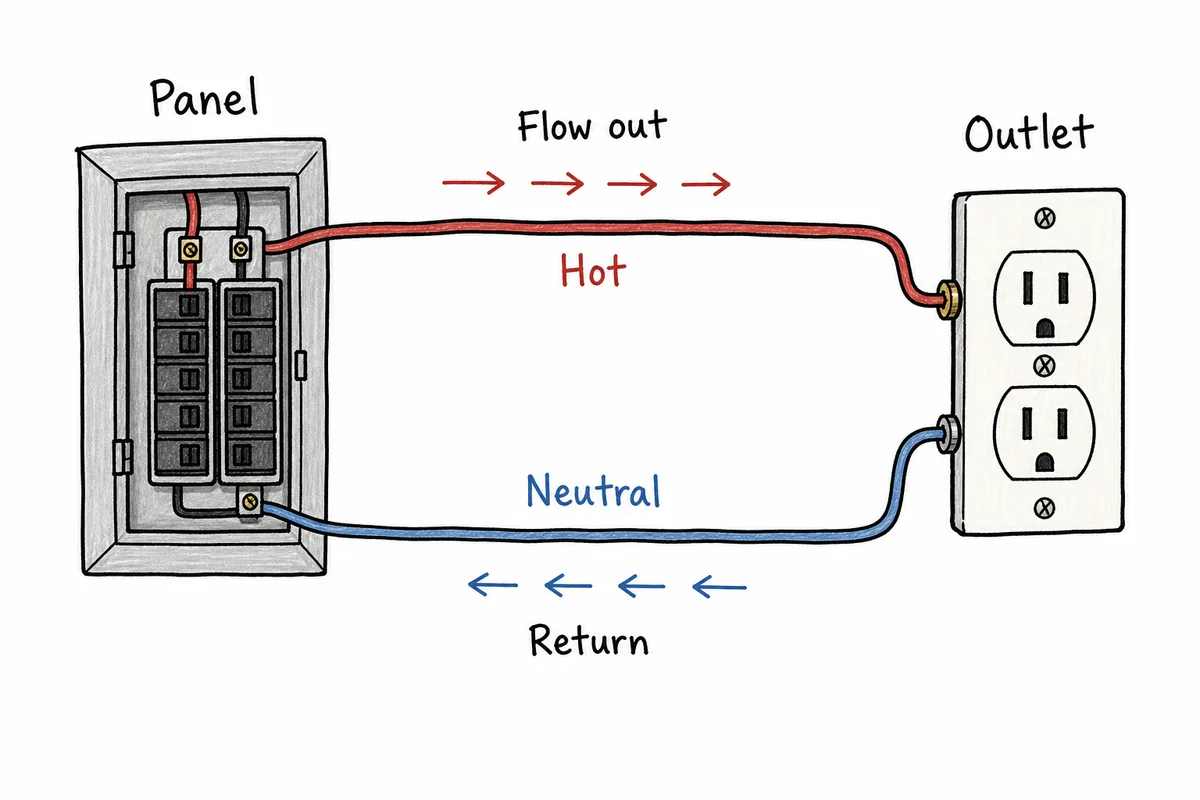 A hand-drawn diagram of an electrical circuit from panel to outlet
So the full picture is a loop: panel to hot wire, through the device, back on the neutral, into the panel, and the breaker sitting at the very start of that loop watching how much is flowing. When people say a circuit is "a run," they mean exactly this physical chain. The outlets in a bedroom are often daisy-chained, one feeding the next, all riding the same pair of wires back to the same breaker. That is why plugging something into the outlet by the door can trip a breaker that a lamp across the room is sharing. They are not separate wells. They are the same pipe.
What "load" means and why it adds up
Load is just the total amount of work being pulled off a circuit at one moment. Every device you switch on adds its share, and the wire feeding them does not care whether that demand comes from one hungry appliance or six small ones. It only sees the sum.
The math is friendlier than it looks. Watts are what appliances are rated in, and you will find the number on a label or nameplate. Volts are fixed at 120 for a normal circuit. Amps, what the breaker measures, are watts divided by volts. So a 1,500-watt space heater on a 120-volt circuit pulls about 12.5 amps. Do that division a few times and you stop guessing.
Now the ceiling. A standard 15-amp circuit tops out around 1,800 watts of continuous load, and a space heater alone can eat most of that, which is why it trips a shared bedroom circuit the moment you also turn on something else. That is not a defect. That is the system doing its job. Twelve and a half amps from the heater leaves only two and a half before the 15-amp breaker says enough. A hair dryer, a vacuum, even a couple of bright work lights can close that last gap in a second.
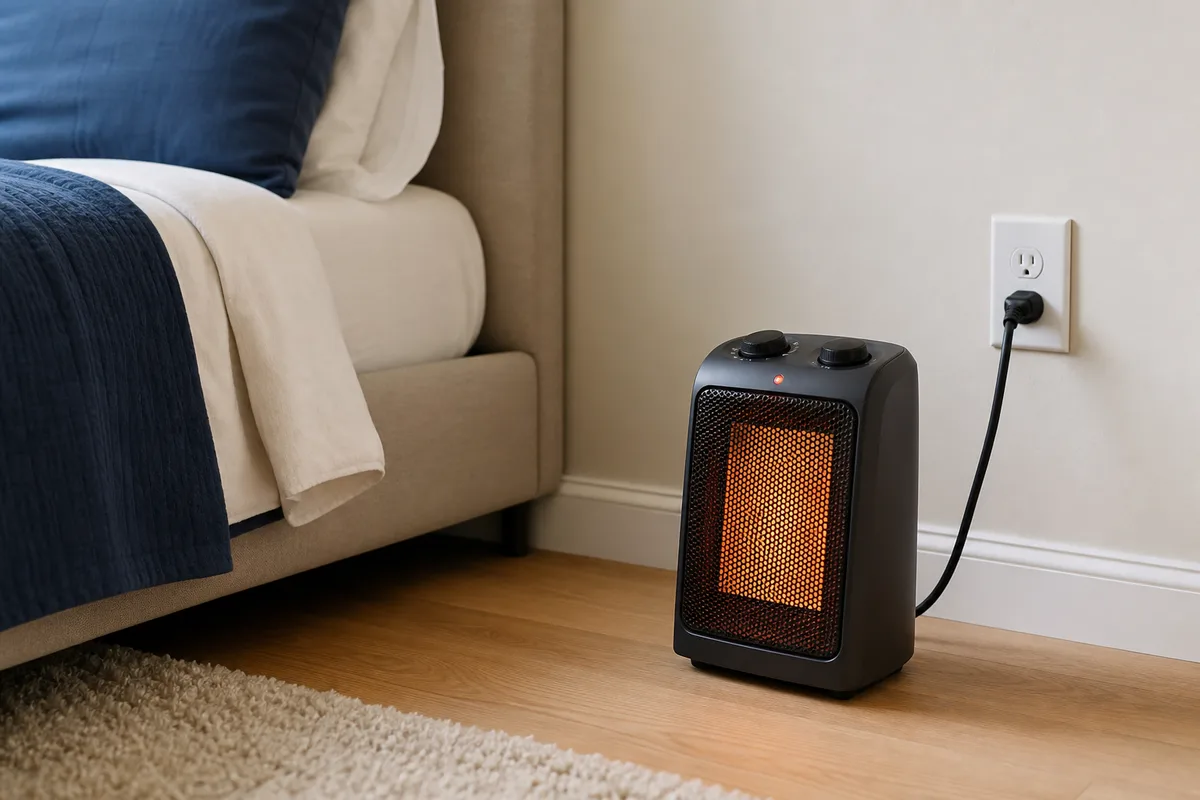 A space heater plugged into a bedroom wall outlet
There is a further wrinkle that trips people who do the basic math and still get bitten. For anything running continuously, meaning three hours or more, the working limit is not the full rating but 80 percent of it. On a 15-amp circuit that is 12 amps, or about 1,440 watts, that you should plan to draw for hours at a stretch. That space heater at 12.5 amps is already over that continuous line by itself. It will often run anyway because it cycles and the breaker tolerates brief peaks, but you are living at the edge, and the edge is where the nuisance trips live.
The practical habit this builds is simple. The heavy hitters in a house are the things that make heat or move air with a motor: heaters, hair dryers, toasters, microwaves, window air conditioners, vacuums. Two of those on the same circuit is asking for trouble, and the circuit will happily oblige. A dozen phone chargers and a laptop are not, because they sip. When you understand that a circuit is a budget and heat-making appliances are the expensive purchases, the "why did that trip" question mostly answers itself before you even reach the panel.
Why breakers trip, in plain terms
A breaker has one job: to cut the power before the wire in your wall gets hot enough to be dangerous. It is a safety valve for heat, not a sensitive electronic gatekeeper. This single idea explains almost everything a breaker does. Breakers trip on heat, not magic, and once you hold that thought, the behavior stops feeling arbitrary.
Wire heats up in proportion to how much current runs through it. Push 20 amps through a wire rated for 15 and it warms past what its insulation can take, and over time that is how insulation breaks down inside a wall. The breaker is calibrated to open before that happens. That is why a 15-amp circuit uses 14-gauge wire and a 20-amp circuit uses thicker 12-gauge wire: the breaker and the wire are a matched pair, and the breaker protects the specific wire behind it. This is also exactly why you never "fix" a nuisance trip by putting in a bigger breaker. A 20-amp breaker on 14-gauge wire lets the wire cook quietly while the breaker sits there thinking everything is fine.
There are two different ways a circuit gets to that too-hot state, and telling them apart is the whole game. The first is an overload: too many things drawing power at once, the honest sum-is-too-big situation from the load section. The breaker warms up gradually and trips after a short delay. Flip it back on with less plugged in and it stays on. Annoying, harmless, solved by spreading the load.
The second is a short circuit or a fault, and this one is not about how much you plugged in. It is a wiring problem where the hot wire finds a shortcut straight to the neutral or the ground without going through a device first. With almost no resistance in the way, current spikes enormously in an instant, and the breaker slams off hard and immediately. This is the important one to respect. A tripped breaker that won't reset usually means the fault is still present, and forcing it back on repeatedly is how people turn a nuisance into a wall fire. If a breaker trips the instant you reset it, or trips with nothing plugged in, that is the circuit telling you something is wrong inside the walls or in a device, and the correct response is to leave it off and investigate, not to keep flipping.
Your senses are part of the warning system here, and they are underrated. Breakers protect the wire, but they cannot catch every slow, low-grade problem, like a loose connection quietly heating up at a screw terminal. A warm outlet plate or a faint burning smell is a real signal to stop and investigate, not to reset and forget. A cover plate should be cool to the touch. If one outlet in the house runs warm, or you catch a whiff of something like hot plastic near a receptacle, treat that as the system asking for attention before it becomes the kind of problem a breaker trips on.
The safety devices: breakers, GFCI, AFCI
The ordinary breaker in the panel is the oldest layer, and it is a blunt instrument. It watches total current and trips on too much. That protects the wire from overheating, but it does nothing about the two subtler dangers that modern codes worry about, and those are where GFCI and AFCI come in. Think of all three as different sensors watching for different kinds of trouble.
A GFCI, which stands for ground-fault circuit interrupter, watches the balance of the loop. In normal use, every bit of current that leaves on the hot wire comes back on the neutral. The two are equal. A GFCI constantly compares them, and if it sees even a tiny mismatch, on the order of 5 milliamps, meaning current is leaking out of the intended path somewhere, it cuts power in a fraction of a second. That leak is what happens when electricity finds an unintended route, and the classic scenario is water or a wet surface giving current a way out of the system. This is why GFCI protection lives where water and electricity meet: kitchens, bathrooms, garages, basements, and outdoor outlets. You recognize a GFCI outlet by the two little buttons in the middle marked test and reset.
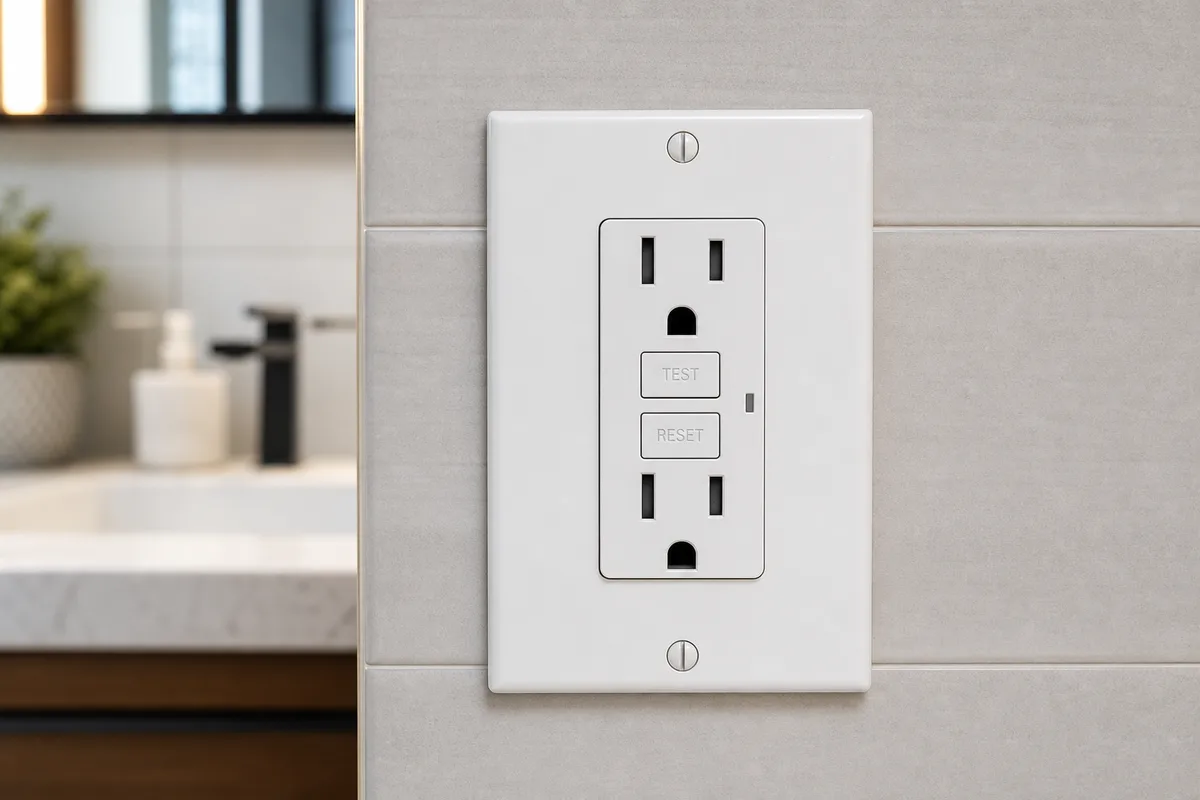 A close-up of a GFCI outlet showing test and reset buttons
Those buttons are not decoration, and they are worth using. Press test and the outlet should click and go dead, cutting power to itself and often to other outlets downstream of it on the same run. Press reset and it comes back. Doing this every month or so is the one bit of electrical maintenance almost anyone can do safely, and the rare kind that takes ten seconds and asks nothing of your weekend, because a GFCI is a mechanical device that can wear out, and a dead one gives you no warning that it has stopped protecting you. If test does nothing, or reset will not hold, the device is at the end of its life and should be replaced. One more thing that confuses people: because a single GFCI can protect several plain outlets wired after it, a dead bathroom outlet is sometimes cured by resetting a GFCI in a completely different room. Knowing the run exists saves a service call.
An AFCI, an arc-fault circuit interrupter, is the newest layer and the hardest to picture. It listens for the electrical signature of arcing, the tiny, erratic sparks that jump across a loose connection, a nail nicked through a wire, or a cracked cord. Those arcs can be too small to trip an ordinary breaker on current, yet hot enough to ignite wood or insulation over time. AFCI protection, now required in bedrooms and living areas in newer construction, is built to catch that pattern and cut power. AFCIs are also famous for being touchy, sometimes tripping on the electrical noise from an old vacuum motor or a cheap power supply, a bit like a smoke alarm that also has strong opinions about toast. That sensitivity is annoying, but it is the same sensitivity that catches the dangerous arc, so an AFCI that trips is doing what it was installed to do, even when the cause turns out to be harmless.
What this means for what you plug in where
Put the pieces together and a set of practical rules falls out on its own, without anyone having to memorize a code book. The first is the one that started this whole article: do not stack heat-makers on the same circuit. If the bedroom trips whenever the space heater and something else run together, the answer is not a bigger breaker, it is a different outlet on a different circuit for the second thing. The load is real and the breaker is right.
The second rule is about extension cords and power strips, and it is where a lot of quiet danger hides. A power strip does not add capacity. Six outlets on a strip still all trace back through one wall outlet to one circuit with one budget. Plugging a second space heater into a power strip next to the first does not give you more power, it just concentrates the whole load through a thin cord and a small strip that were never built for it. This is exactly the setup that gets a cord or strip warm to the touch, and that warmth is the early version of the burning-smell warning from earlier. A cord carrying a heavy appliance should stay cool. If it does not, you are over its limit no matter what the breaker thinks.
The third is to notice which outlets are the special ones and respect why. The GFCI outlets near water are protecting against the leak scenario, so a hair dryer belongs on a bathroom GFCI and not on an extension cord run in from the bedroom to dodge a tripping one. The trip is information. If a bathroom or kitchen GFCI keeps cutting out on a particular device, the device may be failing and letting current leak, which is precisely the thing the outlet exists to catch. Working around the safety device instead of listening to it is how people defeat the one part of the system built for the most dangerous failure. If you want the fuller picture of how the electrical, plumbing, and heating systems in a house tie together, our overview of understanding your home's systems puts electricity in context with the rest.
The fourth is quieter but adds up over years: pay attention to the outlet itself. A plug that falls out of a receptacle under its own weight has worn contacts, and loose contacts make heat exactly where you cannot see it. An outlet that feels warm, buzzes, or shows any scorching around the slots has moved from convenience problem to safety problem. None of these mean the sky is falling. They mean the same thing a low-fuel light means: handle it before it becomes the reason you are standing at the panel in the dark.
The line between safe DIY and calling an electrician
I am a believer in doing your own work, and this whole site is built on that. Electrical is the one area where I am most deliberate about the line, because the failure modes are the least forgiving and the least visible. So let me be specific about where I think the line actually sits, from the perspective of someone who has crossed it in both directions.
On the safe side, with the understanding you now have, is everything that does not involve opening up live wiring. Reading your panel and figuring out which breaker feeds what. Making a labeled map of your circuits by flipping breakers and walking the house, which is genuinely one of the most useful afternoons you can spend and costs nothing but a little dignity spent shouting "is it off now?" from room to room. Resetting a tripped breaker once, thoughtfully, after removing some load. Testing and resetting GFCI outlets with their own buttons. Redistributing what you plug in where. Swapping a lamp, a bulb, a plug-in device. Noticing warm plates, loose outlets, and burning smells and reacting to them. All of that is judgment and observation, and none of it requires you to become an electrician. It is the same instinct behind every other repair skill worth building, which our guide to essential home repair skills lays out across the whole house.
The line gets crossed the moment the work involves the wiring itself with power present, or any repair inside the walls or the panel. Replacing an outlet or a switch, adding a circuit, working in the breaker panel, chasing down what is causing a hard fault, anything where you are handling conductors: this is where the stakes change and where I stop giving how-to and start giving the honest recommendation. Not because a homeowner cannot learn it, but because the margin for a hidden mistake is thin, the mistake can hide in a wall for months, and a permit and a licensed electrician exist precisely for this reason. This is the "this won't work if" moment: the mental model in this article is for understanding and safe judgment, and it deliberately stops short of teaching you to work on live wiring, because that is a different skill with a different standard.
There are a few situations where the call is not even close, and I will name them plainly. A breaker that trips instantly every time you reset it, or trips with nothing plugged in, is signaling a live fault, and repeatedly forcing it is the dangerous move. A warm or scorched outlet, a persistent burning smell you cannot trace to a device, or a panel that buzzes, feels warm, or shows any rust or corrosion, gets a professional, not another reset. Aluminum wiring in an older home, a fuse box someone has "fixed" with an oversized fuse or a coin, or two-prong outlets you want grounded, are all worth an expert eye. Spending a service call to have someone confirm the system is safe is cheaper than the alternative every single time, and understanding the path, the load, and the safety devices is exactly what lets you describe the problem clearly when you make that call.
That is the real payoff of a mental model. You are not trying to replace the electrician. You are trying to stop being the homeowner who stands at the panel flipping a breaker back on for the fourth time, learning nothing, hoping. Once you can see the loop, weigh the load, and read the warning signs, you make better decisions about your own house, and you know exactly when the smartest move is to close the panel and pick up the phone.