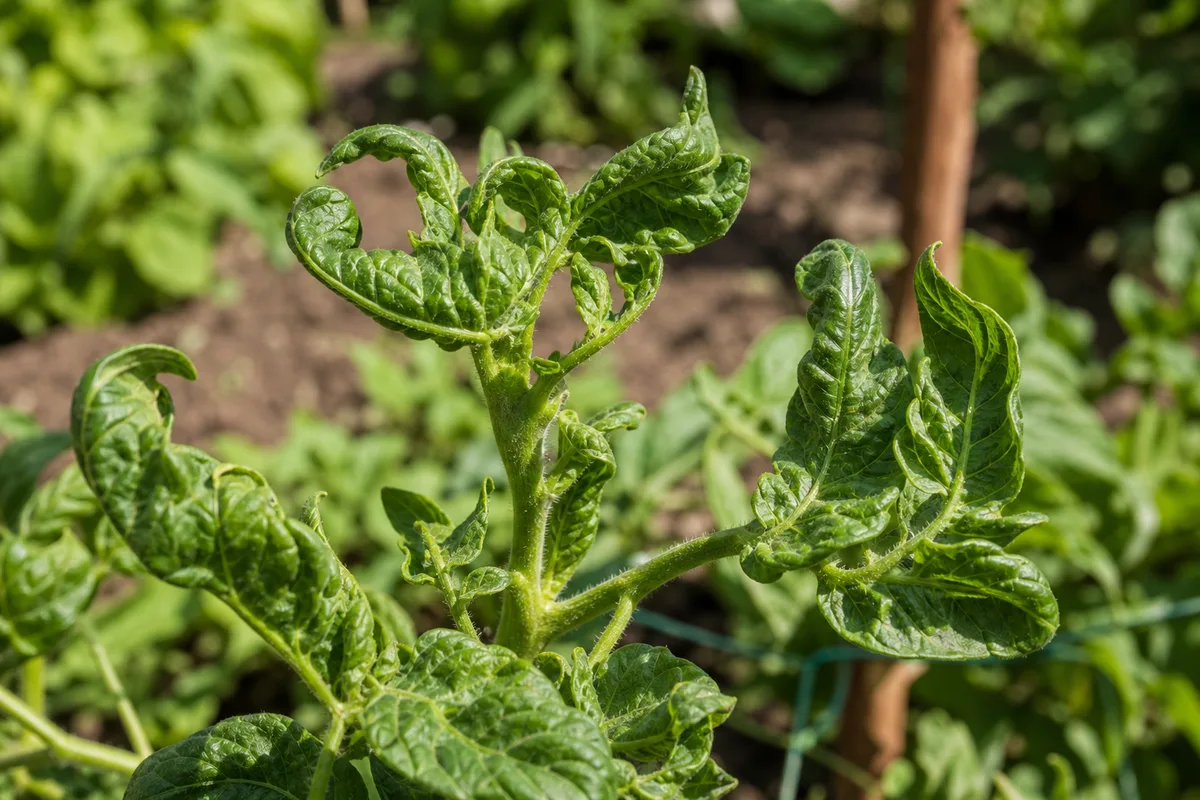
The first curled tomato leaf almost always looks worse than it is. You walk out with your coffee, glance at a plant that was flat and open the day before, and now the lower leaves are cupped up like little taco shells. The instinct is to do something immediately: water it, feed it, spray it. That instinct is exactly what turns a non-problem into a real one, because half of what makes tomato leaves curl is harmless, and the most common wrong move is to drown a plant that was only closing up against the heat.
I have grown tomatoes long enough to have panicked over every version of this, and to have made most of the mistakes. What finally settled me down was learning that leaf curl is not one condition. It is a symptom with at least six different causes, and those causes leave different fingerprints. A plant conserving water in a heat wave does not look like a plant hit by weed killer, and neither looks like a plant sitting in soggy soil. Once you can read the direction of the curl, which leaves are affected, and how the new growth behaves, you stop guessing and start diagnosing. This article walks that reading, cause by cause, so you can tell in a few minutes whether you are looking at a crisis or nothing at all.
The worry that starts with one curled leaf
The reason a single curled leaf sends people into action is that a tomato plant is a big investment of patience. You started it, hardened it off, staked it, waited weeks for the first trusses to set, and now something looks wrong. The stakes feel high, so the response feels urgent.
Slow down before you touch anything. The most useful thing you can do in the first ten minutes is nothing except look, which is harder than it sounds when you have a full watering can in your hand and a strong urge to feel useful. The plant is telling you the cause if you read it in the right order. I have a habit now of asking four questions before I decide anything is wrong. Is it the older lower leaves or the new top growth? Are the leaves cupping up or rolling down? Is the curl the same on every plant in the bed or just one? And did anything change in the last two or three days, in the weather, the watering, or what got sprayed nearby?
Those four answers narrow it down fast. Curl on the lower leaves during a hot spell is a different story from twisted new growth at the tips. A whole bed curling together points somewhere different from one plant curling alone. Most gardeners skip straight to a fix without asking any of this, and that is how a heat response gets "treated" with a flood of water, or a watering problem gets "fed" with fertilizer it did not need. The plant was already handling the situation; the intervention is what set it back.
There is also a plain physical fact worth holding onto: leaf roll is one of the few tools a tomato plant has to protect itself. Curling reduces the leaf surface exposed to sun and wind, which cuts how fast the plant loses moisture. So a curled leaf is not automatically a sick leaf. Sometimes it is a working leaf doing its job, and getting no credit for it. The skill is telling the working kind from the failing kind, and that is entirely readable from the pattern.
Reading the curl: direction and location
Every diagnosis below rests on two observations, so it is worth getting fluent with them before anything else. Direction: do the leaves cup or roll upward, edges lifting toward the sky, or do they curl downward, edges tucking under and the whole leaf sometimes rolling into a tube? Location: is it the older leaves low on the plant, the newest leaves at the growing tips, or all of them at once?
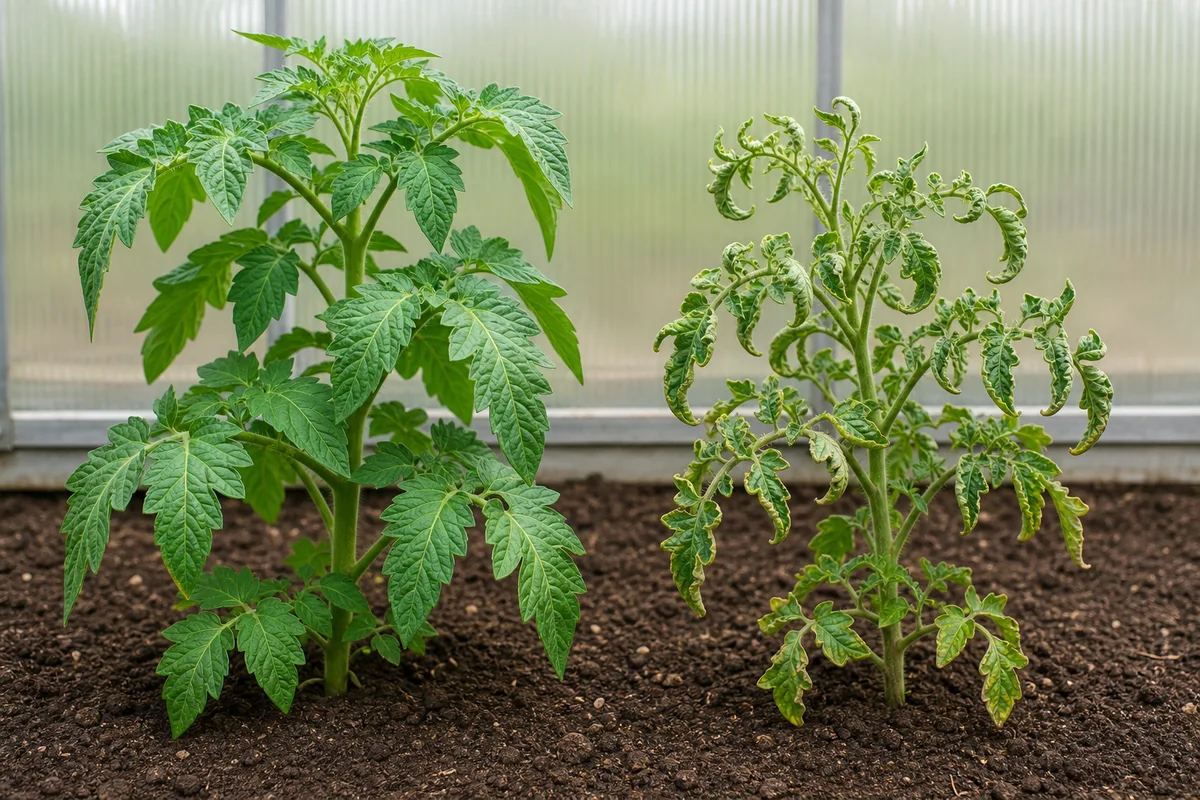 A healthy tomato plant beside one with curling leaves
Here is the shorthand I use, and it holds up more often than not.
Upward cupping on lower, older leaves is the mildest and most common pattern. It leans heavily toward heat and water stress, or a plant that is simply mature and vigorous. The leaves stay green, the texture stays normal, and the plant keeps flowering and setting fruit. This is the version that usually needs no action.
Downward rolling, often starting lower and moving up, with the leaves still normal-colored points toward a water problem, either too much or an abrupt change, or the ordinary shock of a recent transplant. It looks more dramatic than upward cupping but is still, in most cases, recoverable.
Twisted, distorted, stringy new growth at the top of the plant is the pattern that should get your attention. When the newest leaves come in narrow, fernlike, cupped hard, and wrong-shaped rather than just rolled, you are usually not looking at weather at all. That is the signature of herbicide exposure, and it is the one serious cause on this list.
Curl with yellowing, spots, sticky residue, or visible insects moves you into pest and disease territory, which mimics simple curl but always brings a second symptom along with it. The tell is that pure stress rarely discolors the leaf; it just changes its shape.
Keep those four pictures in mind. The rest of the article is really just each of them explained, with what to do and, just as important, what not to do.
Heat and water stress: usually harmless
This is where most curling ends, so it is worth understanding well before you worry about anything scarier. When the temperature climbs into the 90s Fahrenheit and the sun is hard overhead, a tomato plant loses water through its leaves faster than the roots can pull it up from the soil. The plant responds by cupping its lower leaves upward, shrinking the surface area facing the sun. It is the same reason you would rather stand sideways to a bonfire than face it flat.
The classic version is upward cupping on the lower leaves during a heat wave, and the reassuring detail is what it does at the end of the day. If the curl is heat-driven, the leaves often relax and flatten out by evening once the sun comes off them, and they curl again the next afternoon. That daily rhythm, tight at 3 p.m. and loose at 8 p.m., is close to a signature. It means the plant is regulating itself and needs nothing from you, which is a quietly humbling thing to learn about a plant you have been fussing over all afternoon. I have watched the same bed curl and un-curl on a repeating cycle through a July hot spell and produce a full crop without a single intervention.
Wind does the same thing. A dry, gusty day pulls moisture off the leaves even when it is not especially hot, and vigorous, fast-growing plants curl more readily than slow ones because they simply have more leaf area losing water. Some varieties, particularly many of the older heirloom and potato-leaf types, roll their leaves more than others as a matter of habit. If one variety in your bed curls while the others do not, and the plant is otherwise healthy, that is often just what that plant does.
The wrong response here is the tempting one: to see curled leaves and immediately soak the bed. If the soil is already moist a few inches down, more water does not fix a heat response, because the problem was never a lack of water in the ground. It was the plant temporarily unable to move water fast enough to its leaves in the heat. Adding water to already-damp soil just pushes you toward the overwatering problems in the next section. Before you water for curl, put a finger down into the soil to the second knuckle. If it is damp at that depth, leave the hose alone.
What actually helps, when heat curl is severe and constant, is steadier moisture at the root and some relief from the worst afternoon sun. Deep, less frequent watering that keeps the root zone evenly moist beats shallow daily splashing, because it builds a reserve the plant can draw on through the hot hours. A layer of mulch holds that moisture and keeps the soil temperature down. If you want to understand why deep watering outperforms frequent light watering, and how the ground actually stores what you give it, the piece on how soil holds water and nutrients explains the mechanics that make mulch and deep watering work. During a genuine heat emergency, a piece of shade cloth over the plants for the hottest few hours takes the edge off, but for ordinary summer curl, the honest advice is to leave the plant to do its job.
Overwatering and transplant shock
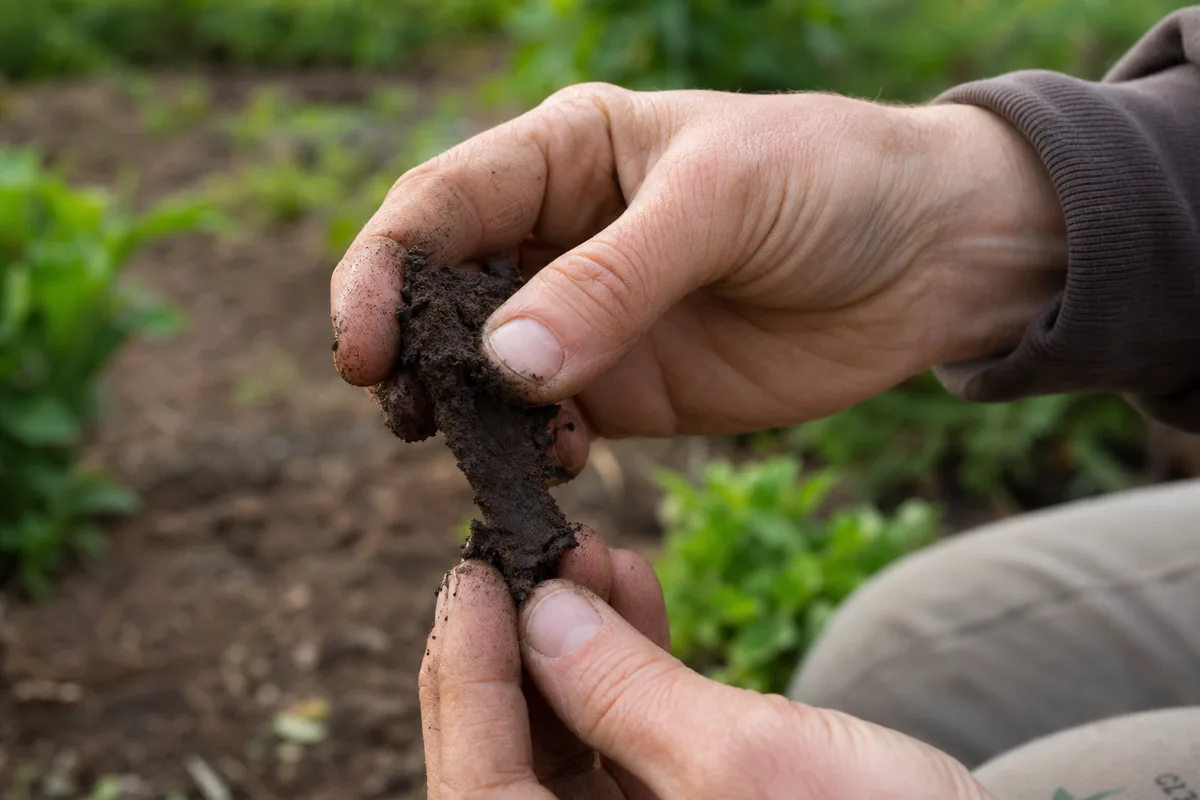
Downward curl tells a different story from upward cupping, and it is the pattern most often tied to water going the other direction: too much of it, or too sudden a change. When a tomato plant sits in soil that stays waterlogged, the roots cannot get oxygen, they start to suffocate, and the plant responds by rolling its leaves downward and looking generally sullen, like it resents the care. The soil surface may look fine, so people miss it. The check is the same finger test in reverse: if the soil two or three inches down is not just moist but genuinely wet and heavy days after watering, drainage is your problem, not dryness.
Transplant timing is where this shows up most. A sudden downward curl in the days right after you move a seedling into the garden or up-pot it is often simple transplant stress, and it frequently overlaps with overwatering because the natural urge with a new transplant is to keep it wet. The roots were disturbed, they lost some of their fine feeder tips in the move, and for a week or two they cannot supply the top of the plant the way they did in the pot. The leaves curl while the root system catches up. The soggy-soil version of this corrects on its own once you back off the water and let the bed drain, and the plant usually flattens out and resumes growth within a week or two as new roots establish. Meanwhile the wrong move, again, is to respond to a droopy new transplant by watering more, which keeps the roots underwater exactly when they need air.
There is a useful distinction between wilting and curling here, because they feel similar but mean opposite things. A plant that is limp and drooping, with soft leaves hanging down, is usually genuinely short of water and will perk up within an hour of a good drink. A plant that is firm but has its leaves rolled downward or cupped tight is not thirsty in the same way; the leaf is stiff, not floppy. If you water a firm, rolled plant expecting the wilt-recovery response and it does not perk up, that is your sign it was never dry. Feel the leaf. Limp and soft means water. Firm and rolled means look elsewhere.
Setting a plant up right from the start heads off most of this. Even, consistent moisture from the day of transplanting, soil that drains rather than holds a puddle, and a gentle transition into the ground all reduce the shock that triggers the curl in the first place. If you are still working out your beds and watering rhythm, the overview of starting a home garden covers building soil that drains well and settling transplants in without shocking them, which is where a lot of this trouble is prevented rather than treated.
Herbicide drift: the serious one
This is the cause that actually matters, the one where no amount of watering, feeding, or patience will fix the plant, and it is worth knowing well because it is the one most often misread as something harmless. Tomatoes are extraordinarily sensitive to certain broadleaf weed killers, the growth-regulator type used on lawns and pastures. It takes only a trace to distort a plant, and the damage looks unmistakable once you have seen it.
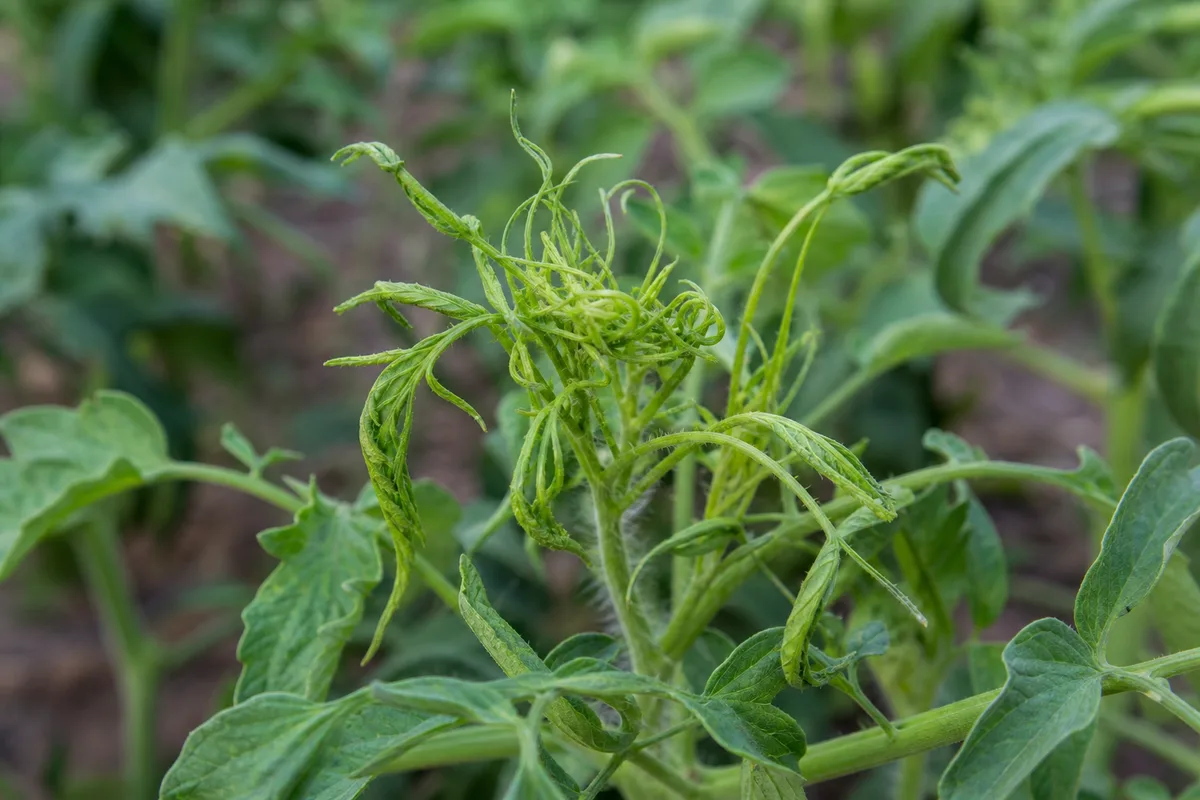 Twisted new growth on a tomato plant from herbicide drift
The signature is in the new growth, not the old. Twisted, stringy, fernlike new leaves, coming in narrow and cupped and wrong-shaped, with stems that may curl or twist and leaf veins that look thick and pale, point to herbicide exposure rather than weather. Where heat curl leaves the leaf a normal shape and just folds it, herbicide damage deforms the leaf itself as it forms, so the newest growth looks like it is trying to grow in a spiral. That distinction, deformed new growth versus rolled normal growth, is the whole diagnosis. Watering does nothing, because water was never the issue.
The exposure comes from a few predictable places, and this is where the four-question habit earns its keep. One is drift from a neighbor's lawn treatment on a breezy day; the spray carries farther than people think, and tomatoes downwind catch it. Another, and the sneakier one, is contaminated straw or hay mulch, or manure or compost sourced from animals that grazed on treated pasture. Some of these herbicides pass through the animal and persist in the manure and the bedding straw for a long time, so you can poison your own bed with mulch you spread in good faith, which is a special kind of frustrating when you did everything right. A third is your own sprayer, if you used it for weed killer and then for anything else without a thorough cleaning; the residue is enough. If every plant in a bed shows the same twisted new growth at once, and especially if you laid new mulch or a neighbor sprayed just before it started, drift or contaminated material is the strong suspect.
Here is the hard, honest part. There is no cure. If the exposure was light, the plant may grow out of it, pushing normal leaves above the damaged ones over several weeks, and still give you a reduced crop. If it was heavy, the plant will not recover and any fruit it manages is not worth keeping. What you can do is stop the source: pull and bag suspect straw mulch rather than turning it into the soil, and if you suspect your compost or a manure source, keep it away from sensitive plants until you have tested it. A simple bioassay works, where you sprout a few fast beans or peas in a pot of the suspect soil or compost and watch whether their new growth comes in twisted. If the test plants deform, the material is contaminated and does not belong near tomatoes. This is the one cause on the list where prevention is nearly everything, because once the plant shows it, your options are mostly gone.
Pests and disease that mimic curl
Not all curl is stress or chemistry. Some of it is a living cause, and the way to catch that is to remember a rule: pure stress changes a leaf's shape, but pests and disease almost always bring a second symptom along with the curl. If you see rolling plus something else, discoloration, spots, sticky residue, fine webbing, or visible insects, you have left the stress category and should look closer.
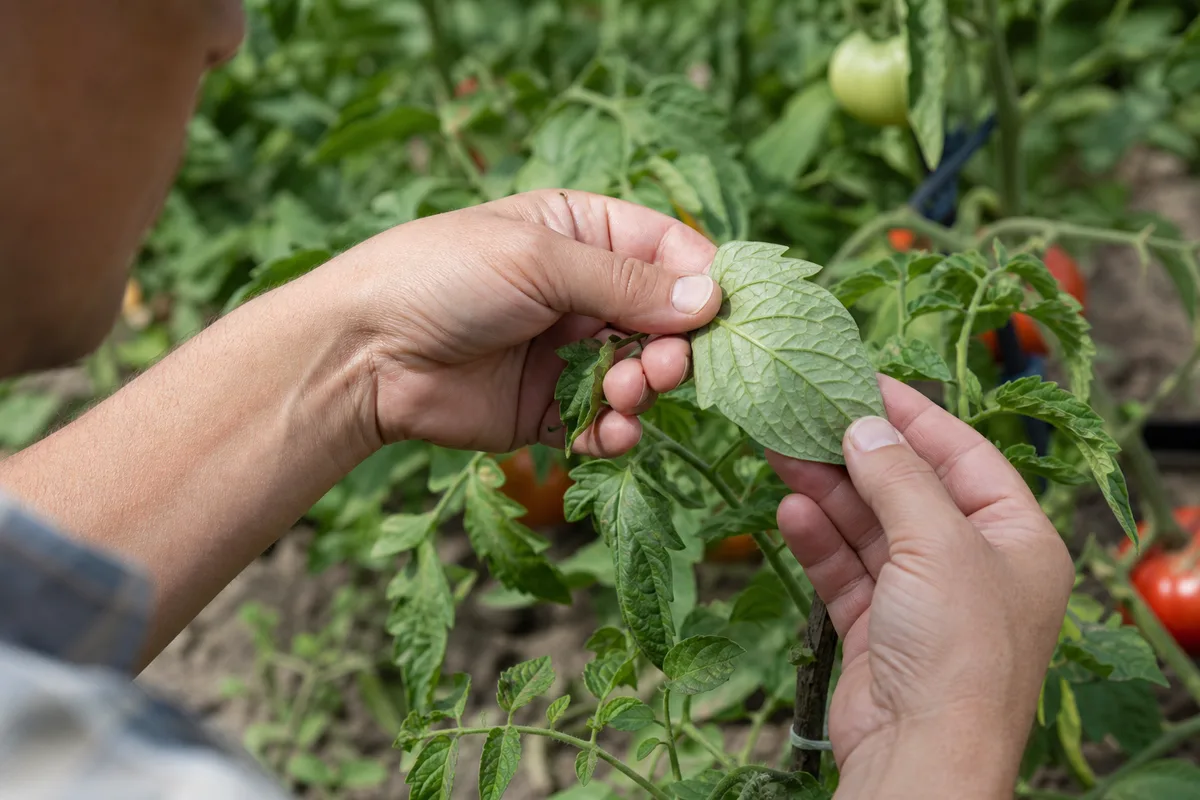 A gardener inspecting the underside of a tomato leaf
The habit that catches most of it is turning leaves over. A lot of the trouble hides on the underside, so when curl comes with any second symptom, flip several affected leaves and look at the backs before you conclude anything. Aphids cluster there in soft green or black colonies and leave a sticky shine; heavy feeding puckers and curls the new growth around them. Whiteflies lift off in a little cloud when you brush the plant, which is unsettling the first time and unwelcome every time after. Certain mites are too small to see clearly but leave fine stippling and a faint webbing, and the leaves take on a dull, dry, curled look. In each of these, the curl is a side effect of feeding, and the fix is the pest, not the water.
Then there are the viral causes, which are more serious and less fixable. Some tomato viruses, several of them spread by those same whiteflies, cause curling together with yellowing, stunting, and a mottled or crumpled look to the leaves, and the plant simply never grows right. A virus-curled plant does not un-curl in the evening the way a heat-stressed one does, and it does not recover with better watering. If a single plant is stunted, discolored, and distorted while its neighbors are fine, and you have ruled out chemistry, a virus is possible, and the honest response is usually to remove that plant so it does not become a reservoir for insects to carry to the others.
The reason this section comes near the end is that pests and disease are the least common explanation for plain curl and the easiest to over-diagnose. Most curled tomato leaves are not sick; they are hot, or overwatered, or newly transplanted. Reach for the pest-and-disease explanation only when the curl arrives with company. If the leaf is simply rolled and otherwise a healthy green, you are almost certainly back in the harmless categories.
A decision path from symptom to cause
Put together, the whole diagnosis runs as a short sequence of questions, and walking it in order will land you on the right cause far more reliably than reacting to the first curled leaf you see. Here is the path I actually follow in the garden.
Start with the new growth. Look at the newest leaves at the tips first. Are they twisted, stringy, narrow, and deformed rather than just rolled? If yes, stop here and think herbicide. Ask what got sprayed nearby, whether you laid new straw or manure, and whether every plant shows it at once. This is the serious branch, and no watering change belongs on it. If the new growth is normal in shape, move on.
Then check direction on the older leaves. Are the lower, older leaves cupping upward while staying green and healthy? During hot or windy weather, and if they relax by evening, that is heat and water stress, and the answer is steady deep watering and patience, not a flood. Put a finger in the soil before you water at all.
If the curl rolls downward, check the soil and the calendar. Is the soil wet and heavy inches down, or did you transplant in the last week or two? Downward curl with soggy soil is overwatering; back off and let it drain. Downward curl right after transplanting is shock; keep moisture even and give it a week or two to root in. Feel a leaf, too: limp and soft means genuinely dry and needs water; firm and rolled means it is not thirst.
Look for a second symptom. Any yellowing, spotting, stickiness, webbing, or insects moves you out of stress and into pests or disease. Turn the leaves over and inspect the undersides. Treat the pest, remove a clearly virus-struck plant, and do not assume plain curl is illness without that second sign.
Weigh whether it is one plant or the whole bed. One plant curling alone leans toward that plant's own issue, its transplant, its roots, its variety, or a virus. The whole bed curling together leans toward something shared, the weather that day or a mulch or spray that touched all of them. That single question separates a lot of causes quickly.
Run that path and most curling resolves into an obvious answer within a few minutes of looking, and more often than not the answer is that the plant is fine and doing exactly what it should in the heat. The discipline is to observe before you act, because nearly every wrong move in this whole subject comes from treating a symptom before reading it. Water the plant that is genuinely dry, drain the one that is drowning, hunt the pest that is feeding, and pull the mulch that is poisoned, but do not water the plant that was only shading itself from the sun. Learn to tell those apart and a curled tomato leaf stops being a scare and becomes just another thing the plant is telling you, in a language you can now read.