The first hard frost makes the decision for you. One October morning the tomato plants that were limping along are suddenly black and collapsed, the squash leaves have gone to wet paper, and the bed that was a going concern last week is now a cleanup job. What you do over the next couple of weekends decides more about next year's garden than anything you will do in April. A bed closed down properly starts spring loose, fed, and ready to plant. A bed abandoned in October starts spring compacted, crusted, and full of last year's problems.
The trouble is that "put the garden to bed" gets explained as one blanket instruction, rip everything out, cover it up, when the honest answer is different for different plants and different beds. Some plants should be pulled roots and all. Some are better cut at the soil line and left to rot in place. Some beds want a blanket of leaves; a bed you finish early enough might do better growing a cover crop instead. This article walks the whole shutdown in the order you would actually do it, with the reasons attached, so you can make those calls for your own bed instead of following a rule that fits nobody's yard exactly.
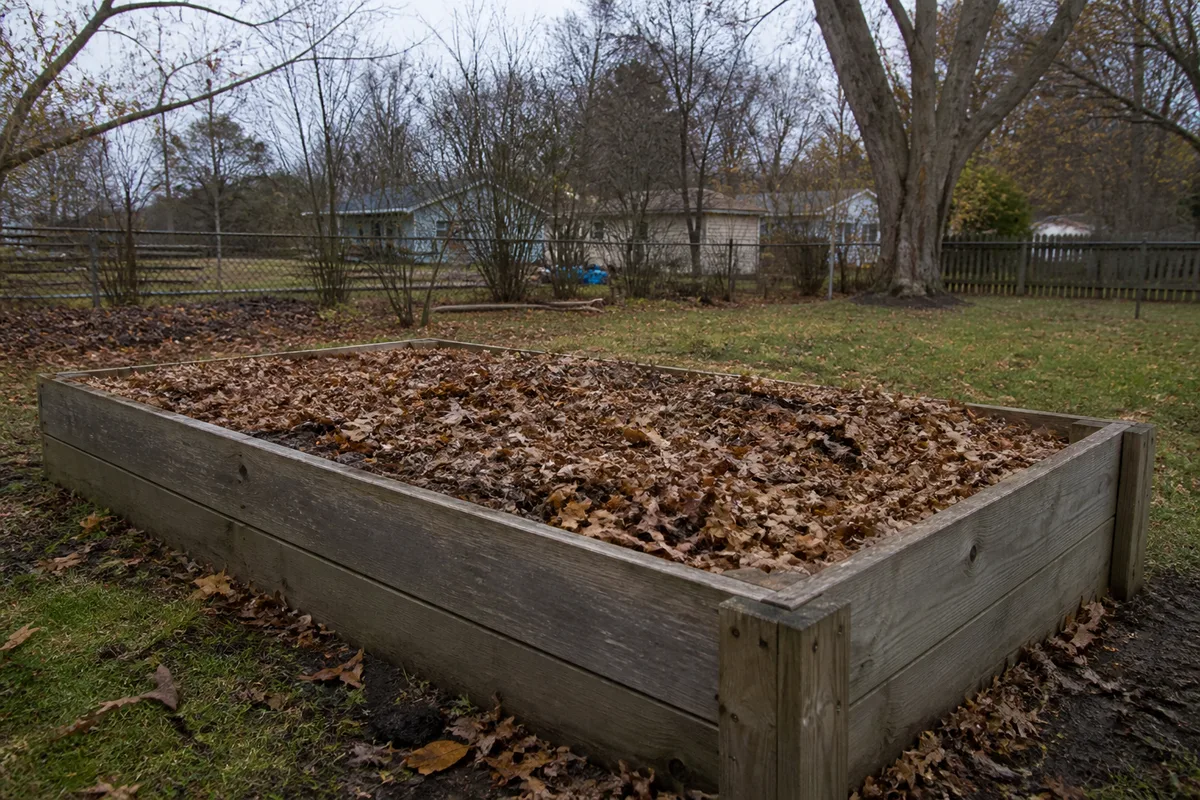 A raised vegetable bed cleared and covered with shredded leaves in late fall
This piece goes deep on the closing-down section of our guide to starting a home garden, which covers the full first season from the other end.
When to start, and why the frost date is only half the answer
The shutdown is not a single afternoon; it is a sequence spread over four to six weeks, and the anchor is your first fall frost date. Look yours up by zip code, most of the northern half of the country lands somewhere between late September and early November, and then work backward and forward from it.
Backward from frost is harvest season. Anything tender, tomatoes, peppers, beans, zucchini, basil, dies at the first real freeze, so the week the forecast first flirts with 32°F, strip the plants of everything usable. Green tomatoes ripen indoors on a counter if they have reached full size and show even a hint of color change; a paper bag with a ripe banana speeds them along. It feels greedy to pick a plant bare, but frost does not negotiate, and a counter of slowly reddening tomatoes in November beats a bed of frozen ones.
Forward from frost is the actual closing, and here is the part most people get backward: you do not have to race. A killed plant is not going anywhere, and a few weeks of dead stems hurt nothing. What you should not do is the opposite, tear everything out in a rush the first cold weekend and leave the soil bare until April. Bare is the one state a bed should never winter in. Rain hits uncovered soil at full force all winter, and by spring the surface is crusted tight and the structure you spent a season building has been beaten flat. Everything in this article is ultimately in service of one rule: the bed goes into winter covered, by mulch, by a cover crop, or at minimum by the stubble of cut plants, never naked.
One more date matters: about four weeks before the ground freezes solid is your deadline for the deep final watering, and roughly six weeks before is the realistic cutoff for sowing a cover crop. Both are covered below. The point of naming them now is that the shutdown has a real schedule, and the tasks that look optional in early October stop being possible by Thanksgiving.
Laid out against a first frost in mid-October, which is a common date across the middle of the country, the sequence looks like this:
- Late August to mid-September: sow cover crop into any gaps where summer crops have already finished. This is the task people miss, because the bed still looks busy.
- The week frost first appears in the forecast: strip the tender crops of everything usable.
- First dry weekend after the killing frost: pull the diseased plants, cut the healthy ones, clear the hardware.
- Late October into November: spread compost, give the bed its last deep soak, drain and store the hoses.
- After the ground crusts over, usually November: spread the mulch on any bed that did not get a cover crop, and mulch the overwintering rows.
Shift the whole ladder earlier or later to match your own frost date. The shape of it is what matters: sowing happens before frost, cleanup happens after it, and covering happens last.
Pull it or cut it: the decision that matters most
The core of the cleanup is what to do with the dead and dying plants, and the blanket advice to rip everything out is wrong about half the time. The better rule has two parts.
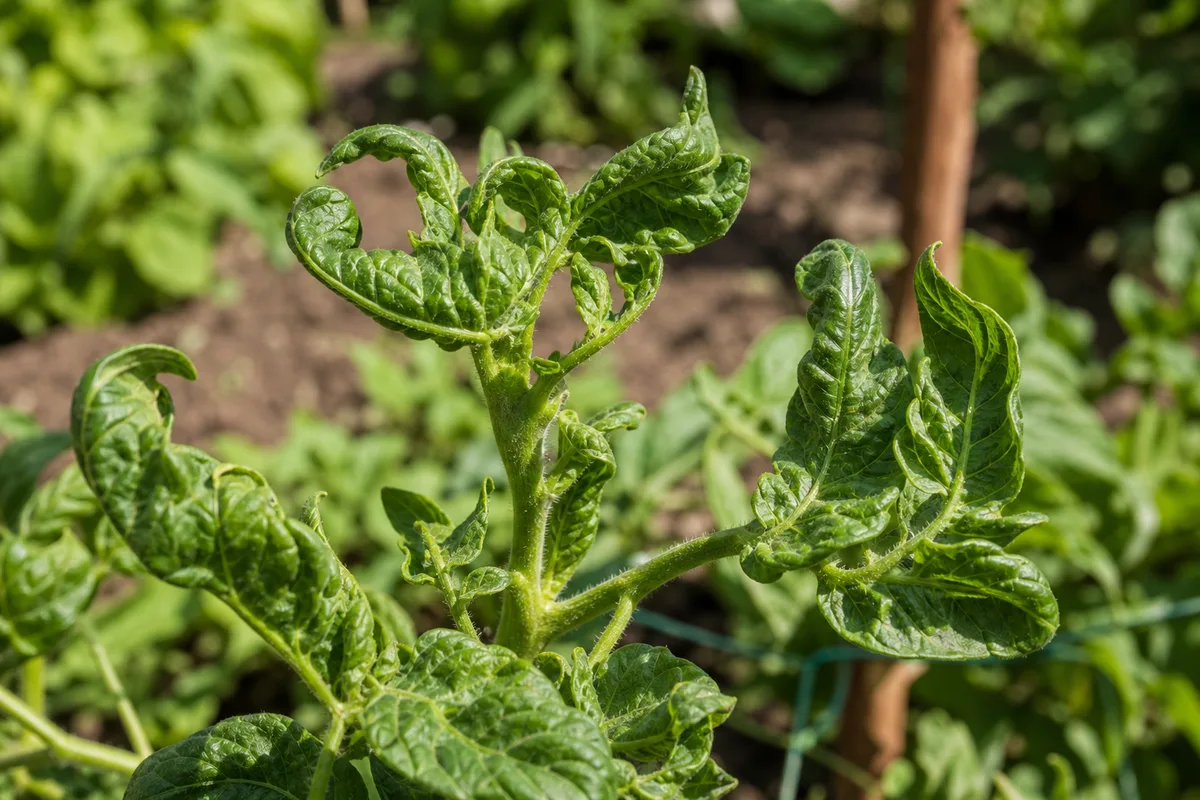
Pull, roots and all, anything that had disease or heavy pest trouble, and be ruthless about the usual suspects. Tomatoes are the headline case. Nearly every tomato plant in the country carries some level of early blight or septoria leaf spot by September, those are the yellowing lower leaves with dark spots you stopped noticing in August, and both overwinter on dead tomato tissue. The same caution applies to peppers and eggplant, tomato relatives with shared diseases, and to squash, cucumbers, and melons, which finish most seasons carrying powdery mildew and hiding squash bug eggs in their debris. All of it comes out of the bed completely, roots included, and none of it goes in a home compost pile. A backyard pile rarely holds the sustained heat that kills these pathogens, so composting blighted tomato vines just stores the disease over winter and hands it back in spring. Bag it for the trash or municipal yard waste, where the commercial piles run hot enough to matter. It stings to throw away that much organic matter. Do it anyway; one season of hauling blight back into your bed via homemade compost teaches this lesson at a much higher price.
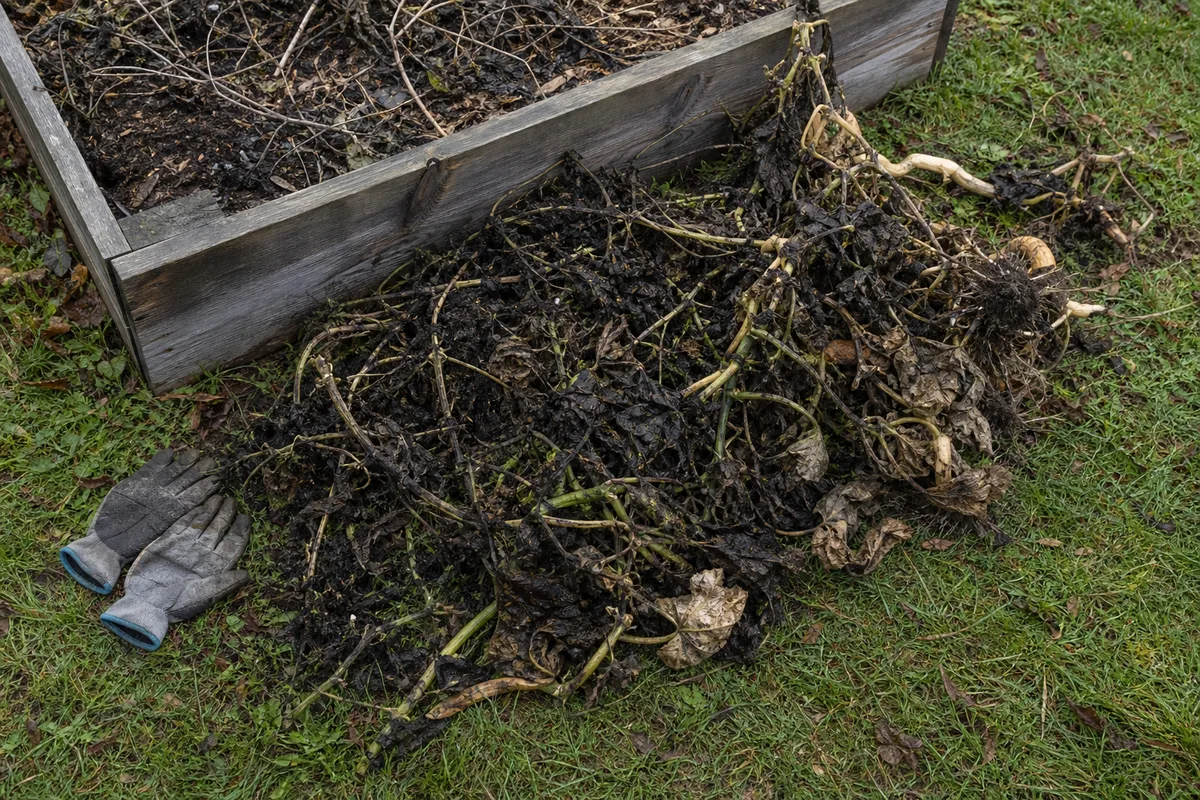 Frost-killed tomato and squash plants pulled and piled beside a garden bed
Cut at the soil line, and leave the roots in the ground, anything that finished the season healthy. Beans and peas are the clearest case: their roots carry nodules of nitrogen-fixing bacteria, and leaving those roots to rot in place releases that nitrogen into the bed instead of hauling it to the compost pile. But the logic extends to any clean plant, lettuce that bolted, spent marigolds, healthy herb stems. A root left to decay becomes a channel of organic matter running down through the soil, exactly where you want it, and pulling it would tear up the soil structure around it for no gain. Snip the plant off at the surface, compost the healthy tops, and let the underground half do quiet work all winter. If cutting through a season's worth of woody stems and vines is a fight, a decent bypass pruner earns its keep here; the choice is covered in choosing hand pruners.
Two edge cases round this out. First, weeds: pull them completely, especially anything carrying seed heads, because a weed that seeds in October is a planting you did for free next spring. Do a slow final pass around the bed edges where they hide. Second, do the whole cleanup on a dry day. Working through wet foliage smears disease spores from plant to plant, and walking on saturated soil packs it like a road. If the week is rainy, wait. The dead plants will keep.
A third category gets to stay put entirely: root crops still in the ground. Carrots, parsnips, and beets do not just tolerate the cold, they improve in it, converting starch to sugar as the temperature drops, which is why a November-dug carrot tastes sweeter than a September one. Cover the row with six inches of leaves or straw before the ground freezes, mark it with a stake tall enough to find above snow, and you can dig them through most of the winter as you need them. The mulch is not for the roots, they can take the cold, it is to keep the ground around them soft enough to get a fork into in January. The practical limit is a wet winter in heavy soil, where roots left too long sit in cold muck and split; in that situation, dig them all by Thanksgiving and store them in a cool spot indoors instead.
Anything healthy you cut goes to the compost pile, and fall is the pile's best season, you suddenly have carbon in bulk falling off the trees to layer with the last green material. What makes a cold, slow autumn pile actually break down by spring is covered in how compost breaks down.
Strip the hardware before the ground freezes
Before covering anything, clear the infrastructure out of the bed: tomato cages, stakes, trellis netting, row cover hoops, plant labels, and any drip lines or soaker hoses.
The reason to bother is partly lifespan and partly spring. A steel tomato cage left out all winter rusts at every weld; a bamboo stake left in the ground rots at the soil line and snaps next July under a loaded plant. Ten minutes of collection buys years of reuse. Knock the dirt off everything, let it dry, and if anything supported a diseased plant, tomato cages again being the prime suspect, wipe it down before storage so it does not reinoculate next year's planting. Stack it all somewhere dry, cages nested, stakes bundled.
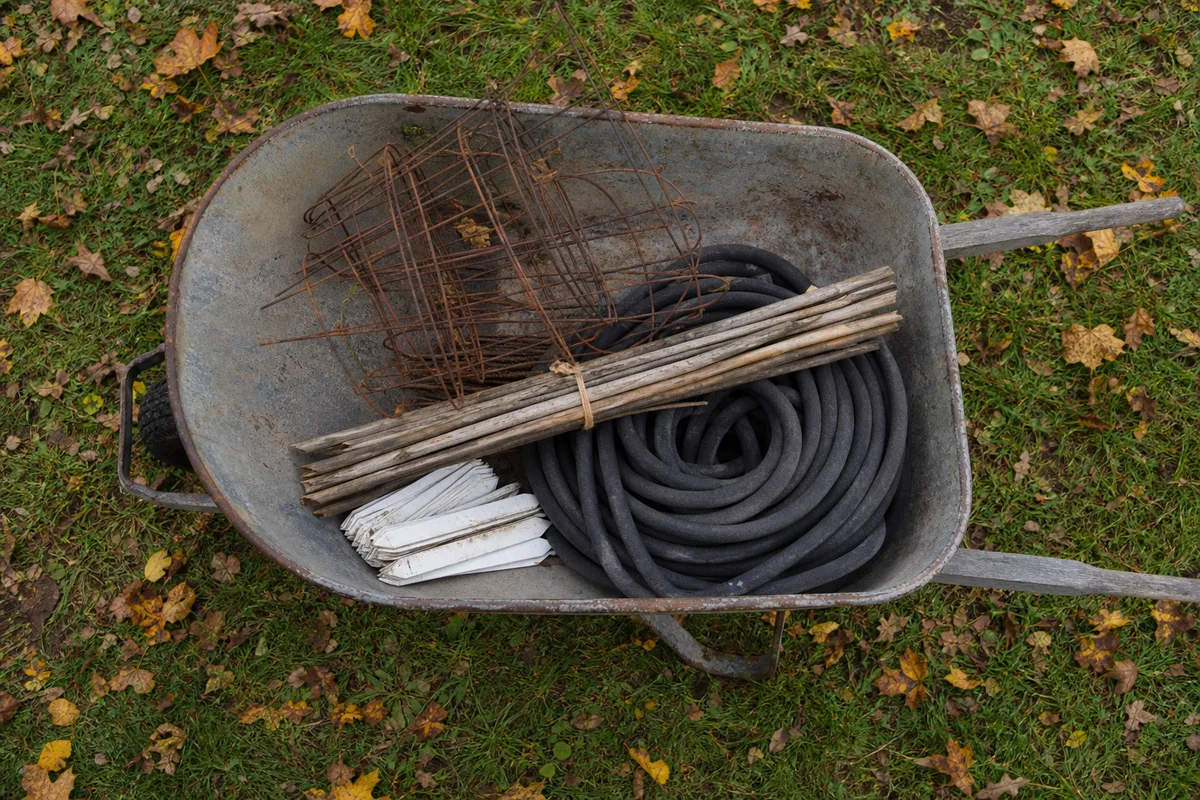 Tomato cages, stakes, and plant labels collected in a wheelbarrow for storage
Drip lines and hoses have a harder deadline: water expands when it freezes, and a soaker hose that goes into winter full of water comes out of it split. Drain them fully, coil them loose, and get them into a shed or garage. Disconnect the garden hose from the outdoor spigot too, a connected hose traps water in the faucet and can crack the pipe inside the wall, which turns a two-minute fall chore into a plumber visit in March.
This is also the moment to look at the bed itself. Check raised-bed corners for boards that have bowed or pulled their screws, because frost heave will widen every gap you leave. A loose corner re-screwed in October is a five-minute fix; the same corner in spring, after a winter of freeze-thaw cycles working on it, often means replacing the board. If the bed is reaching the end of its life, the rebuild is covered in build a raised garden bed.
Feed the soil now, not in spring
With the bed cleared, feed it, and fall is genuinely the better season for this, not just an acceptable one. Spread one to two inches of finished compost across the surface of the bed. Then, and this is the part that saves work, do not dig it in. Rake it level and stop.
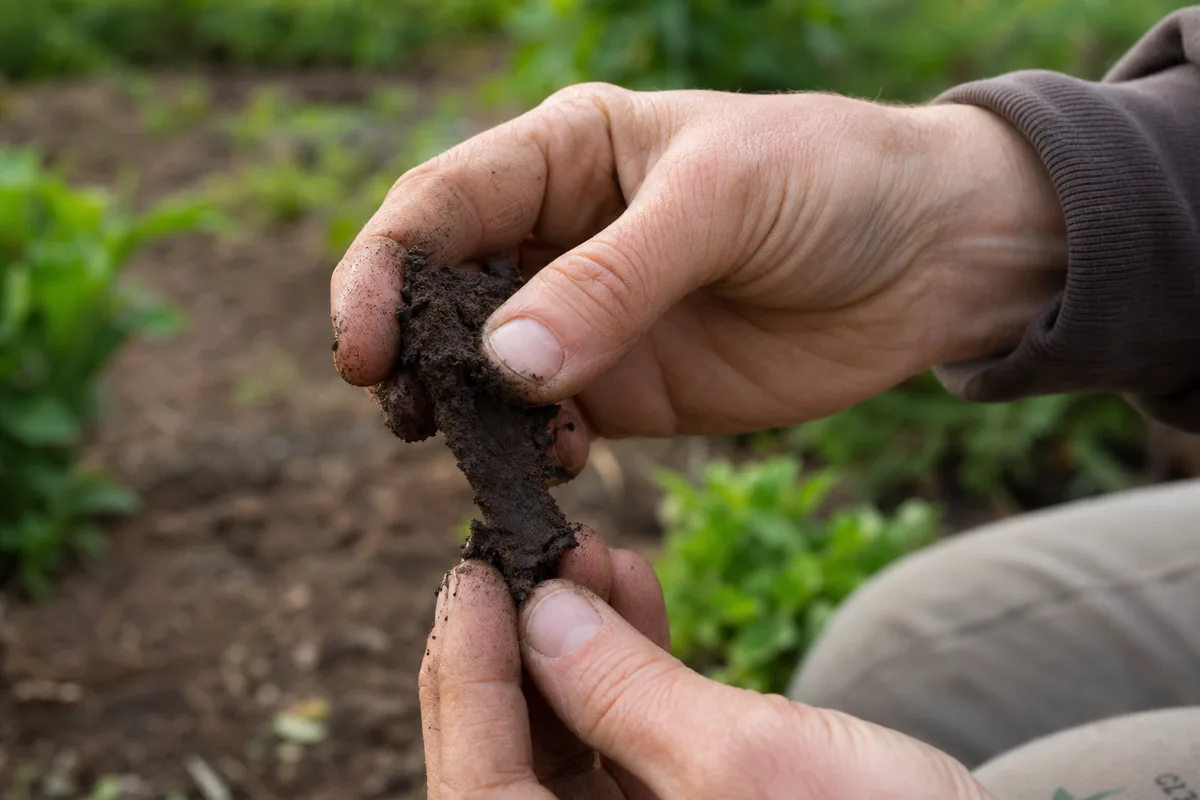
The reasoning is worth understanding because it runs against instinct. Every pass of a shovel or tiller through the bed breaks up the network of soil channels, worm tunnels, root paths, fungal threads, that took all season to form. Left on the surface, compost gets carried down anyway: winter rain leaches its soluble nutrients into the root zone, and worms physically drag the organic matter down through their tunnels, months of free labor working every mild day between now and spring. By planting time the compost has effectively been incorporated without a single channel destroyed. Digging it in gets you the same result minus the intact structure. The mechanics of how that organic matter actually holds water and nutrients where roots can use them are laid out in how soil holds water and nutrients.
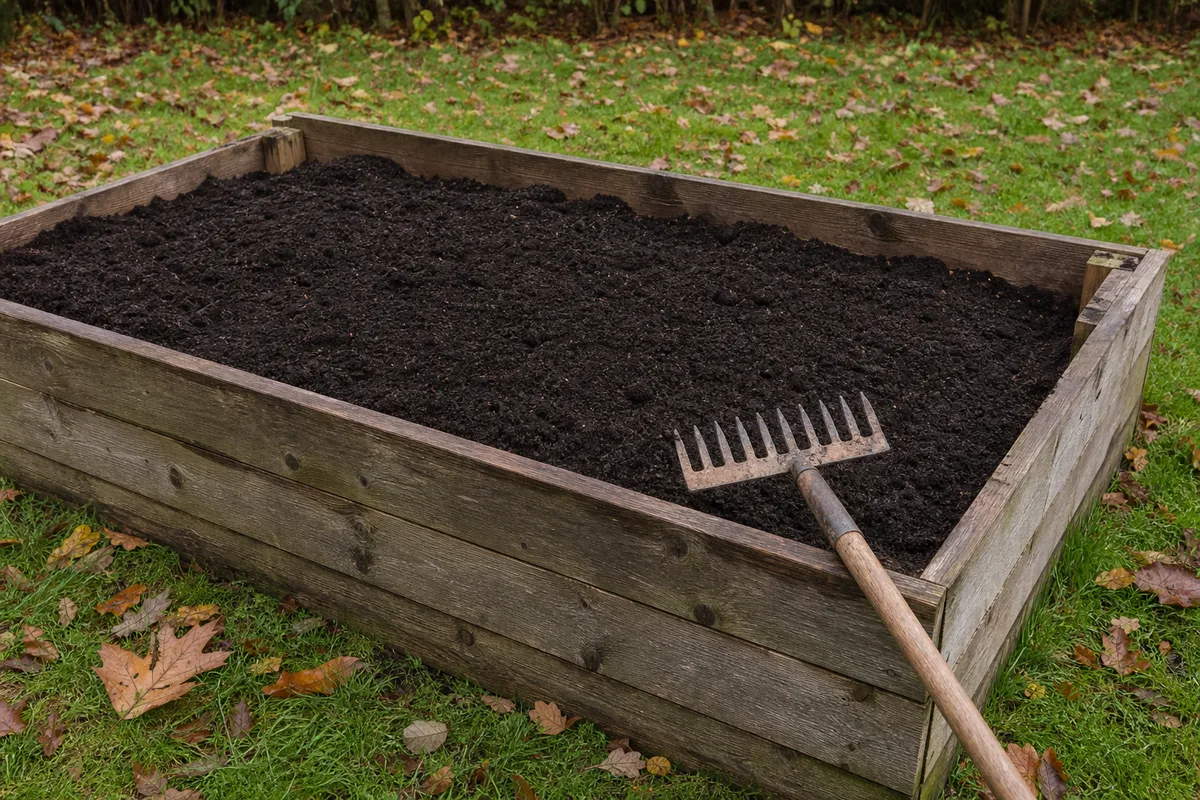 A layer of compost spread across the surface of a garden bed with a rake resting on the edge
Fall is also the one time of year the slow amendments make sense. Manure that would be too fresh to plant into in spring has all winter to mellow; spread it in fall and it is safe and settled by planting time. If a soil test says your bed needs lime or sulfur to adjust pH, both take months to shift anything, so an October application is working by April while a April application is working by July. And if your underlying problem is heavy clay that a raised bed only partially escapes, fall is when the freeze-thaw cycle becomes your ally, the approach is in fixing compacted clay soil, and it leans on winter doing work you cannot.
Give the bed one last deep soak before the ground freezes, especially after a dry fall. Soil with moisture in it holds warmth better than dry soil and insulates the life in it through the cold; bone-dry soil freezes deeper and faster. Aim to get this done while daytime temperatures still run above freezing, then drain the hose as above. After this, you are done watering until spring, snow and winter rain take over the job.
Mulch or cover crop: choosing the winter blanket
The bed is cleared, fed, and watered. Now the actual putting-to-bed: covering the soil for the winter. You have two good options, and the honest deciding factor is the calendar.
The default: three to four inches of mulch. Shredded leaves are the best material most people can get, and they are free in exactly the season you need them. Run the mower over a leaf pile and bag the shreds, whole leaves mat into a wet, airless sheet that shrugs off rain, while shredded ones knit into a blanket that breathes. Straw works nearly as well if you can get clean straw rather than hay, hay is full of seed and will plant your bed with grass. Spread the layer across the whole surface and walk away. All winter it absorbs the impact of rain, moderates the freeze-thaw swings that churn the surface, and starves winter weeds of the light they need. By spring the bottom of the layer is half-rotted into food and the bed under it is loose enough to plant into with your hands. Do not use bark or wood chips on a vegetable bed, they are the right mulch for paths and perennials, but they take years to break down and are a nuisance to plant through in April.
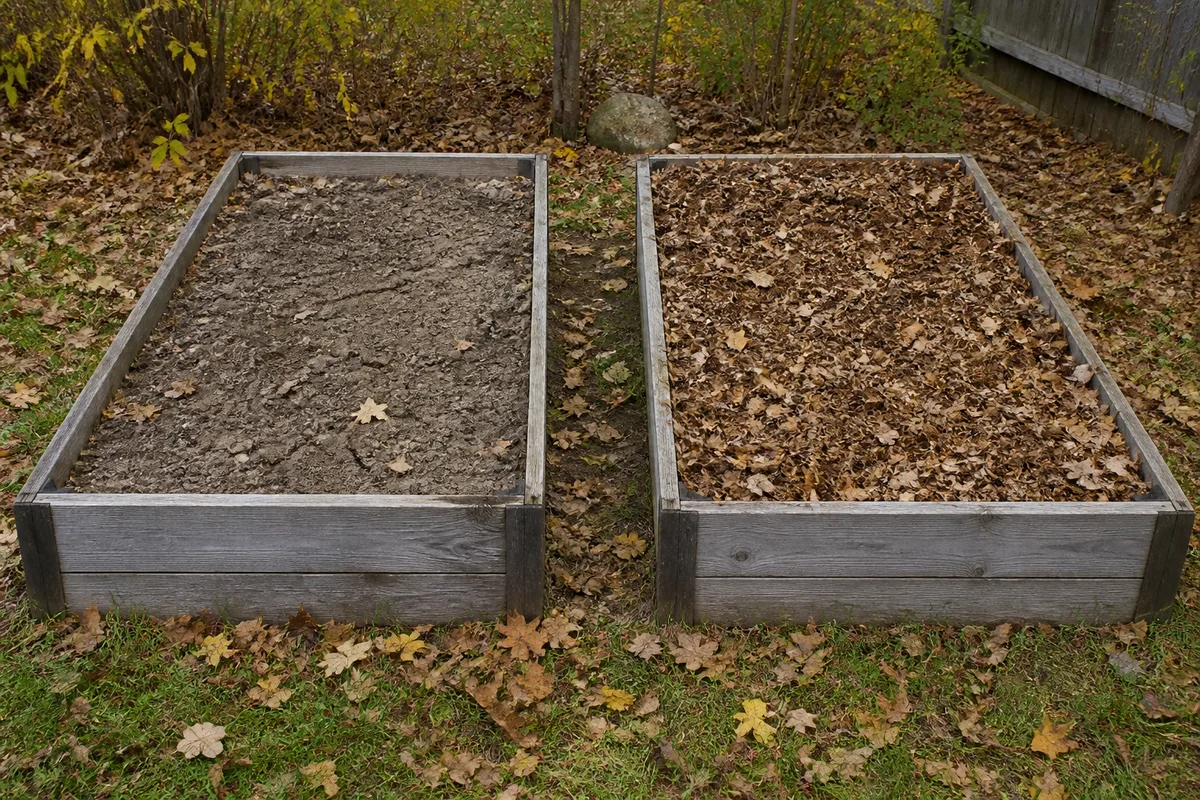 Two raised beds side by side, one left bare and one covered with leaf mulch
One timing note: if your area has real vole or mouse pressure, wait to spread the mulch until after the ground has frozen its first crust. Mulch laid on warm soil in early October makes a comfortable rodent hotel for the winter; the same mulch laid over frozen ground in late November protects the soil just as well without the tenants.
The upgrade, if you are early enough: a cover crop. A cover crop is a placeholder planting grown not to harvest but to occupy the bed, winter rye, oats, crimson clover, and field peas being the common choices. Instead of a passive blanket, the bed spends winter with living roots holding the soil open, pulling up leftover nutrients that rain would otherwise wash away, and, in the case of clover and peas, fixing nitrogen. Come spring you cut the growth down before it sets seed and either turn it in shallowly or leave it on the surface as a mulch, and the bed gets the whole season's biomass as a meal.
The catch is the sowing deadline. Seed needs to germinate and put on a few inches of growth before hard frost, which in practice means sowing five to six weeks before your first frost date, mid-August to late September for most of the country. That timing collides with reality: the bed is usually still full of tomatoes then. The workable pattern for a small garden is to sow cover crop in the gaps as each crop finishes, the corner where the beans came out in August gets rye in August, rather than waiting for one grand clearing day. If frost has already come and gone, the decision is made for you: winter rye is the only common choice that still establishes in cold soil, and past mid-October in most zones, mulch is simply the right answer. There is no shame in it; a leaf-mulched bed and a cover-cropped bed both come through winter in fine shape, and the cover crop's edge is real but modest at backyard scale.
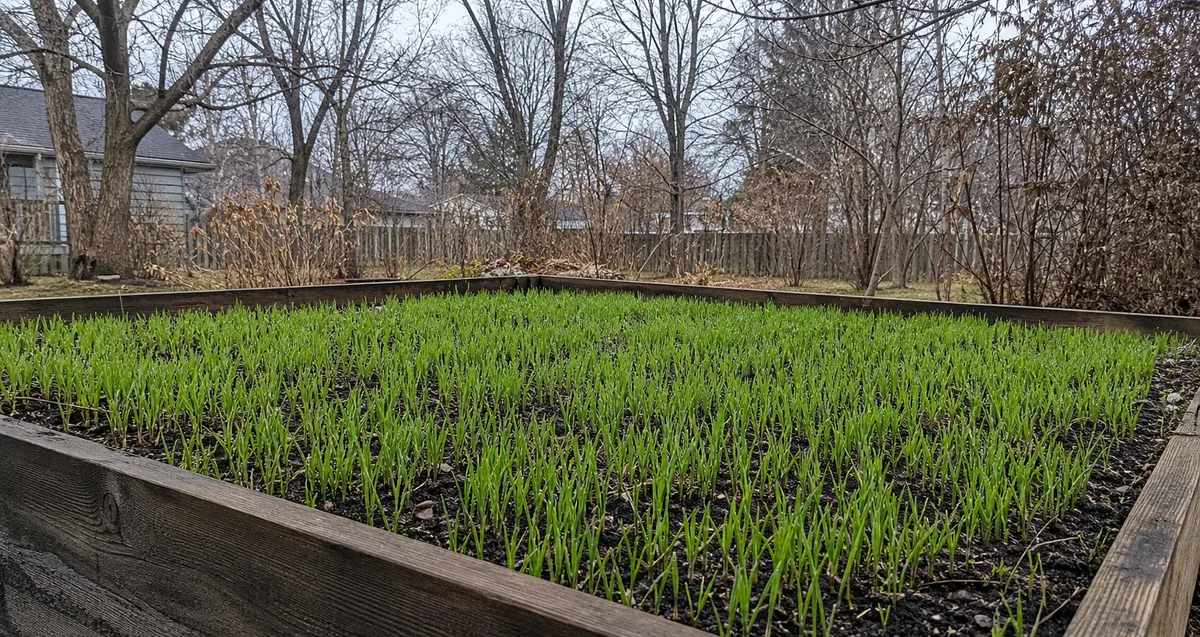 Young winter rye cover crop growing in a raised bed in late fall
What disqualifies the third option, doing nothing, is worth restating once with numbers attached. A 4-by-8 bed left bare catches every drop of a winter's rain, 30 inches of it in much of the country, each drop hitting at terminal velocity and each impact breaking surface crumbs into paste. The crust that forms is real enough that spring seedlings struggle to push through it. Covered versus bare is the difference between starting next season ahead or behind, and the cover costs one afternoon and a pile of leaves.
What this will not fix, and the honest limits
A few boundaries on all of the above, so the work goes where it pays.
This shutdown will not sterilize a bed that had a bad disease year. Pulling infected plants and keeping them out of the compost sharply cuts what carries over, but blight spores and mildew are also in the neighborhood at large, your neighbor's garden, wild nightshades, last year's leaves under the hedge. If tomatoes struggled this year, the cleanup helps, but the bigger levers are planting them in a different part of the bed next year and giving them more space for airflow. Closing the bed well is one leg of that stool, not the whole stool.
A cover crop will not fix compaction in one winter, and mulch will not turn poor soil good by itself. Both are compounding habits: the bed that gets covered and fed every fall is noticeably better in year three and unrecognizable in year five, but no single autumn performs a miracle. If the soil is genuinely bad, dense, gray, lifeless, the fall work is still worth doing, just pair it with realistic expectations and a plan to keep adding organic matter every season.
The perennial edges of the garden follow their own rules, and it is worth separating them from the vegetable bed in your head. Hardy perennial herbs, chives, thyme, sage, oregano, mostly want to be left alone: resist the urge to cut them back hard in fall, because the standing growth shelters the crown through winter, and prune them in spring instead when you can see what survived. Rosemary is the exception worth knowing, it is reliably hardy only to roughly zone 7, so in most of the northern states it comes indoors in a pot or gets treated as an annual; no amount of mulch changes that math. Strawberries get their mulch late, after a few hard frosts have hardened them off, an inch or two of straw loosely over the crowns, which is the entire origin of the name. The common thread: perennials are not being shut down, they are being tucked in, and the fall mistake with them is usually doing too much, not too little.
And none of this applies to a bed you intend to garden through winter. Garlic goes in around your first frost date and wants mulch over it, that part fits, but if you are growing under row cover or planting fall greens, the bed is not going to sleep and the calculus is different. This article is about the bed you are done with until spring.
Ten minutes of notes, then walk away
The last task is the cheapest and the most skipped. Before the season fades from memory, stand at the bed with a notebook for ten minutes and write down what actually happened: which crops earned their space and which did not, where the shade really fell in July, how the watering held up in the hot stretch, what ran out of room. Add what you did today, what got pulled, what got cut, what the bed was fed, what covered it, so that in April you are not squinting at a mulch layer trying to remember whether the compost went down before it.
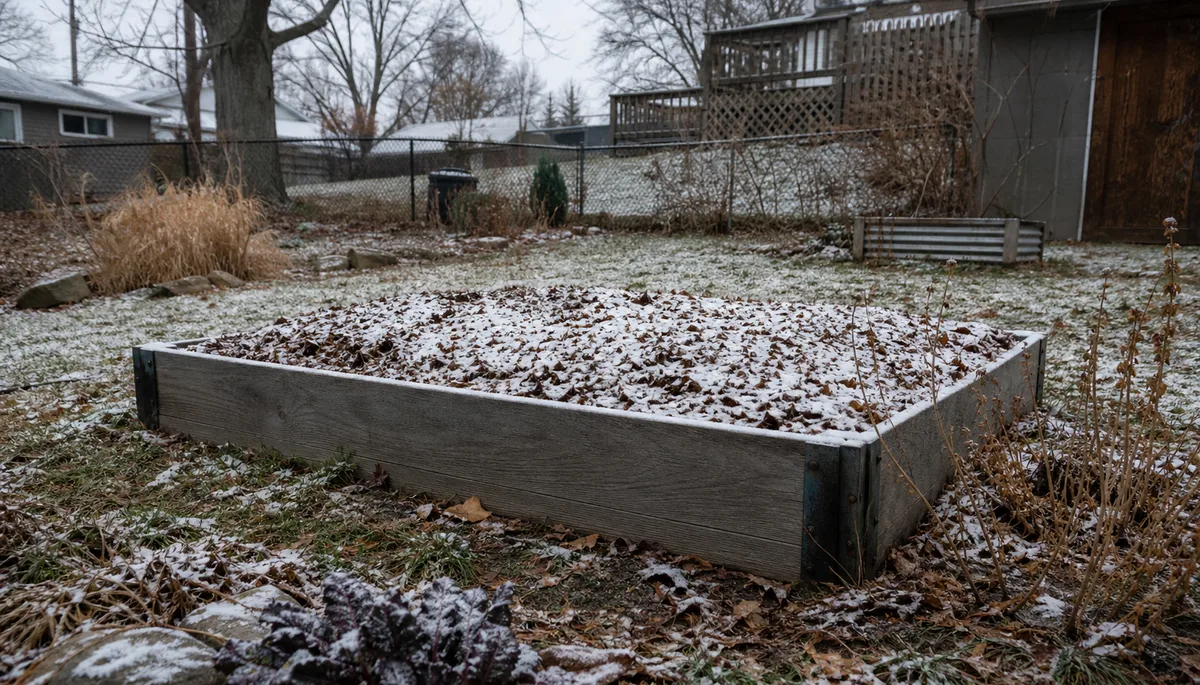 A closed garden bed under the first light snow of the season
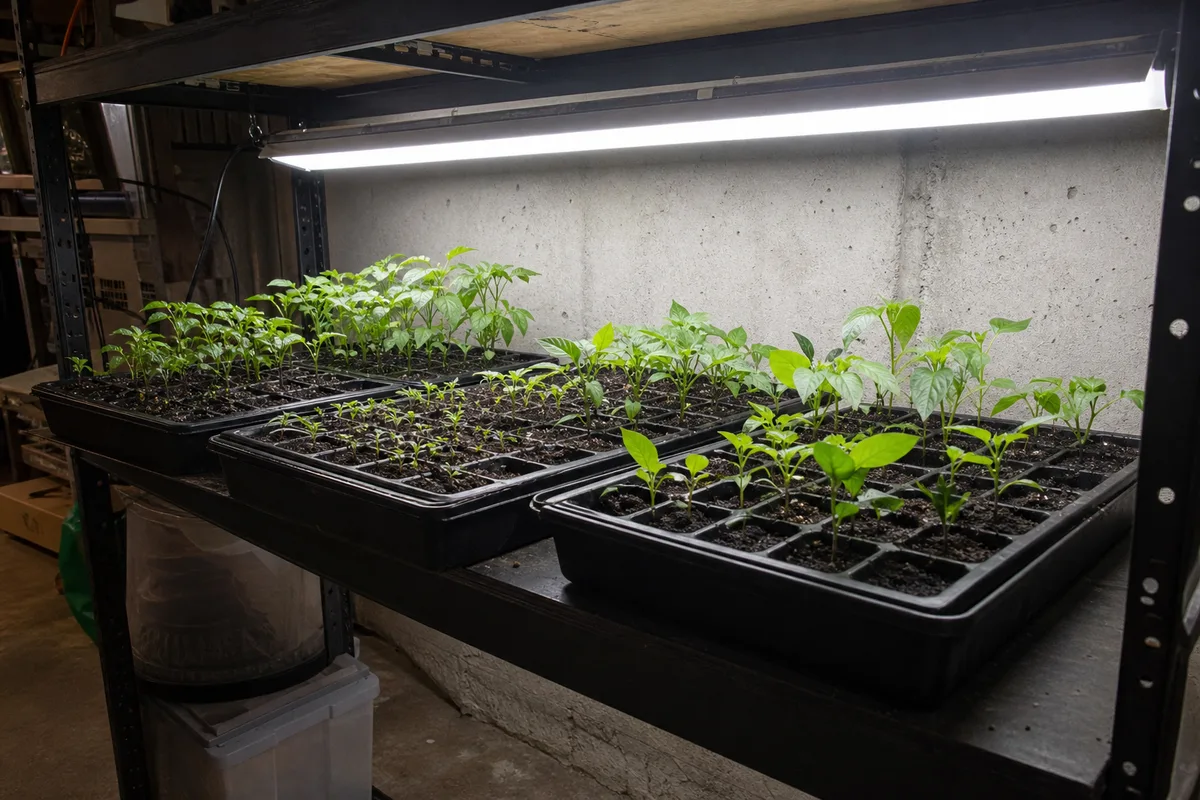
Those notes turn into next year's plan almost by themselves, and winter is when the planning happens, seed catalogs arrive in January, and the gardeners who know what disappointed them last August order better. If part of that plan is getting a head start on the season, the setup for starting seeds indoors begins on a windowsill in late winter, months before the bed wakes up.
Then you are done. The whole sequence, harvest ahead of frost, pull the sick and cut the healthy, clear the hardware, feed the surface, soak it once, cover it, write it down, fits into two or three unhurried weekends. The bed sits under its blanket doing slow chemistry until spring, the worms haul your compost down through the profile, and the first warm Saturday of March you pull back the mulch to find dark, loose, ready soil where other people find crust. That morning is when this October's work pays out, and it pays every year you repeat it.