The two most confusing garden problems look like opposites, and they often come from the same place. One gardener waters faithfully and the plants still wilt by afternoon. Another barely waters at all and the roots sit in muck and rot. Both are watering the plant when the real answer is under it. The soil decides how much of that water a root ever gets to use, and until you understand what your soil is doing with it, you are guessing.
I spent my first few seasons blaming the weather, the seeds, and, on the rougher evenings, myself, before I dug down and actually looked at what I was growing in. What I found under one bed was a gritty layer that water shot straight through, and under another was a dense grey clay that held a footprint for a week. Same yard, two completely different problems, and no amount of adjusting the hose was going to fix either one. Once I could read what the soil itself was doing, the watering questions mostly answered themselves. This is the piece I wish I had read first.
The mystery of wilting and drowning plants
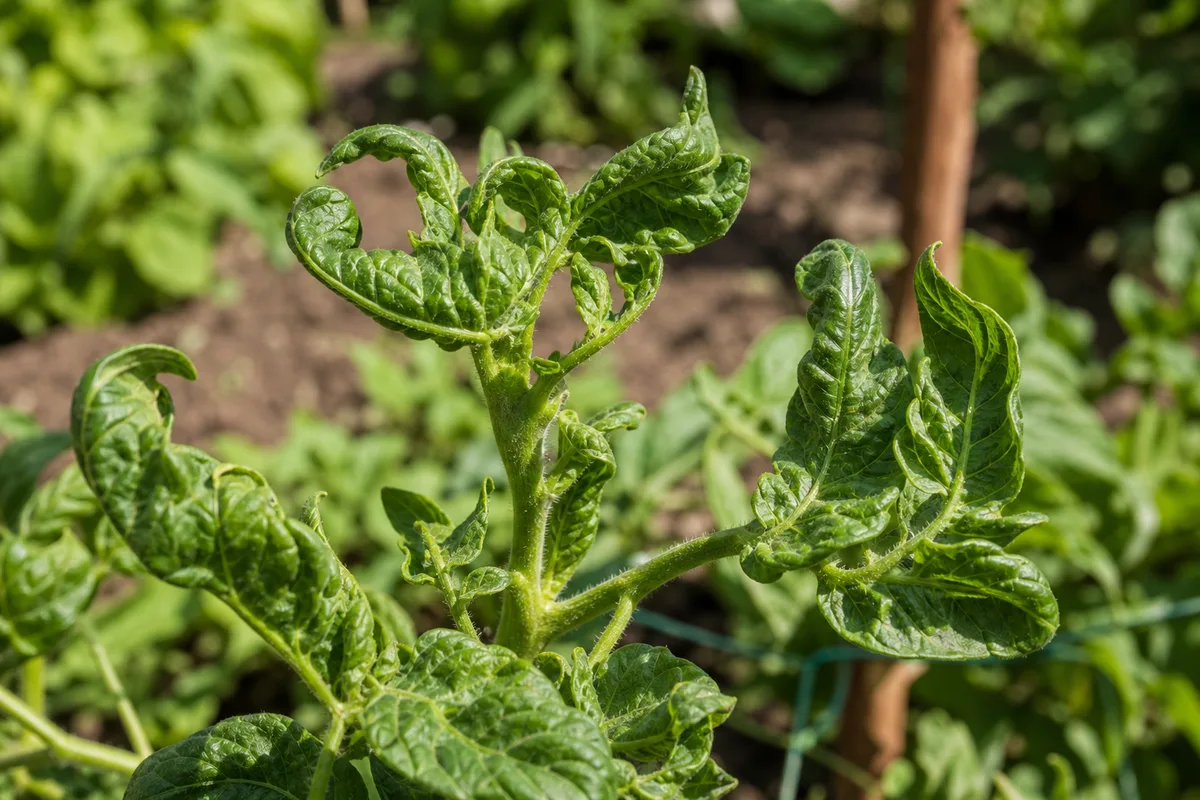
Start with the symptom, because it is the thing you can actually see. A plant wilts when its roots cannot pull in water fast enough to replace what the leaves lose. The obvious reading is "it needs more water," and sometimes that is true. But a plant in soggy, airless soil wilts in exactly the same way, because roots that are drowning stop working and cannot drink even though they are surrounded by water. So the same wilted, drooping leaf can mean too little water or too much. That is why watering by the look of the plant alone leads people in circles.
The tell is in the ground, not the leaf. Push a finger two inches into the soil next to the plant. If it comes out dry and dusty at that depth, the plant is genuinely short of water. If it comes out cool and wet and the soil smells sour or swampy, the plant is drowning and more water will finish it off. I keep a cheap wooden dowel by the beds and push it in like a cake tester; soil clings to it when there is moisture down deep, and comes out clean when it is dry. It cost nothing, it has outlasted two fancier moisture gadgets, and it settles the argument in three seconds.
The reason one garden drains too fast and the next stays soggy has almost nothing to do with how much rain fell. It has to do with the size of the mineral particles that make up the dirt and the spaces between them. That is the whole game, and it is worth understanding once, properly, so that every watering decision after it becomes obvious rather than anxious. If you are still setting up your first beds and want the wider picture of planning, timing, and what to plant, the pillar guide to starting a home garden puts this soil chapter in context; here we go deep on the ground itself.
Particle size: sand, silt, and clay
Reduced to its bones, mineral soil is broken-down rock, and the pieces come in three size classes. The names describe size, nothing else. Sand is the biggest, silt is in the middle, and clay is the smallest by a wide margin.
The scale is hard to picture until you put numbers on it. A grain of sand runs from about 0.05 up to 2 millimeters, which is big enough to see and feel individually. Silt is far smaller, roughly 0.002 to 0.05 millimeters, small enough that a pile of it feels like flour. Clay particles are smaller still, under 0.002 millimeters, so fine that thousands would fit across a single sand grain. If you scaled a clay particle up to the size of a coin, a single sand grain at the same scale would be taller than a two-story house. That difference in size is not a detail. It drives everything the soil does with water and nutrients.
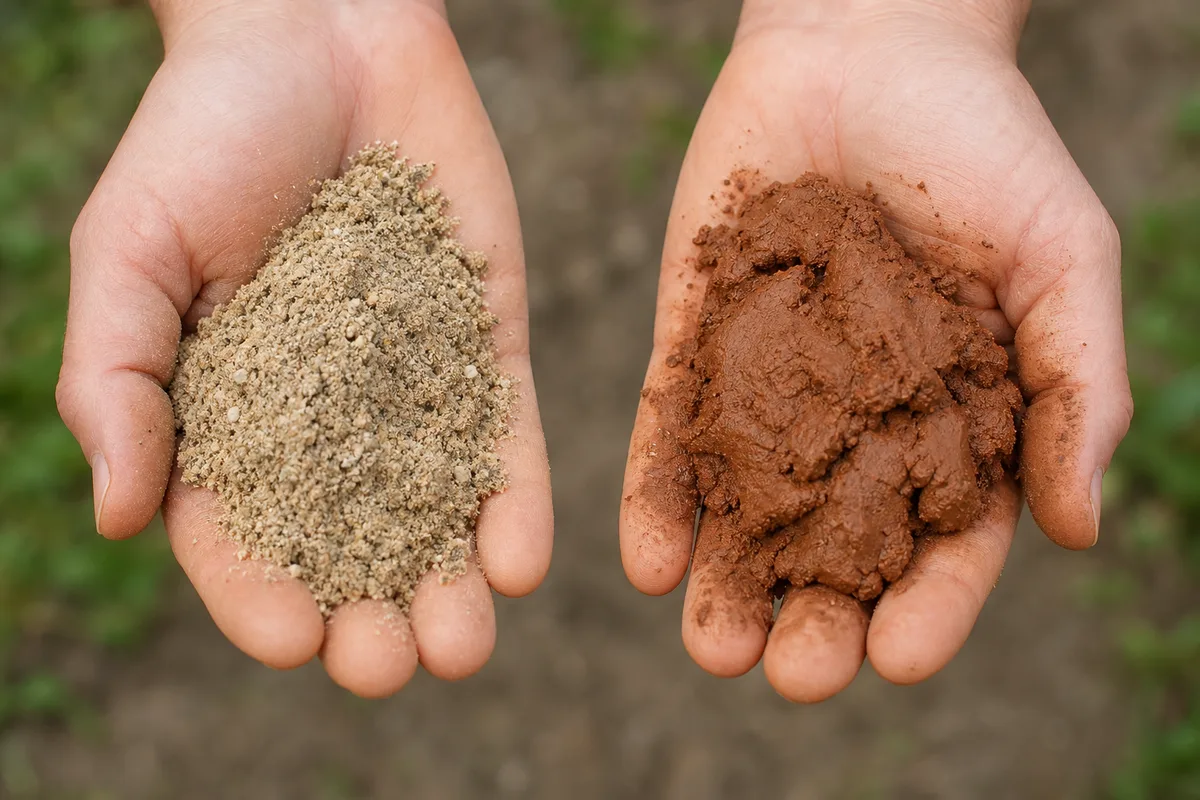 Sandy soil and clay soil compared in two hands
Two things follow from size. The first is the size of the gaps. Big sand grains stack together loosely and leave big open channels between them, like marbles in a jar. Tiny clay particles pack together tightly and leave only microscopic gaps, like flour pressed in a cup. Water runs freely through the big channels and creeps slowly through the tiny ones. The second is surface area. If you take a handful of clay and add up the surface of every particle in it, the total is enormous compared with the same handful of sand, because dividing the same volume into far smaller pieces multiplies the surface many times over. Surface area is where soil grips both water and nutrients, so clay grips a great deal and sand grips almost none.
Almost no real garden soil is purely one class. What you have is a blend, and the blend has a name called soil texture. A soil that is a comfortable mix of all three, with enough clay to hold together and enough sand to breathe, is called a loam, and it is what most amending is quietly trying to move toward. You do not need a lab to find out where you stand. You can read the blend with your hands, and I will get to exactly how in a later section.
How water actually moves through soil
Water in soil is pulled in two directions at once, and the tug-of-war between them explains nearly everything about draining and staying wet. Gravity pulls water straight down, trying to drain it away. At the same time the soil particles themselves hold onto a film of water on their surfaces, and the finer the particle, the harder it clings. In the big open pores of sandy soil, gravity wins easily and water drains right through. In the tiny pores of clay, the clinging force is strong enough to resist gravity, so water lingers.
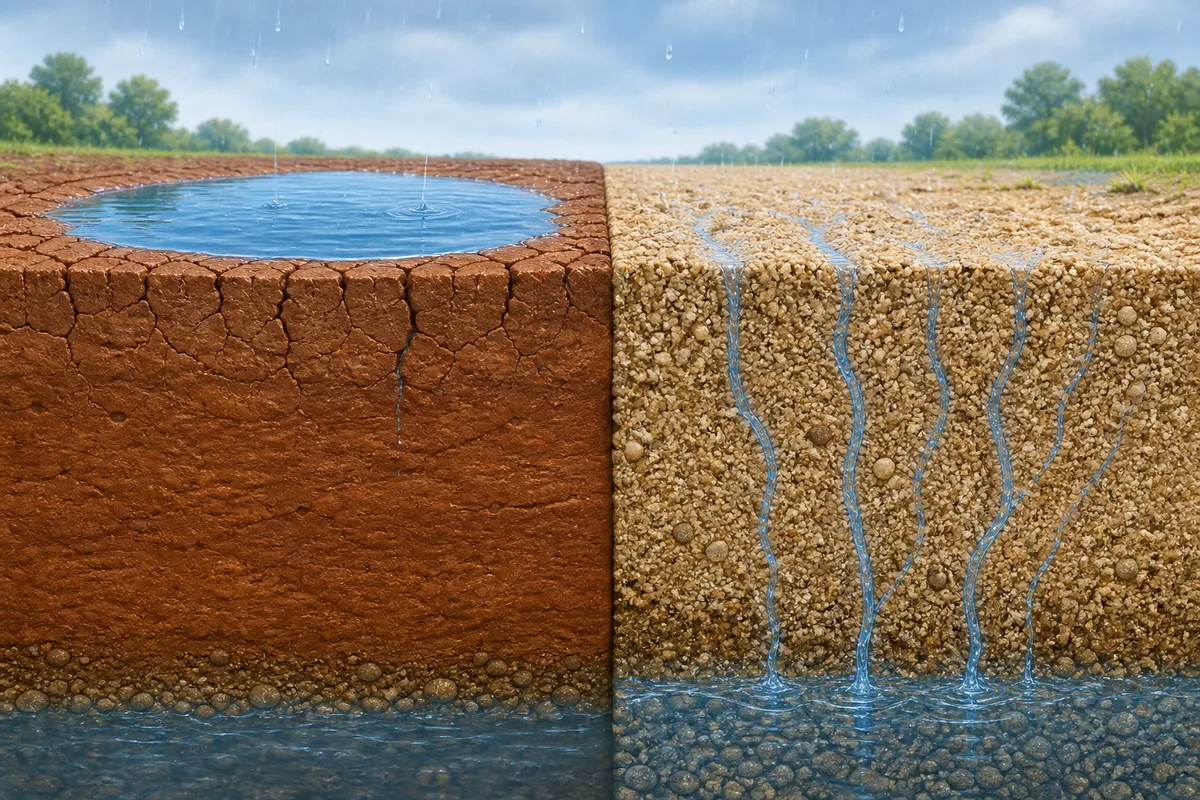 Water pooling on clay soil beside water draining through sandy soil
This is why the same inch of rain behaves so differently on different ground. On sandy soil it vanishes within minutes, sometimes so fast that the top dries out by afternoon while the water is already below the reach of shallow roots. Sand does not so much hold water as pass it along. That is why a sandy garden can be genuinely thirsty a day after a soaking; the water visited, admired the place, and kept going downward. On clay, the same inch sits on the surface in puddles, then seeps in slowly over hours and stays for days, because the fine pores release it grudgingly. Neither is broken. They are doing exactly what their particle size dictates.
There is a middle state that matters more than either extreme, and it has a name worth knowing: field capacity. After a soaking rain or a deep watering, gravity drains the biggest pores over a day or so, leaving the smaller pores still full of water that roots can drink and the drained pores full of air that roots need to breathe. That balance of water and air is the sweet spot, and a good loam holds it for days. Sandy soil blows past it in hours because it cannot retain the water. Heavy clay overshoots it because it cannot drain enough air back in, and roots sitting in fully saturated soil suffocate. The practical takeaway is that you are not really watering to wet the soil; you are watering to return it to field capacity and then letting it ride. That single reframing fixed more of my watering habits than any schedule ever did.
One more practical point. Because sand drains so fast and dries from the top, sandy soil rewards watering that is deeper and more frequent, aimed at getting moisture down where roots can chase it. Clay, which holds water long and drowns easily, rewards watering that is slower, less frequent, and patient enough to let each soak fully absorb before the next. The soil, not the calendar, sets the rhythm.
How nutrients cling, and how they wash away
Water is only half of what soil manages. The other half is nutrients, and here the same particle-size story plays out with a twist. Plants take up most of their mineral nutrients dissolved in soil water, as charged particles called ions. Many of the important ones, including potassium, calcium, magnesium, and the ammonium form of nitrogen, carry a positive charge. And the surfaces of clay particles and organic matter carry a negative charge. Opposite charges attract, so those surfaces act like tiny magnets that hold positively charged nutrients loosely on their surface, keeping them from washing straight out with the drainage water.
This holding capacity has a formal name, cation exchange capacity, but you do not need the term to use the idea. What matters is the picture: a nutrient held lightly on a clay or organic surface is parked within reach of a root, released into the soil water gradually as the plant draws it down, rather than flushed away with the first heavy rain. The more of that charged surface a soil has, the more nutrients it can stockpile and hand out slowly. Clay, with its enormous surface area, has a lot of it. Organic matter has even more per ounce. Sand has almost none.
That is the quiet reason sandy soil is so often hungry. It is not that nutrients were never there; it is that sand has almost nowhere to hold them, so every rain and every watering rinses dissolved nutrients down and out of reach, the same way it rinses the water itself. You can fertilize a pure sand and watch the effect fade within weeks, because there is nothing to catch and store what you added; it is a bit like leaving groceries out in the rain and wondering where dinner went. Feeding sandy soil in smaller, more frequent doses works far better than one big application that mostly leaches away before roots can use it.
Clay sits at the other end and this is where it earns some respect. Clay holds nutrients tenaciously, so a clay soil is often chemically rich, a genuine bank of minerals. Its problem was never fertility. Its problem is getting water, air, and roots into that tight structure so plants can actually reach the wealth that is stored there. That distinction, rich but locked up, is the key to treating clay correctly, and it points straight at the one amendment that helps both extremes at once.
The role of organic matter
If particle size is the problem you were dealt, organic matter is the lever you can actually pull. By organic matter I mean decomposed plant material, most practically compost, worked into the soil until it becomes part of it. It is the closest thing gardening has to a universal fix, because it does something almost paradoxical: it helps sandy soil hold more water, and it helps clay soil drain better. The same amendment, opposite problems, and it improves both.
The reason it works both ways comes down to structure. Organic matter is spongy and full of pores at a scale between sand and clay. Mixed into sand, it acts as a sponge among the loose grains, catching water and dissolved nutrients that would otherwise drain past, giving that thirsty soil somewhere to store moisture between waterings. Mixed into clay, it does the opposite favor: the coarse fibers wedge between the fine clay particles and prop them apart, opening up channels for water to drain and air to enter, and it feeds the soil life whose burrowing and gluing builds those channels into something lasting. It also carries a large charged surface of its own, so it boosts the nutrient-holding capacity of any soil you add it to.
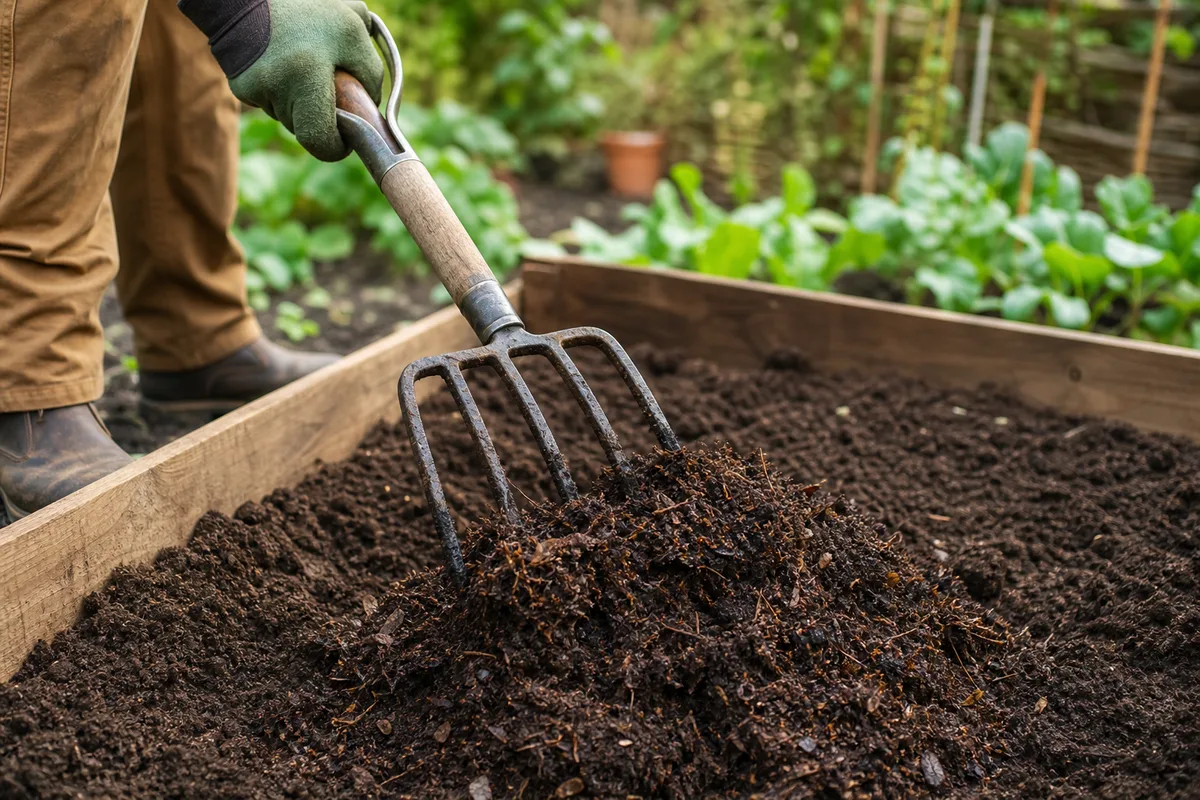 Working compost into a garden bed with a garden fork
In practice the move is to spread a couple of inches of finished compost over the bed and work it into the top six to eight inches with a fork. A couple of inches of compost worked in genuinely changes how both a sandy and a clay soil behave, and you can feel the difference within a season. It is not a one-time fix, because organic matter is constantly being consumed by soil life and has to be topped up, which is a feature rather than a flaw: the ongoing breakdown is what keeps feeding the structure. If you want to understand what is actually happening inside that compost and why some piles turn to crumbly black gold while others just sit, the companion piece on how compost breaks down walks through the microbial side of it.
The honest limit is time and quantity. Organic matter improves soil gradually, over seasons of steady addition, not in a single dramatic weekend. And you need a real amount to move heavy clay; a token sprinkle does little. Adding compost yearly and never removing all the plant residue is how soil slowly gets better on its own, which is the long game worth playing.
Reading your own soil by feel
You can send soil to a lab, and for pH and specific nutrient levels that is worth doing once. But for texture, the thing that governs water and nutrients, your hands are a genuinely good instrument, and reading soil by feel is a skill you can have in ten minutes. Field crews and soil scientists use a version of this same hand test in the field, because it is fast and reliable enough to classify soil on the spot.
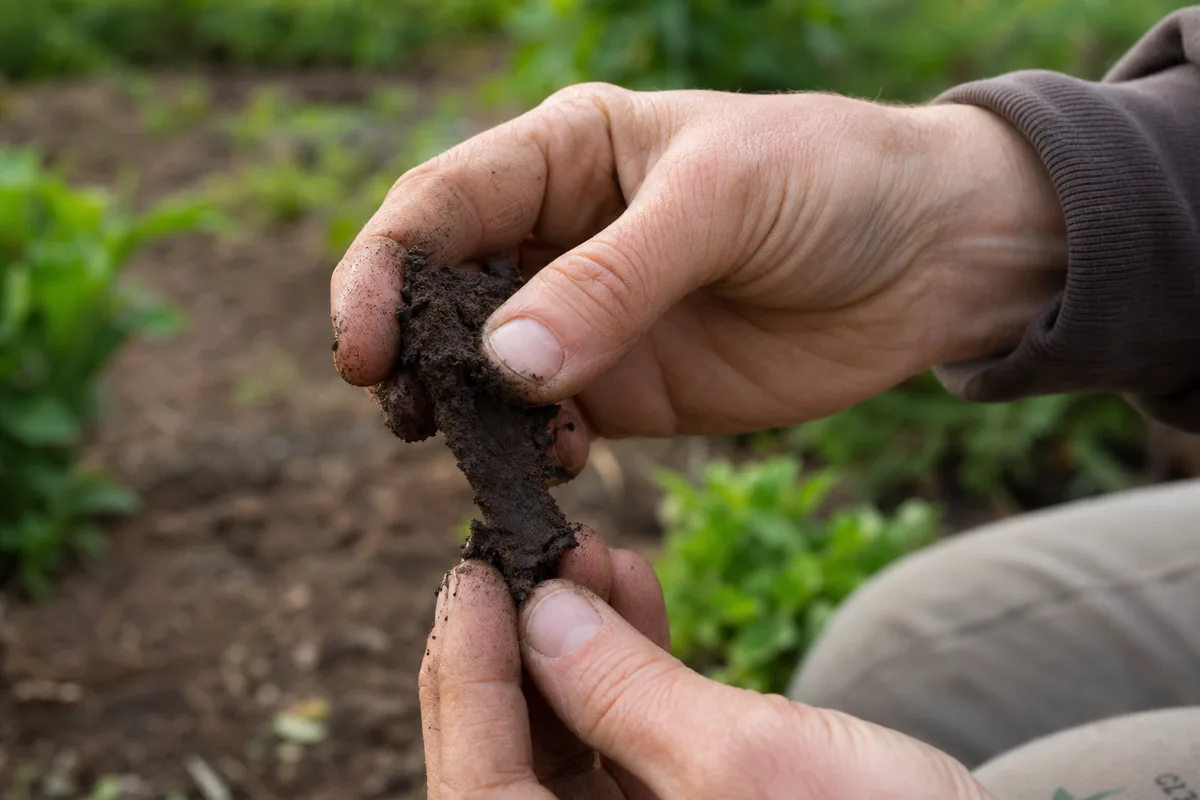
Take a small handful of soil from a few inches down, not the loose surface. Pick out any stones and roots. Wet it gradually and knead it until it is the consistency of moldable putty, moist but not dripping. Now work it in your palm and read what it tells you.
- Grittiness is sand. If the wet soil feels rough and sandy and the grains grind audibly between your fingers, there is a lot of sand in it.
- Smoothness with no grit is silt. Wet silt feels slick and floury, almost soapy, like wet flour, without the grip of clay.
- Stickiness and shine is clay. Wet clay feels sticky, molds like modeling clay, and takes a slight polish when you rub it.
Then do the ribbon test, which is the single most telling move. Squeeze the moist soil out between your thumb and forefinger, pushing it upward into a flat ribbon that hangs over the edge of your finger. A ribbon that holds together and gets long before it breaks, an inch or two of self-supporting ribbon, is clay-heavy soil, because only clay has the stickiness to hold that shape. A soil that will not ribbon at all, that crumbles into a gritty pile the moment you push it, is sandy, because there is not enough clay to bind it. Something in between, a short ribbon of an inch or less that breaks under its own weight, is a loam, which is what you are hoping to find or build toward. Clay ribbons and sand crumbles, and each one needs the opposite fix: clay needs opening up, sand needs bulking out, and organic matter does both.
Do this test in a few spots around the yard, not just one. My own garden read as three different soils within thirty feet, which explained why the same watering routine drowned one bed and starved another, and why I had spent a season convinced the plants were just being difficult. Reading each bed on its own terms was the thing that finally made watering make sense.
Fixing the soil you actually have
Once you can name what you are working with, the fix follows directly, and it is less dramatic than most people expect. The goal is never to replace your soil. It is to nudge it toward that comfortable loam middle where water drains but not too fast, and nutrients stay within reach.
For sandy soil that drains too fast and stays hungry, the fix is to add water-holding, nutrient-holding body, and that means organic matter, generously and repeatedly. Compost is the workhorse. Work in a couple of inches each season and keep the surface covered with mulch so the top does not bake dry and so the organic matter breaks down into the soil rather than blowing off. Because sand cannot store nutrients well even improved, lean toward feeding little and often rather than one heavy dose. Do not bother trying to add clay to sand; the amounts required are impractical and organic matter gives you most of the same benefit without the risk.
For clay soil that stays soggy and compacts, the instinct many gardeners have is to add sand to loosen it, and this is the one mistake I want to stop you from making. Mixing a modest amount of sand into clay without a large amount of organic matter can set up something close to concrete, because you fill the fine clay gaps with sand grains and cement the whole thing tighter rather than looser. Ask me how I know, or rather do not, because the clay only got harder and the shovel took it personally. Clay is not poor soil; it is slow soil, rich in held nutrients but starved of structure. The right fix is organic matter, the same compost, worked in to prop the clay particles apart and feed the soil life that builds lasting channels. Raised beds and avoiding walking on wet clay, which crushes the structure you are trying to build, both help. Clay rewards patience more than any other soil, and it is worth the wait because that stored fertility is real. The deeper, hands-on version of this, including how to break a hard pan and rebuild tilth over a season, is laid out in the guide to fixing compacted clay soil.
For soil that is already close to loam, the job is maintenance: top up organic matter yearly, mulch to protect the surface, disturb it as little as you can, and let the worms and roots do the structural work. Good soil is not a state you reach once; it is a balance you keep.
A few honest limits are worth stating plainly. None of this changes soil overnight; think in seasons, not weekends. Amending improves the top layer you can reach with a fork, roughly the top eight inches, and does little for a hard compacted layer deeper down, which sometimes needs a broadfork or, in a bad case, raised beds built on top instead of fighting the subsoil. And if your soil stays waterlogged no matter what you add, the problem may be drainage across the whole yard rather than the soil in one bed, which is a landscaping question rather than an amending one. But for the ordinary too-fast or too-slow garden bed, the path is the same and it is not complicated: read your soil by feel, add organic matter to move it toward the middle, water to the rhythm the soil asks for rather than the calendar, and give it a season or two to answer. The plants stop wilting and drowning for no reason once the soil under them stops being a mystery.