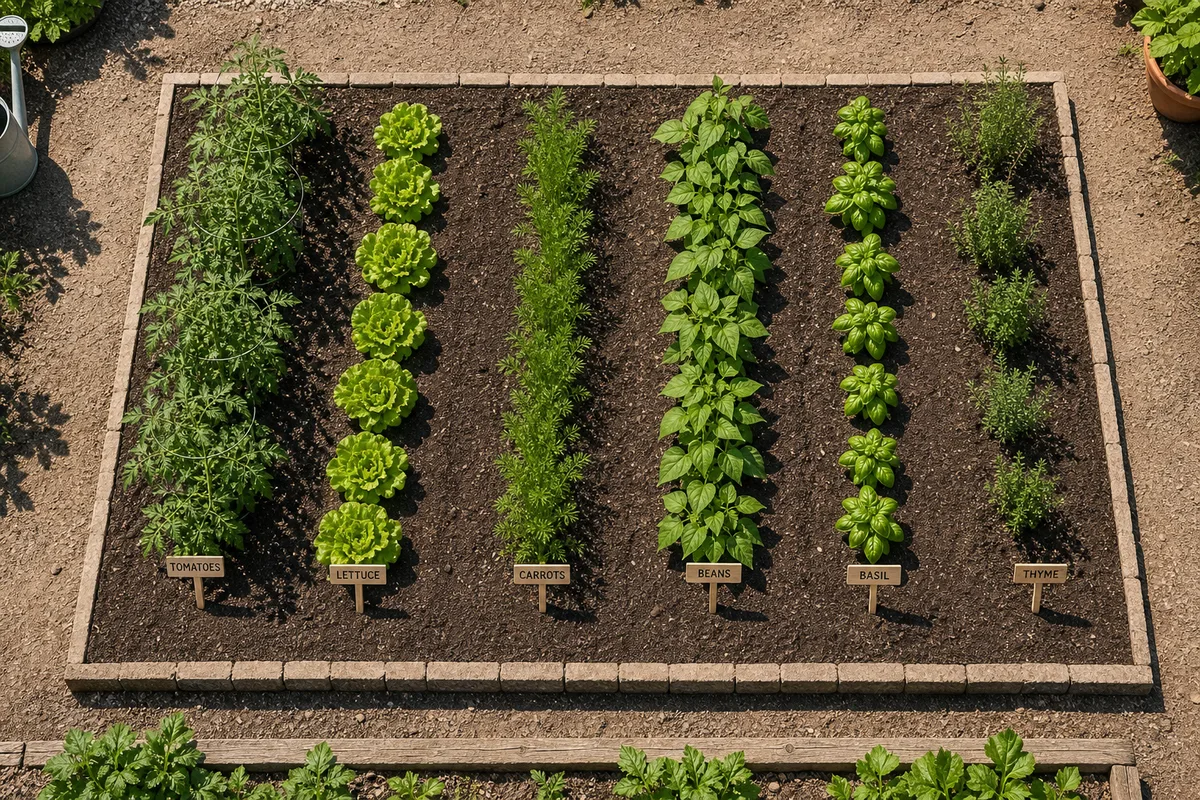
The bed that gets away from you almost always started the same way: on a warm Saturday in spring, with a stack of seed packets and a feeling that this year you would grow everything. I have done it, and I have watched a dozen neighbors do it. By late June the tomatoes have swallowed the peppers, the weeds have won the corners you never reach, and the whole thing sits there as a low-grade guilt trip every time you look out the window. The plants did not fail. The plan did. It was sized to a mood, not to a calendar.
This is a planning article, not a planting one. The goal is a vegetable bed you can keep up with from the first radish to the last frost, sized to the free time you actually have on an ordinary week, not the burst of energy you feel the day you buy seeds. If you have never built a plot before and want the whole first-season arc, start with the complete first-season garden guide and come back here when you are ready to draw a bed. What follows is the counter to over-planting: map your sun honestly, do the arithmetic on your own hours, and space things so the bed fills in instead of choking itself out.
Start from your weekly time budget
Every good bed plan I have made started with a number that has nothing to do with plants: how many minutes a week I will genuinely spend out there once the newness wears off. Not the peak weekend in May when planting is fun. The random Tuesday in July when it is hot, you are tired, and the bed still needs water, weeding, and a look for pests. That Tuesday is the real test of your plan.
Here is the working figure I plan against. Budget roughly 20 to 30 minutes of upkeep per week for every 32 square feet of established bed. A 4-by-8-foot bed is 32 square feet, so a single bed of that size costs you about half an hour a week through the heart of the season. That is watering, pulling the weeds that got going, tying up what flopped, checking undersides of leaves, and a light harvest. Two of those beds is close to an hour. Three is an hour and a half, and now you are committing to a standing weekly appointment from May to September, one the garden fully intends to keep whether or not you do.
The number climbs as the season peaks. A bed in April is nearly free to maintain because nothing has grown yet. The same bed in mid-July, when everything is producing and the weeds are running, is at the top of that range or past it. So plan for the peak, not the average. If you know you have about 30 focused minutes a week to give the garden, plan one 4-by-8 bed and no more. If you have an hour, you can consider two, but I would still start with one your first year and expand only after you have proven to yourself you actually show up.
Be honest about the season's shape
Your available time is not flat, and neither is the garden's demand. The two curves usually collide in July and August, exactly when many people also travel. If you will be away for a week in summer, that is not a footnote, it is a design constraint. A bed of leafy greens and herbs forgives a neglectful week far better than a bed of thirsty tomatoes and squash in fruit. Decide who waters when you are gone before you decide what to plant, because "I'll figure it out" is how a good bed cooks in a heat wave.
There is also a startup cost that hides in the planning stage. The first two or three weeks after planting are the most demanding of the whole season, even though the plants are tiny, because new transplants and just-sprouted seeds need watering nearly every day until their roots reach down. That early stretch is the opposite of the low-effort April I described, so if your calendar is jammed the month you would plant, that is a reason to shift your start by a couple of weeks rather than to plant on schedule and then miss the waterings that matter most. A bed set up during a calm week gets its roots down and then coasts; a bed rushed in during a busy one often never establishes.
Mapping sun across the real season
Sunlight is the one input you cannot buy or add later, so it decides the plan more than soil, water, or ambition. The mistake almost everyone makes is judging sun on the day they happen to be standing in the yard, usually a bright afternoon in early spring when the trees are still bare and the sun sits low and to the south. That reading lies to you, cheerfully and with total confidence.
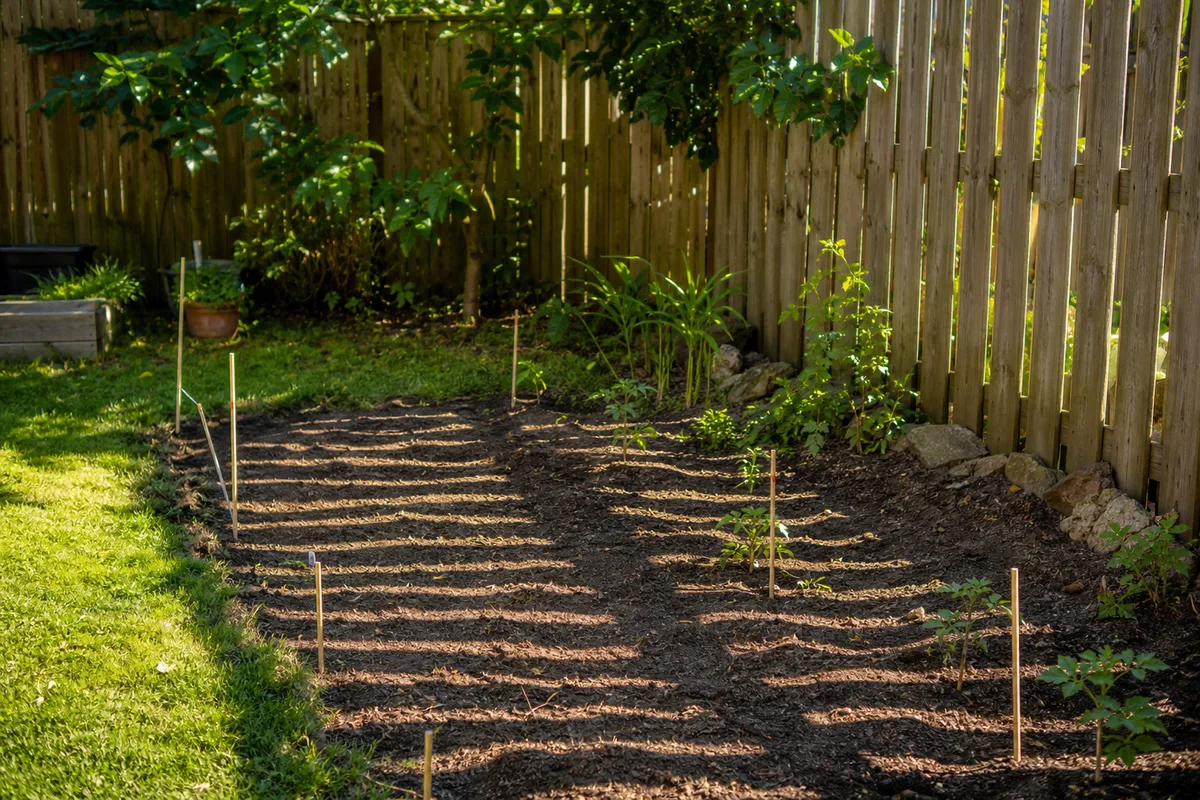 A backyard garden area showing shade cast by a fence
Sun moves across the season, and it moves a lot. A spot that is shaded by a neighbor's fence or a leafed-out maple in April can bake by July as the sun climbs higher and swings farther north at your latitude. The reverse happens too: a corner that looks perfect in spring gets swallowed by shade once the deciduous trees fill in. This is why you map sun in the month you will actually plant, and ideally you note it again a month later. A single spring reading is not enough to bet a season on.
The practical way to do this without any tools: pick a clear day near your planting date and check the future bed spot every hour or two from mid-morning to late afternoon. Jot down "sun" or "shade" and the time. Add it up at the end of the day. Most vegetables that fruit, meaning tomatoes, peppers, squash, beans, and cucumbers, want six or more hours of direct sun. Leafy crops like lettuce, spinach, kale, and most herbs get by on four, and in a hot climate they actually prefer some afternoon shade so they do not bolt. If your best available spot gets four hours, that is not a failure, it just tells you what to grow there. Plan the crop list to the light, never the other way around.
Watch what casts the shadow
Note whether the shade comes from something permanent or something seasonal. A fence, a shed, or the house itself throws the same shadow every year, so you can plan around it for good. A young tree throws a shadow that grows with it, so a bed that gets seven hours today may get five in three years (the tree is in no hurry, and neither is the shade). Afternoon sun also runs hotter and harsher than morning sun, so a spot with morning light and afternoon shade behaves gentler than the raw hour count suggests. If you want the full mechanism behind why light placement matters this much, how plants use sunlight goes deeper, but for planning purposes the hour count and the direction are enough.
Sizing the bed to the hours you have
Now you multiply the two numbers you just found. You have a weekly time budget in minutes and an upkeep cost of about 20 to 30 minutes per 32 square feet. Divide, and you get your maximum square footage. Thirty minutes a week means one 4-by-8 bed. An hour means up to two, though I would round down for a first year. This is arithmetic, and it is deliberately unromantic, because romance is what got the old bed overgrown.
I favor the 4-by-8 dimension for a reason beyond the math. Four feet is about the widest a bed can be while you still reach the center from either side without stepping in. The moment you step into a bed to reach the middle, you compact the soil you worked to loosen, and compacted soil sheds water and starves roots. So width is capped by your arm's reach at roughly four feet whether the bed is raised or dug in the ground. Length is flexible; eight feet is just a convenient span of lumber and a distance you can walk around without it feeling like a chore.
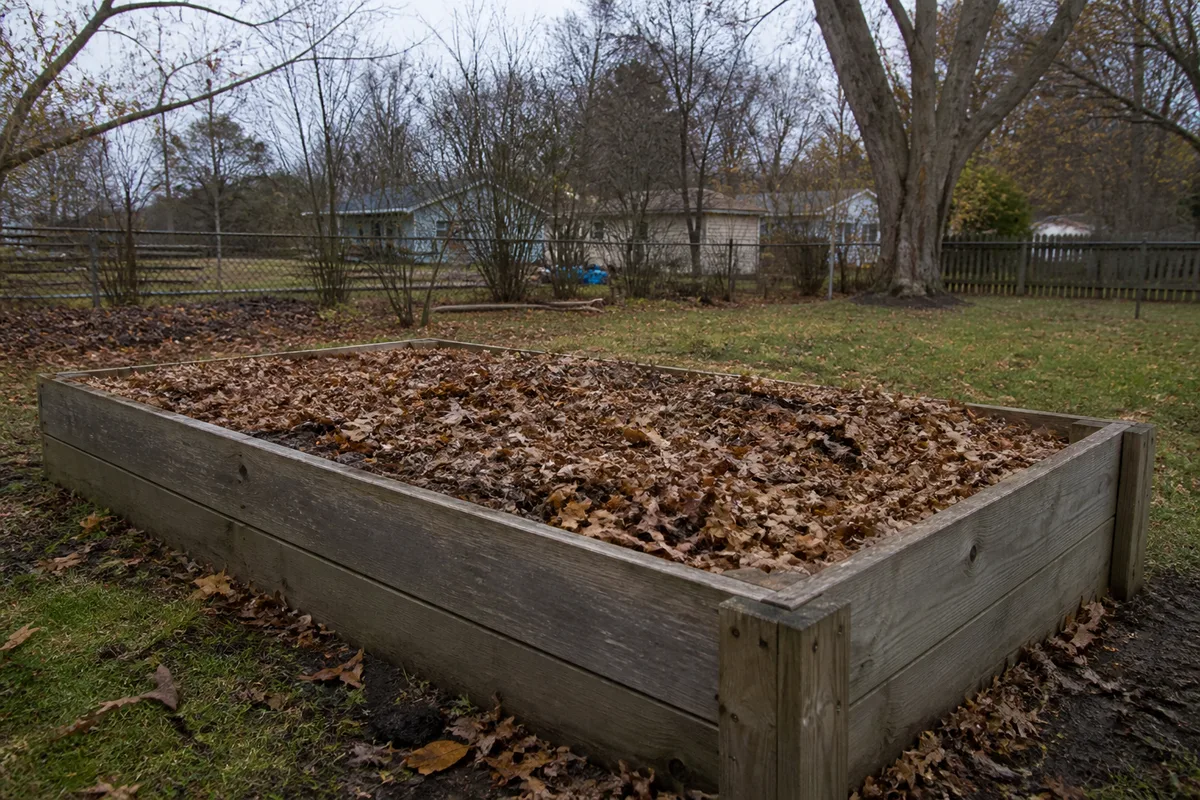
Depth matters less for planning than people think, but it interacts with your effort. A raised bed you fill with good soil lets you skip the labor of improving hard native ground, which can be the difference between a plan you follow and one you abandon in the digging. If you are leaning that way, the guide on building a raised garden bed covers wood choice and the layered fill that keeps the cost down. If you are planting straight into the ground, the size math is identical; you just trade dollars for digging.
Smaller and finished beats bigger and abandoned
If the arithmetic tells you one bed and every instinct says three, listen to the arithmetic. A single 4-by-8 bed with five crops, fully tended, produces more actual food than four beds gone to weeds by midsummer. The overgrown beds do not just underproduce; they demand more of your dwindling motivation, because a jungle is discouraging to walk up to. A tidy small bed pulls you back out there. Momentum is a real input, and a right-sized bed protects it.
Choosing crops that match your commitment
Crops are not equal in the demands they make on you, and matching them to your realistic effort is half of keeping a bed alive. I sort candidates into three rough buckets before anything goes on the plan.
The forgiving crops tolerate a missed watering and shrug off a week of neglect: bush beans, chard, kale, leaf lettuce cut as you go, and hardy herbs like thyme, oregano, and sage. If your time is tight or unreliable, weight the bed toward these. They also tend to produce over a long window rather than all at once, which spreads your harvest work out instead of dumping it on one overwhelming weekend.
The moderate crops want steadier attention but pay it back well: bush tomatoes, peppers, cucumbers on a short trellis, and zucchini. These need consistent water and a look every few days once they fruit, because a cucumber or zucchini goes from perfect to baseball-bat in about three days if you stop checking. They are worth growing; just know they are the ones that punish a two-week vacation.
The demanding crops I steer first-timers away from, not because they are impossible but because they eat the time budget: indeterminate tomatoes that need constant pruning and tying, sprawling winter squash that overruns a small bed, and anything that needs daily fussing. A demanding crop in a bed sized for casual upkeep is how the whole plan tips over. Save them for a year when you have proven your hours.
Pick around five crops for a first 4-by-8 bed. Fewer feels too plain and you lose interest; more and the spacing gets tight and the tending fragments into too many small tasks. Five is enough variety to stay engaging and few enough to actually track, which is roughly the number I relearn every spring after ignoring it.
Match the harvest to how you eat
There is one more filter worth running before a crop makes the plan, and it has nothing to do with difficulty: will you actually use what it produces. A single zucchini plant in a good year will hand you more squash than most households can eat, week after week, until you are leaving bags of it on the neighbors' porches. Two plants is a burden. On the other end, herbs you snip a little at a time, like parsley or basil, earn their square footage every single meal and almost never overwhelm you. So weight the plan toward cut-as-you-go crops you reach for constantly and go light on the ones that arrive all at once in volumes you cannot use. A bed that feeds you is one you keep tending; a bed producing food you resent picking gets quietly abandoned by August no matter how healthy the plants look.
Spacing and layout that prevent crowding
This is the section where good plans go wrong, because correct spacing feels absurd in May. You set two tomato transplants 24 inches apart with bare dirt yawning between them, and it looks less like a garden than a very small parking lot. Plant them a foot apart to "use the space," and by July you have a shaded, airless tangle where nothing dries after a rain and every leaf is a candidate for disease.
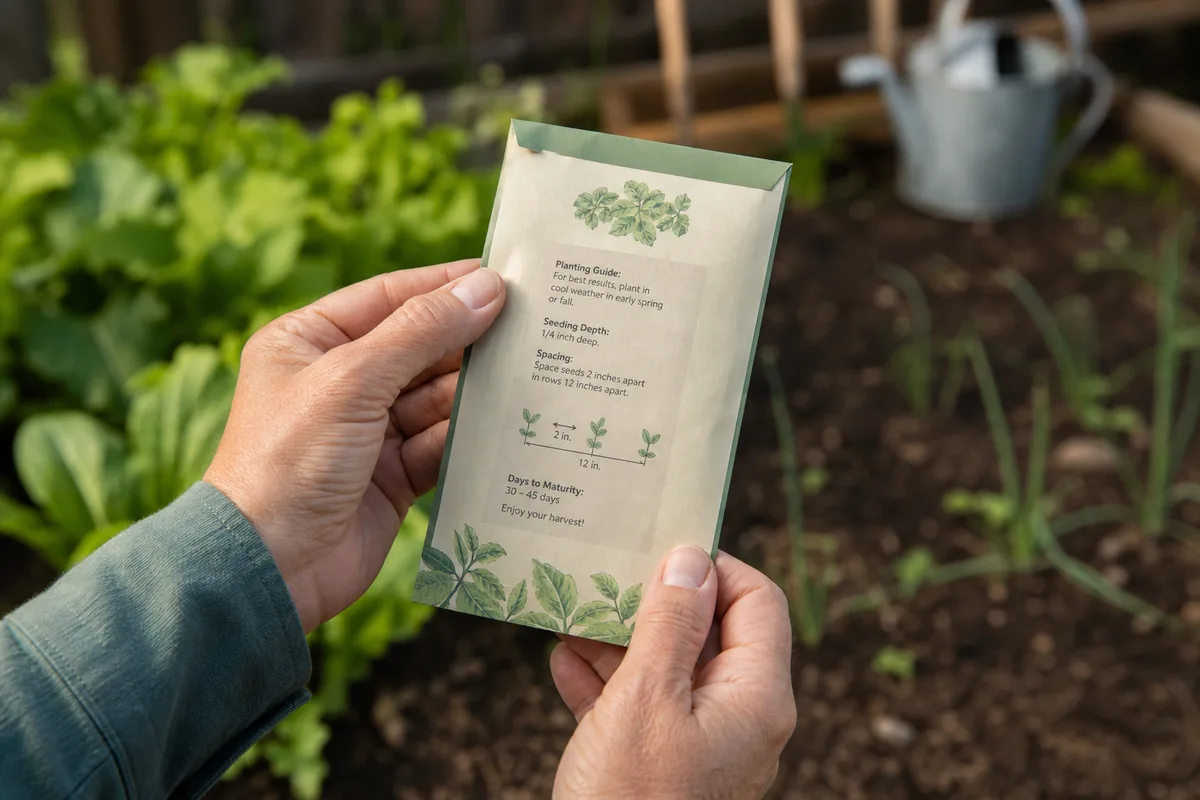 A gardener reading spacing guidance on a seed packet
Follow the seed-packet or plant-tag spacing, and follow it to the mature size, not the seedling size. The number on the packet is not a suggestion or a manufacturer padding the figure to sell more seed; it is the room the plant needs when it is full-grown, with enough airflow between plants that leaves dry quickly and light reaches the lower growth. Crowding is the single biggest cause of small, disease-prone plants in a home bed. Give a tomato its 24 inches, a pepper its 18, bush beans their 4 to 6 inches, and lettuce its 8 to 10, and the bed fills in to look full and lush right around the time it starts producing. The empty look in May is the plan working, not failing. To check how many of a crop will actually fit before you buy transplants, run your bed size through the plant spacing calculator.
Tall to the north, short to the south
Lay out the bed so tall plants do not shade short ones. In the northern hemisphere that means putting the tallest crops, trellised tomatoes or cucumbers, along the north edge, stepping down through peppers in the middle to low greens and herbs on the south side. Get this backwards and a row of tomatoes throws a wall of shade over the lettuce behind it by midsummer. Also give yourself a mental note of which crops finish early: a spring row of lettuce or radishes that bolts in the heat leaves a gap you can replant, so a smart layout keeps the quick crops where you can get at them to swap.
Group by water and reach
Cluster the thirsty crops together and the drought-tolerant ones together, so you are not forced to overwater the herbs to satisfy the cucumbers. And keep anything you harvest constantly, cutting lettuce, picking beans, snipping herbs, within easy reach of the path edge. The crops you touch daily should never be the ones you have to lean across the bed to get, or you will either stop picking them or start stepping into the soil.
Leaving room for paths and access
The part of the plan that new gardeners skip entirely is the space around and between the beds, and it is the part that decides whether tending feels easy or annoying. A bed you cannot comfortably walk around and kneel beside is a bed you will tend less, plan or no plan.
Give yourself a path of at least 18 inches between beds if you have more than one, and closer to 24 to 30 inches on at least one side if you ever want to bring in a wheelbarrow or a cart. Anything narrower and you are shuffling sideways with a watering can, knocking into plants at the edge. Around a single bed, make sure you can kneel on every side. That kneeling room is not a luxury; weeding and harvesting happen from your knees at the bed edge, and if one side backs against a fence with six inches of clearance, that side becomes the neglected side where the weeds and pests settle in and quietly make themselves at home.
Plan the water route too
Access is not only about your feet. Think about how water gets to the bed before you site it. A bed at the far end of the yard from the nearest spigot means dragging a hose or hauling cans every few days, and that friction is exactly what makes people skip waterings in a heat wave. If the convenient spot for you and the sunny spot for the plants are the same spot, you have found your bed. If they fight, weigh the sun for the plants against the honest reality that a bed you have to trek to gets watered less. Sometimes a slightly less sunny bed that sits ten steps from the tap outproduces a perfect-sun bed you keep neglecting because it is a hassle to reach.
A one-page plan you can follow
Everything above collapses into a single sheet of paper, and I genuinely draw one every year before I buy a thing. Graph paper helps because you can let one square equal six inches or a foot and the spacing draws itself to scale, so crowding shows up on paper before it happens in dirt.
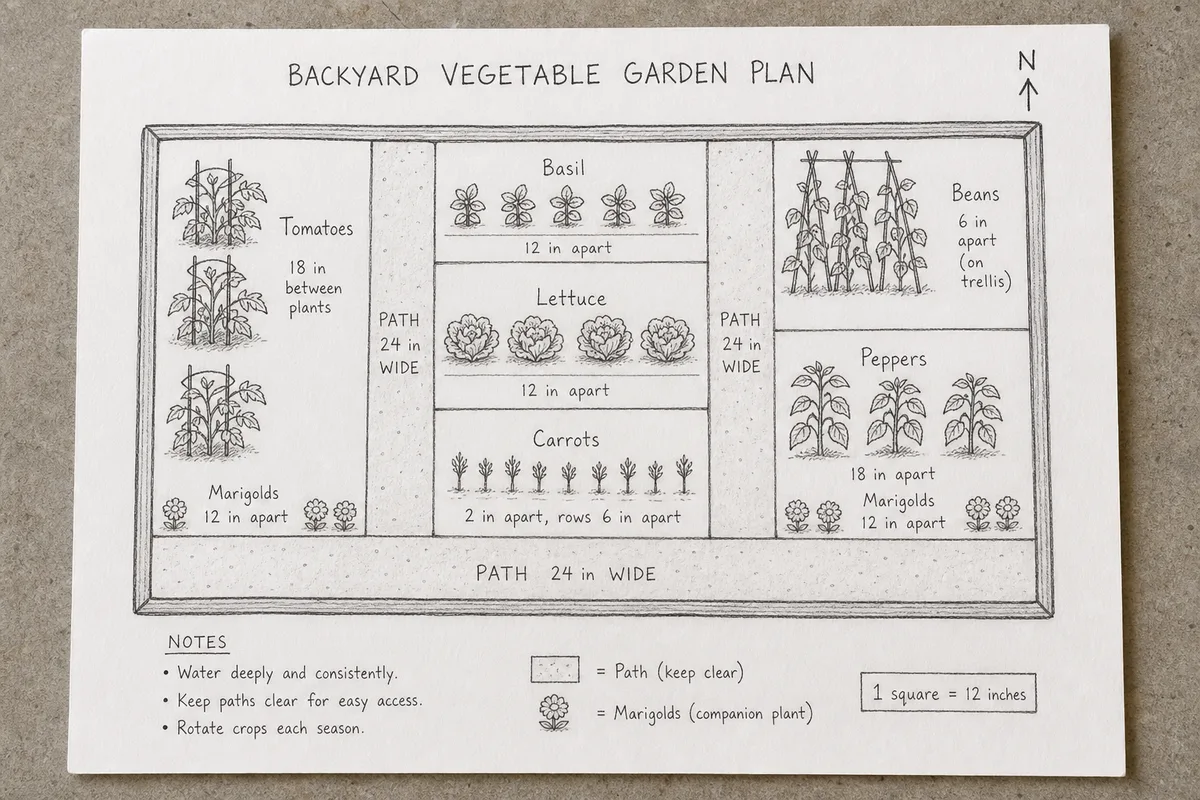 A hand-drawn vegetable bed layout with crop spacing notes
Put these on the page and you are done planning. First, the bed outline to scale, with its dimensions and its measured sun hours written in a corner so you do not forget what you observed. Second, the crops placed to scale at their mature spacing, tall crops to the north, thirsty ones grouped, quick crops near the edge. Third, the path widths marked around it, so you have confirmed you can reach every side. Fourth, a one-line note of your weekly time budget and the upkeep math, right there as a reality check against the temptation to squeeze in one more thing.
Keep the sheet. When you are standing in the store surrounded by tempting seedlings, the paper is what stops you from buying the fourth tomato variety there is no room and no time for. It also becomes next year's starting point: jot what thrived, what got crowded, and what you never got around to eating, and the following spring's plan half-writes itself. A plan that survives contact with July is worth more than the fanciest bed drawn on optimism, and the difference between them is almost always the honesty of the numbers you started with.
If your native ground is the thing fighting you rather than your time, the reason often lives in the soil itself, and understanding how soil holds water and nutrients will tell you whether your spot needs grit, compost, or just a raised bed sitting on top of the problem. But that is the next decision. The first one, the one that decides whether you are still tending this bed in August, is sizing the whole thing to the ordinary week you actually live, not the Saturday you are dreaming on.