The paw prints show up first. A dusting of them across the counter you wiped an hour ago, a single hair on the cutting board, the distinct outline of four toes in a patch of morning light. You did not see the cat do it, which is exactly the problem. By the time you notice, the cat is asleep on the couch looking like it has never committed a crime in its life, and the counter tells you it has been up there all night.
I have lived with counter-surfing cats for years, and I will tell you up front what took me too long to accept: you are not going to win this by catching the cat in the act. Shooing works only while you are standing there. The moment you leave the kitchen, or fall asleep, the counter is fair game again. The fix that actually holds is not about you being present and vigilant. It is about changing what the counter is worth to the cat when nobody is watching. This guide walks through why the counter is so appealing, why the usual tactics fail, and the environment changes that make a cat lose interest on its own.
Why the counter is irresistible
Before you can make a counter boring, you have to understand what makes it exciting, because you are competing with three separate rewards stacked on top of each other. Cats jump up for food smells, for height, and for the view, and a kitchen counter delivers all three at once. That is why it is the single most-fought-over surface in the house, and why arguing with the cat about it has never once worked; the cat considers the matter settled and is faintly puzzled that you keep bringing it up.
Start with food smells. A counter is where food gets prepared, set down, and left. Even a counter that looks clean to you is a map of scents to a cat: the ghost of last night's chicken, a smear of butter near the toaster, crumbs in the crack behind the sink. A cat's sense of smell is its primary way of reading a room, and to a nose like that, the counter is the most interesting real estate in the house. Every so often the counter also pays out for real, with a forgotten plate or a stick of butter, and that occasional jackpot is enough to keep the habit alive for months.
Then there is height. Cats are wired to seek elevated resting and watching spots. Up high, a cat can survey the room, keep an eye on doorways, and feel out of reach of anything that might bother it. In a lot of homes the counter is simply the tallest, most accessible flat surface a cat can get to. If the highest comfortable perch in your kitchen happens to be the counter, the cat is not being defiant. It is doing what its instincts tell it to do, using the best lookout available.
The view stacks on top. Counters often sit beside a window, and a window is cat television: birds, passing cars, the neighbor's dog, leaves moving. A warm patch of sun on a counter next to a bird feeder is close to the perfect cat spot. When you understand that the counter is scoring on food, height, and view all together, the whole problem reframes. You are not trying to stop one behavior. You are trying to out-compete three rewards, which means the winning move is to take those rewards away from the counter and offer them somewhere better. A counter wiped genuinely free of crumbs and a tall perch by the window solve more than any spray bottle ever will.
This same "read the reward, then redirect it" logic is the core of most cat behavior work. It is exactly how you approach clawed-up furniture, too, which is why the companion piece on why cats scratch and what it means lands on the same conclusion: change the environment, not the cat.
Why shooing and spray bottles fail
Most people fight the counter the intuitive way. You see the cat up there, you clap, you say "off," you maybe reach for a spray bottle, and the cat jumps down. It feels like it is working, because in that moment the cat is off the counter. Then it happens again the next day, and the day after, and you start to feel like the cat is either stupid or spiteful. It is neither. The tactic is the problem, not the cat.
Here is the mechanism. Shooing only teaches the cat not to jump up while you are watching. From the cat's point of view, the counter is safe and rewarding right up until a specific event occurs: you appear and make a fuss. So the cat learns the pattern precisely. It does not learn "the counter is off limits." It learns "the counter is off limits when the human is in the room and looking at me." The behavior continues the moment you leave, which is why it feels endless. You are not extinguishing the habit, you are teaching the cat to time it around your presence.
The spray bottle is worse than useless for the same reason, with an extra cost. The cat connects the unpleasant squirt not to the counter but to you. You become the thing that occasionally, unpredictably, sprays water, which is a strange reputation to build with an animal you share a couch with. That erodes the trust that makes every other part of living with a cat easier, and it still does not keep the cat off the counter when you are asleep or at work. You have paid a real price in the relationship and gotten nothing durable in return.
The general rule is that any deterrent depending on your presence will fail, because you cannot be present twenty-four hours a day, and the cat knows the difference. This is the same reason punishment-based approaches backfire across cat behavior generally. Cats do not reason about rules; they respond to what the environment does the instant they act. A consequence that only shows up when a person is around teaches the cat about the person, not about the counter. Everything that follows in this guide is built to work when you are not there, because that is the only kind of fix that lasts. The broader case for building routines and environments that run themselves is laid out in the pillar guide to everyday pet care at home.
Removing the food reward
Of the three rewards, food is the one you can attack most directly and the one that pays off fastest, so start here. The goal is to make the counter a place where nothing edible or interesting ever appears, so that the biggest, most concrete payout disappears entirely.
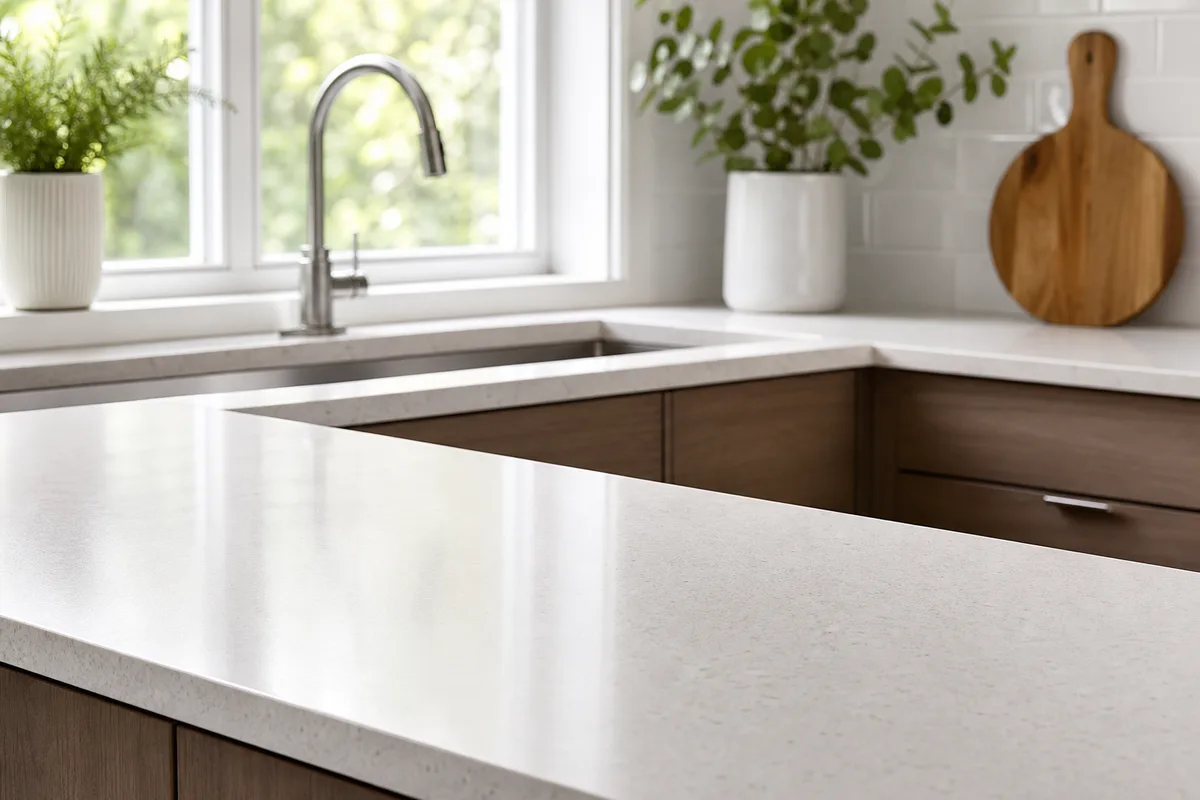 A clean, clear kitchen counter with no food left out
The obvious part is not leaving food out. No plates left overnight, no loaf of bread on the counter, no stick of butter softening in its dish, no bag of cat treats sitting where the cat can smell it. The part people miss is that "clean enough for me" is not "clean enough for a cat." The cat is running a far stricter inspection than you are, and it works for scent, not sight. A quick wipe leaves the scent of what was there, and the scent alone is enough to keep a cat checking. Wipe the counter down after cooking with something that actually cuts grease, get into the corner behind the faucet and the gap beside the stove where crumbs collect, and give it a moment to dry. The standard you are aiming for is a surface that smells like nothing, not one that looks tidy.
Watch the specific hotspots. The toaster catches crumbs underneath it, the area around the stove picks up grease spatter, and the spot beside the sink collects food rinse. These are the places a cat's nose goes first. If you have a cat that has been surfing for a while, expect it to keep checking these spots out of habit for a week or two even after they are clean, the way you might still glance at a mailbox after you have stopped expecting mail. The checking fades once the payout stays at zero.
There is one more food source that catches people off guard: the cat's own food. If you feed the cat on a schedule and it comes up short, or if the gap between meals is long enough that the cat gets genuinely hungry, the counter becomes a foraging ground and the whole project gets harder. A cat on a predictable feeding rhythm, fed at consistent times, does far less scavenging than a cat that never quite knows when the next meal lands. You do not need to overfeed. You need the timing to be dependable enough that the cat is not hunting the kitchen out of uncertainty. The checkpoint for this section: for a solid week, there is nothing on the counter, ever, that rewards a jump. If the cat jumps up and finds nothing, every single time, you have pulled out the strongest of the three legs holding the habit up.
Offering a better height nearby
Removing the food gets you partway, but a cat still wants height and a view, and if you take away the counter without replacing what it offered, you have created a vacuum. The cat will either keep trying the counter out of sheer lack of alternatives or move to the top of the fridge. The fix is not just subtraction. You have to give the cat somewhere better to satisfy the same drives, and it has to be genuinely better from the cat's point of view, not yours.
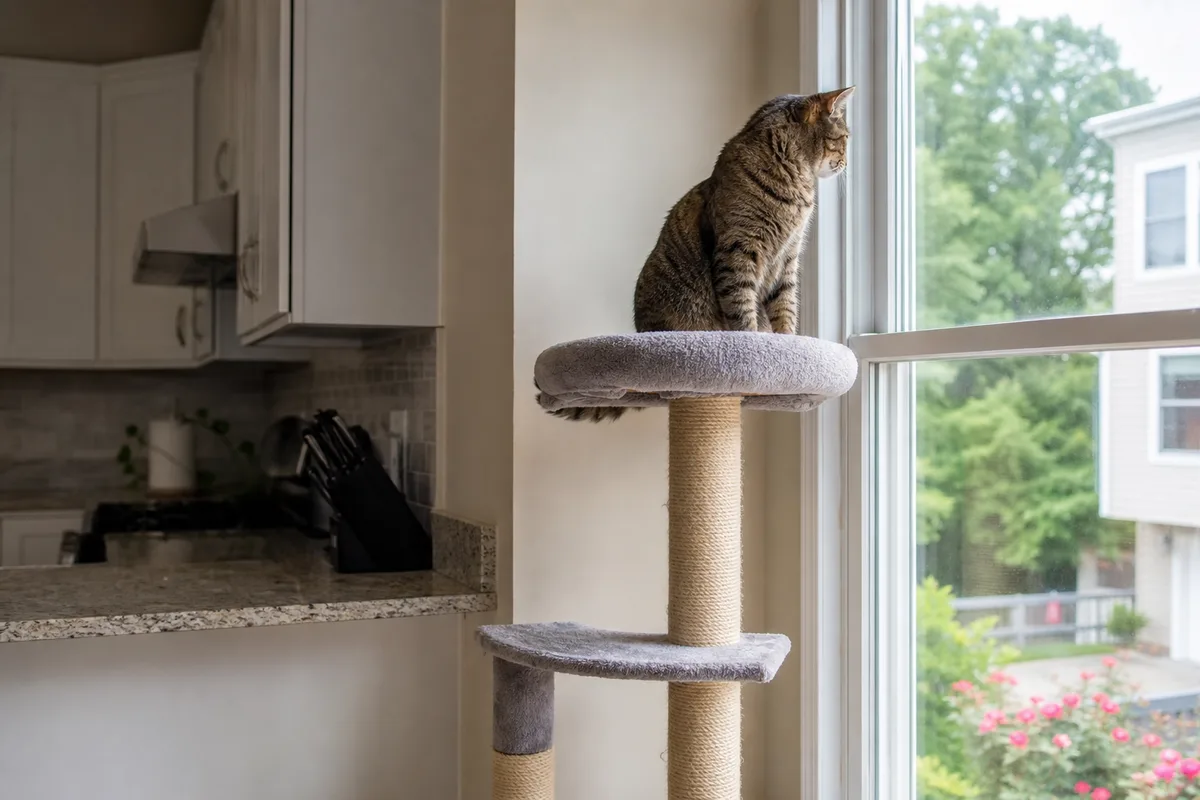
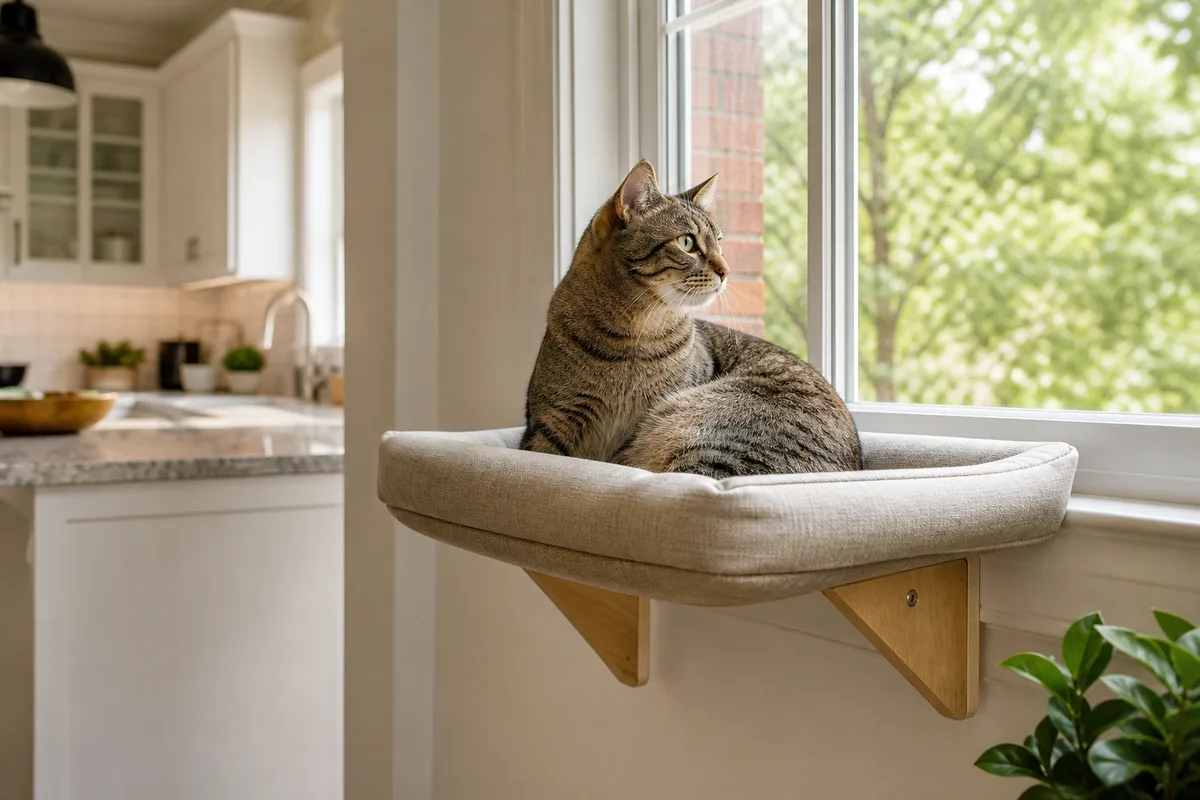 A cat resting on a window perch offered as a counter alternative
The ideal replacement is a tall perch placed near the kitchen, ideally by a window. A cat tree that reaches five or six feet, or a sturdy window perch mounted where the cat can watch the yard, hits both the height and the view rewards without the food temptation of the counter. The single most important quality is that it should be as tall as or taller than the counter. A cat weighing the two spots will pick the higher one, so if the perch tops out at chair height while the counter sits at 36 inches, you have offered a downgrade, and the cat, a careful shopper, knows it. Match or beat the counter's height and you have given the cat a reason to choose your option.
Placement matters as much as height. The perch has to be near enough to the action that the cat can still keep an eye on the kitchen and on you, because part of what a cat likes about the counter is being in the middle of things. A cat tree stuck in a spare bedroom down the hall will be ignored, the same way a scratching post gets ignored when it is tucked somewhere the cat never chooses to be. Put the perch where the cat already wants to be, which is usually within sight of where the family gathers and near a window if you have one. If there is a sunny spot the cat already gravitates to, build the new perch around that spot rather than trying to relocate the cat's preferences.
Make the perch the more comfortable option, too. A soft pad, a spot that catches morning sun, a stable platform that does not wobble when the cat lands on it. Cats commit to a perch they trust not to move under them. When the cat uses the new perch, you can quietly reinforce the choice by making that the spot where good things happen, a place it gets a bit of attention or the occasional treat delivered right there, so the perch earns its own positive associations. You are not bribing the cat off the counter so much as making the alternative the obvious best seat in the house. The checkpoint here: the cat starts choosing the perch on its own, without you steering it there, which tells you the height and view rewards have successfully moved.
Making the counter surface unappealing
Now for the counter itself, and this is the piece that finally works when you are not home, because it changes what the counter does the instant the cat lands on it, with no human required. You have removed the food and offered a better perch; this step closes the gap by making the act of being on the counter mildly unpleasant on its own terms.
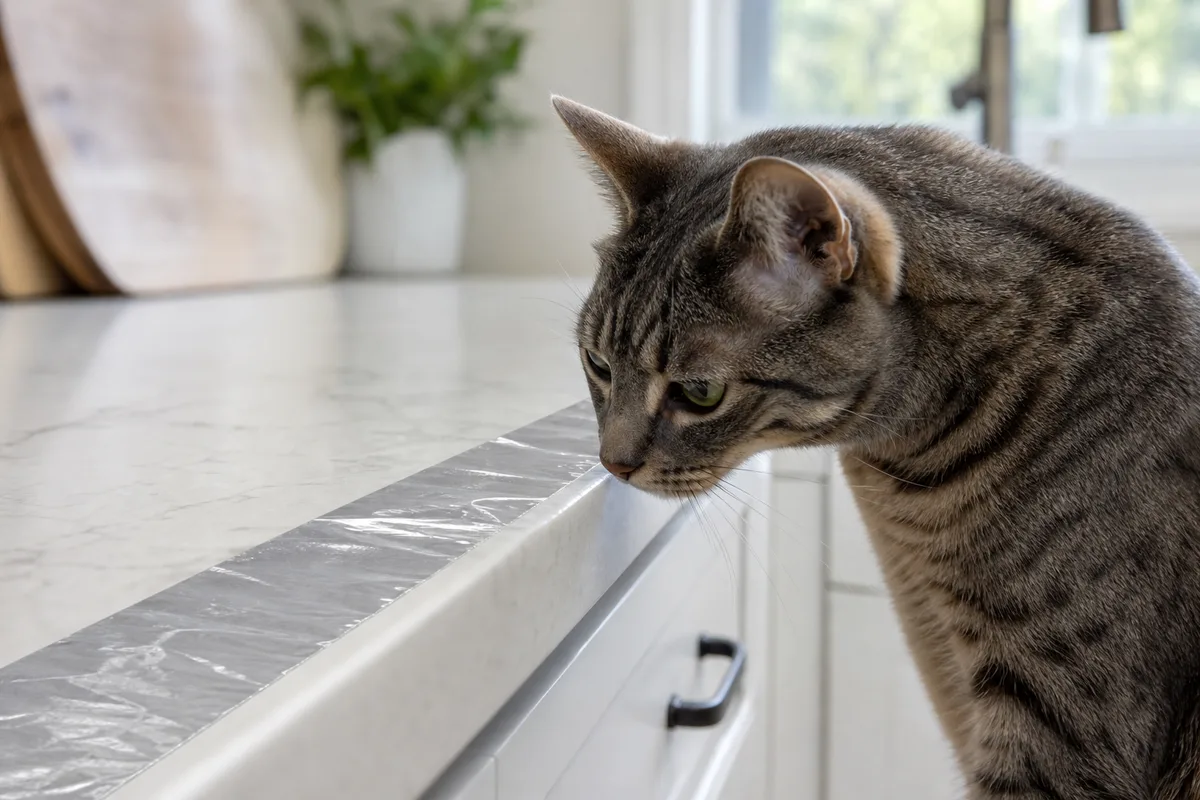 A cat investigating a counter edge lined with deterrent tape
The most reliable lever is footing. Cats dislike unstable, sticky, or crinkly surfaces under their paws, and they make a landing decision in the split second before they commit. A few options that exploit this, cheapest and simplest first:
- Low-tack tape along the counter edge. A strip of tape laid sticky-side up, or double-sided tape, along the edge where the cat jumps up. Cats hate the tacky feel on their paws and will not settle on it. Use a low-tack version so it lifts off cleanly and does not leave residue on the counter.
- A boot tray lined with foil. Set a shallow tray of aluminum foil where the cat lands. The crinkle and the shifting, unstable footing are exactly what a cat wants to avoid, and the tray is easy to pick up when you need the counter.
- Upside-down plastic carpet runner. The kind with little nubs on the underside. Flipped nub-side up along the counter, it gives an uncomfortable, prickly footing that cats avoid without it hurting them.
The point of all of these is that they act at the moment of the jump, whether or not you are in the room. The cat leaps up expecting the usual comfortable landing, meets tape or foil or nubs instead, and leaves. Nothing about it depends on you. Do this for a week or two while the food is gone and the new perch is in place, and most cats simply stop trying, because every one of the counter's rewards has been replaced by a small hassle.
A few honest cautions. This will not work if you leave gaps, because a cat will find the one stretch of bare counter and use it, so cover the whole landing zone the cat actually uses, not just a token strip. It also will not work in isolation. Deterrents on the surface while a plate of food sits three feet away just teach the cat to route around the tape to reach the reward. The surface treatment is the closer, not the whole plan. And a small number of cats are bold enough to tolerate mild footing they do not like if the reward is worth it, which is one more reason the food has to be genuinely gone first. The checkpoint: you find the deterrents undisturbed, morning after morning, with no fresh paw prints between them. That undisturbed foil is the cat telling you it tried, disliked it, and gave up.
Consistency across the whole household
Here is where more of these projects fall apart than anywhere else, and it has nothing to do with the cat. A behavior plan is only as strong as the least consistent person in the house. If you are diligently keeping the counter clear and deterred while someone else leaves a plate out, feeds the cat scraps from the counter, or lifts it up there for a cuddle, the cat learns that the counter sometimes pays out after all, and an intermittent reward is the hardest kind to extinguish. It actually makes the habit more stubborn than a reliable one would.
Cats are relentless pattern-readers. A counter that is barren and unpleasant twenty times but rewarding on the twenty-first is, to a cat, a slot machine, and slot machines are designed to keep you pulling the lever. The occasional win is enough to justify checking again and again. That is why one family member who slips undoes the work of everyone else. The plan does not need everyone to be perfect. It needs everyone to be the same, so the counter means one consistent thing.
Get the household on the same page with a short, blunt conversation and a few concrete agreements. No food left on the counter by anyone, ever, not even "just for a minute." Nobody feeds the cat from the counter or hand-delivers treats up there. Nobody lifts the cat onto the counter, even affectionately, because to the cat there is no difference between being placed there and jumping there; it is a rewarding place either way. And everyone points the cat toward the new perch instead. If you have kids, make the rules simple enough for them to follow: food goes in the cupboard or the fridge, never on the counter overnight. Building shared household habits like this is the same discipline behind any routine that sticks, and the pillar guide to everyday pet care at home makes the case that a routine everyone follows is what prevents most behavior problems before they start. The checkpoint: a week where no one in the house can remember a single counter reward, because when that is true, the cat's math stops adding up.
Weaning off the deterrents
You do not want tape and foil on your counters forever, and the good news is you should not need them. The deterrents are training wheels. Their job is to bridge the gap while the cat's habit fades and the new perch takes over, and once the habit is genuinely gone, you can pull them and reclaim your counter. The mistake is pulling them too early, before the new pattern has set, which hands the cat back its old playground and undoes weeks of work in a day.
Timing is the whole thing. Leave the deterrents in place until the cat has clearly lost interest, which usually means a stretch of two to three weeks where you see no attempts, no fresh prints, and no disturbed foil. Do not count from when you started; count from the last time the cat actually tried. If the cat made a run at the counter four days ago, the clock resets to four days, not three weeks. You are waiting for a quiet period long enough that the counter has genuinely dropped off the cat's list of interesting places.
When you do remove them, do it gradually, not all at once. Take up the foil tray but leave a strip of tape for another week. Then shorten the tape. Then remove it entirely. Each step, watch for a return of the behavior. If the cat tests the counter the day after you pull a deterrent, that is useful information, not a failure: it means the habit was not as gone as it looked, so put the deterrent back for another week or two and try again later. A brief relapse is normal and easy to handle if you catch it early, precisely because you have not dismantled the whole system yet.
Keep the two foundations in place permanently, because they are not deterrents, they are the reason the deterrents worked. The counter stays clear of food, and the perch stays where it is. Those two are cheap to maintain and they are what keeps the counter uninteresting for good. If you ever find the cat drifting back to the counter months later, the first two questions are almost always the answer: did something edible start appearing up there again, or did the perch get moved, blocked, or crowded out? Restore those and the behavior settles again without a fight. The final checkpoint: the counters are bare of deterrents, the cat is happily installed on its perch by the window, and the paw prints that started this whole thing simply stop showing up. That is the point of it all, not a cat that obeys you when you are watching, but a kitchen that has quietly stopped being worth the jump.