Most of what goes wrong with a dog or cat at home is not a training problem or a temperament problem. It is a rhythm problem. The animal does not know what happens next, so it invents its own plan, and its plan usually involves the trash, the counter, or your ankles at 5 a.m. The fix is rarely a new gadget. It is a routine steady enough that the pet stops guessing.
I have run daily care for both dogs and cats in small apartments and in houses with a yard, and the pattern holds across all of them. The households that feel calm are not the ones with the most equipment or the most patience. They are the ones where the same things happen at roughly the same times, day after day, until the pet stops testing the edges. This article lays out that routine: what to do daily, weekly, and across the seasons, and how to set up a home so the routine mostly runs itself. It stays on the owner's side of the work, the things you do, and leaves the animal's insides to your veterinarian.
What a good routine is really solving for
A routine is not about discipline for its own sake. It is solving one specific thing: uncertainty. A pet that can predict the shape of the day is a pet with less reason to be anxious, pushy, or destructive. When food, walks, play, and rest land at reliable times, the animal's nervous system gets to relax between them because it is not on alert waiting for the next event.
You see this most clearly in the problems that disappear once a routine sets in. A dog that barks at every small sound in the evening is often a dog with nothing scheduled after dinner, so it appoints itself night watchman. A cat that wakes you before dawn is usually a cat whose only meal times are random, so it treats every stir you make, every sigh, every unfortunate rollover, as a possible feeding. Give both animals a predictable pattern and the behavior fades, not because you trained it away directly, but because you removed the uncertainty that was driving it.
Predictability is the core of a calm household, and it is worth being precise about what predictable means. It does not mean rigid to the minute. It means the same sequence in the same rough windows. Breakfast comes before the morning walk. Play comes before the evening settle. The order matters more than the exact clock time, because the order is what the animal actually learns. Once the sequence is stable, you can shift the whole thing thirty minutes for a late morning and the pet stays fine, because the pattern held even though the clock moved.
The other thing a routine solves is your own decision fatigue. When the day has a shape, you are not deciding forty times whether now is a good moment to feed, walk, or play. You just follow the pattern. That is the real reason routines stick: they are easier for the human, not only calmer for the animal. Very few systems survive on the animal's gratitude alone.
The daily blocks: morning, midday, evening
I find it easier to think in three blocks than in a long list of tasks. Each block has a job, and once you know the job, the specific chores fall into place.
The morning block is about getting the animal's needs met before the day's demands start pulling at you. For a dog that means out to relieve itself first thing, then breakfast, then a real walk or a solid play session before you settle into work. Do the walk after breakfast, not before, so the dog is not dragging you around on an empty, over-eager start. For a cat, the morning is a feeding, a fresh water change, and a few minutes of play if the cat is the type that wants it. The whole morning block for one animal runs twenty to forty minutes of actual attention, and it pays for itself by producing a pet content to rest while you work, rather than one auditioning to be your coworker.
The midday block is the one people skip, and skipping it is where a lot of afternoon trouble comes from. A dog left eight or nine hours with nothing in the middle will find a way to burn the energy, and you will not like the way it chooses. If you are home, midday is a short walk or a chew and a bathroom break. If you are out, this is where a midday visit, a dog walker, or a securely arranged yard break earns its keep. Cats need less midday structure, but a scattered handful of food puzzles or a rotated toy keeps a bored indoor cat from turning your furniture into its project.
The evening block is about winding down, and it is the block that most shapes how your night goes. Feed dinner, do a proper play or walk to spend the last of the day's energy, and then deliberately lower the tempo. The mistake is playing hard right up until bedtime and expecting the animal to switch off on command, which is not a setting most pets come with. Give a wind-down window of thirty to sixty minutes between the last big activity and lights out. End the block with a five-minute evening reset: pick up the chews and toys scattered through the day, refill the water bowl, and wipe down the bowl area. That small reset is the difference between walking into a clean setup tomorrow morning and slowly letting the pet's corner slide into a chaotic zone you eventually dread dealing with.
Feeding rhythm and why timing beats fancy food
If you change one thing after reading this, make it feeding time. Owners spend enormous energy comparing foods and almost none on when the food arrives, and the timing is what the animal actually responds to day to day.
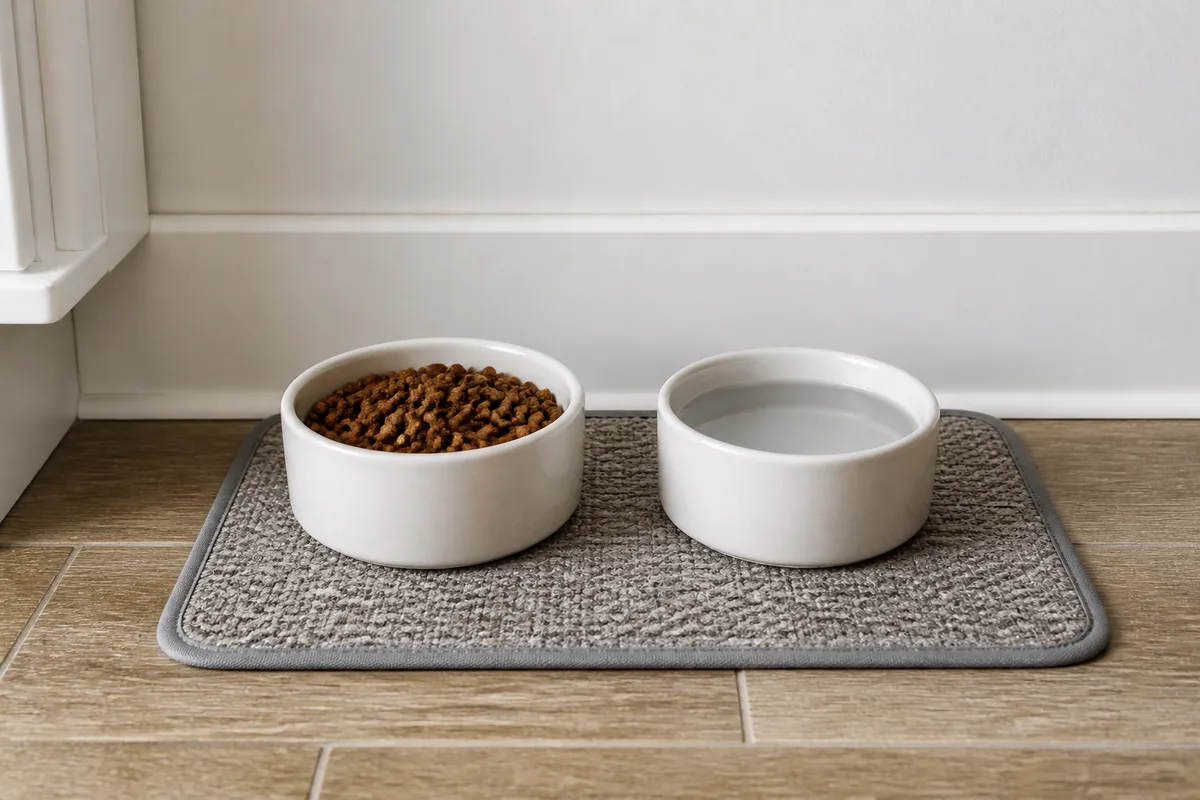 Two pet food and water bowls set up on a mat in a kitchen corner
Feed at the same two times each day, and keep each meal inside a thirty-minute window. Breakfast between 7 and 7:30, dinner between 6 and 6:30, as an example. Within about two weeks, feeding on this kind of schedule cuts most begging and counter-surfing, because the animal learns that food comes at feeding time and not by working you over between meals. A pet that knows dinner is coming at six has no reason to stalk the kitchen at four. A pet fed at random times treats every trip you make to the counter as a possible payout, and that is exactly the behavior that turns into counter-surfing and under-the-table hovering.
Two meals a day suits most adult dogs and cats. Very young animals eat more often, and that schedule is worth confirming with your vet rather than guessing, since it depends on age and size. Set meals also let you actually see how much the animal eats. Free-feeding, where a full bowl sits out all day, hides changes in appetite and, in multi-pet homes, makes it impossible to know who ate what. With set meals you learn each animal's normal, and a skipped meal becomes visible information instead of noise.
Measure the food rather than eyeballing it. A cheap dry measuring cup kept in the food bin removes the slow creep of portions that happens when you scoop by feel. The amount itself is a question for the food's guidance and your vet, since it varies with the animal, but whatever the amount, keep it consistent so meals stay predictable in size as well as timing.
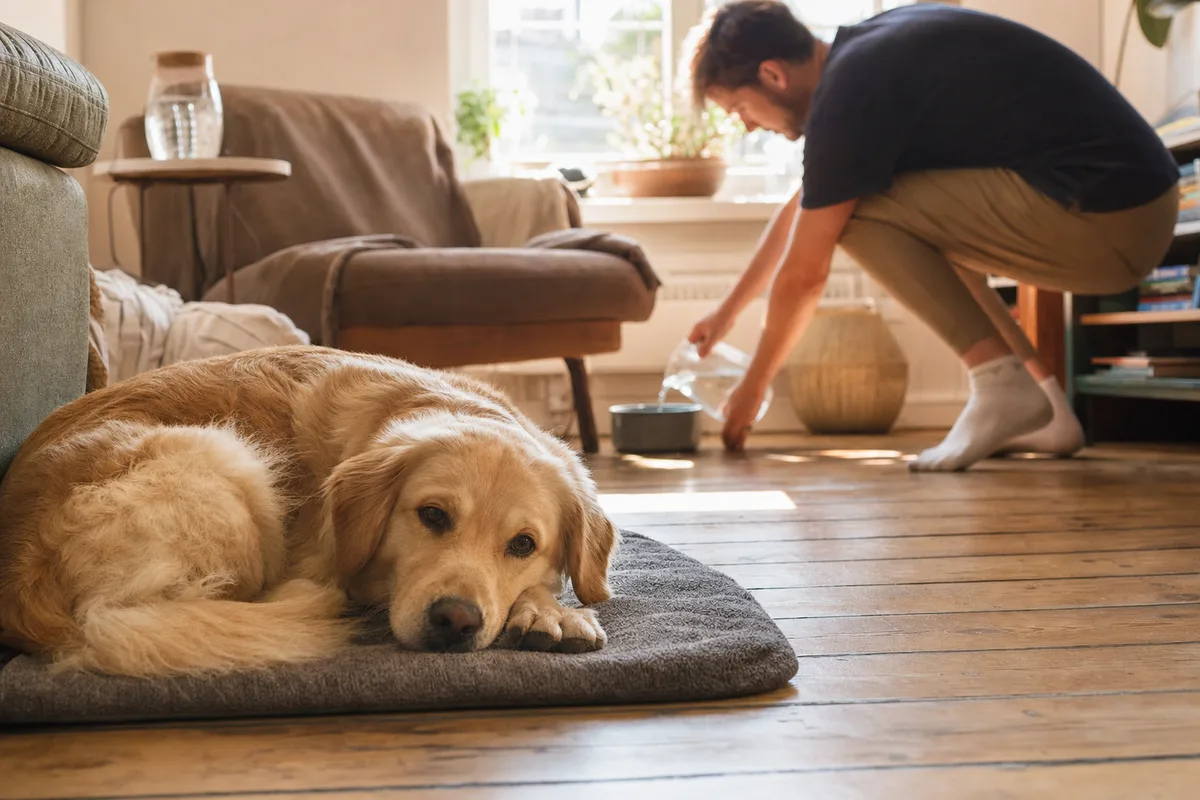
Water is the other half of the bowl station and the part people neglect. Change it daily, not when it looks low, and wash the bowl regularly since a filmy bowl is the kind of thing that quietly builds up while you are not looking. Keep the water station away from the food if you have a cat, since many cats prefer to drink at a distance from where they eat, and a separate water spot gets used more.
Movement and enrichment without a big yard
A yard helps, but it is not the thing that tires an animal out. A dog let into a fenced yard alone will often stand around, sniff for two minutes, and ask to come back in. What actually spends energy is engagement: walking with you, chasing something, working for food, solving a small problem. All of that is available in an apartment.
For dogs, the walk is the anchor, and the quality of it matters more than the distance. A twenty-minute walk where the dog is allowed to stop and sniff does more for its mind than a brisk forty-minute march where you never let it read the ground. Sniffing is how a dog gathers information, and a walk that permits it comes home as a settled dog rather than a wound-up one. If your walks are a constant tug of war, that is a training piece worth fixing on its own; a dog that walks calmly beside you turns every outing into useful decompression, and the way to get there is covered in teaching a dog to walk on a loose leash.
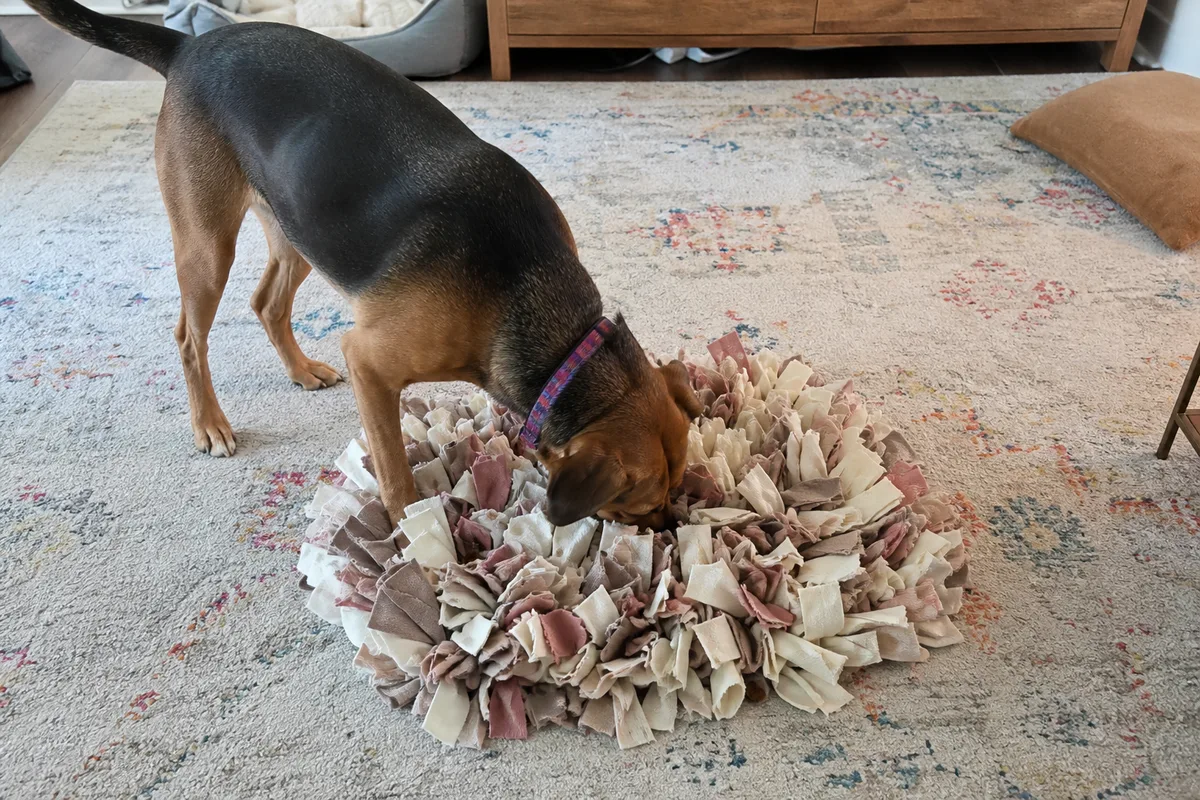
Enrichment is the indoor multiplier. Feed part of a meal out of a puzzle feeder or a rubber toy the animal has to work. Scatter kibble across a towel and let the dog nose it out. Hide a few pieces of food around a room and let a cat hunt them down. Ten minutes of this kind of work often settles an animal more than half an hour of plain fetch, because it engages the problem-solving part of the brain that plain exercise leaves untouched. If you have a dog and no yard at all, this is worth going deep on, because scent work, food puzzles, and a proper off switch spend more energy than grass ever did; wearing out a dog without a yard lays out a full routine.
 A person playing with a cat using a treat-dispensing toy on the floor
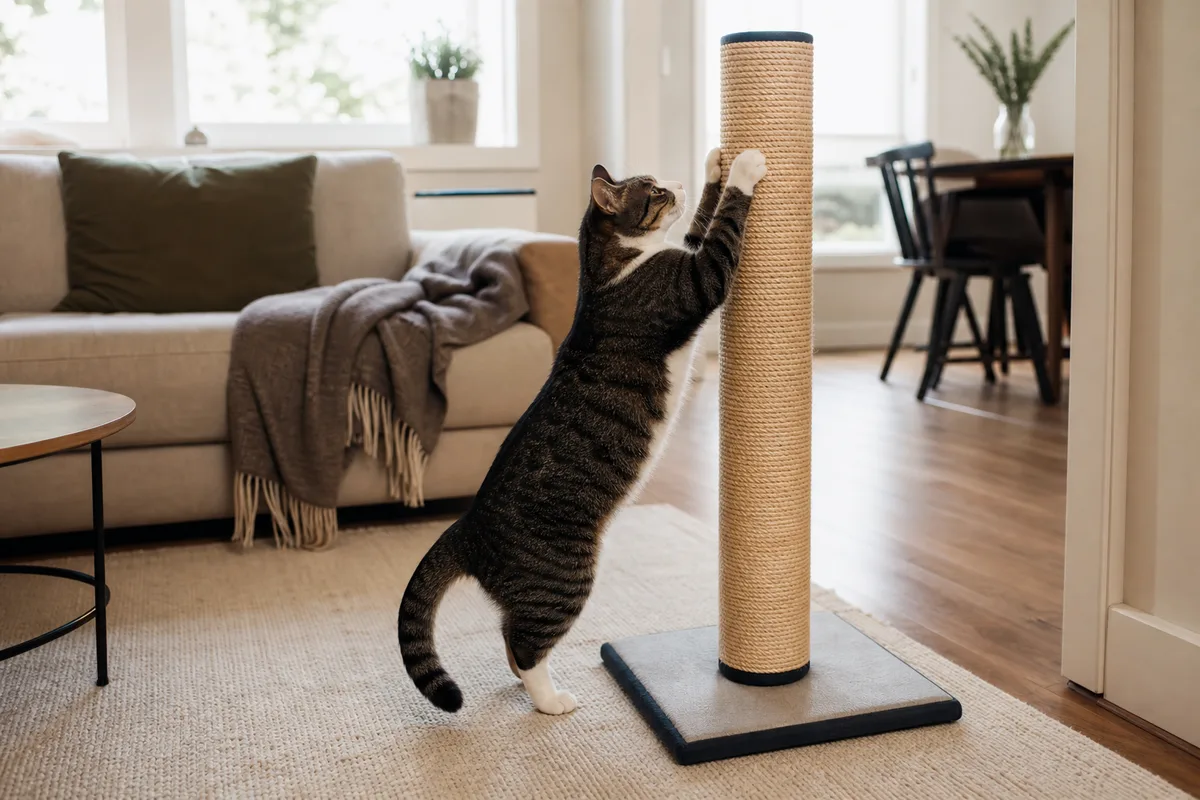
Cats need this even more than dogs, because an indoor cat has no walk to fall back on. A treat-dispensing ball the cat bats around for a few pieces of food gives it a hunt to complete, and a wand toy you move like prey for ten minutes gives it the chase-and-catch sequence it is built for. Rotate toys rather than leaving all of them out; a toy that vanishes for a week comes back interesting. Do a real play session before the cat's biggest meal, since the natural rhythm of hunt-then-eat-then-sleep is what settles a cat for the evening and cuts down on the pre-dawn wake-ups. Scratching is another built-in behavior worth giving an outlet rather than fighting, and why cats scratch and what it means explains what the cat is actually doing and how a well-placed post redirects it off your furniture.
None of this needs a big space or a big budget. The limit is not square footage. It is whether the animal gets a few short bouts of real engagement across the day, and every one of those can happen in a one-bedroom apartment.
The weekly tasks people forget
The daily rhythm carries the household, but a handful of weekly tasks keep it from slowly degrading. These are the ones that do not shout for attention, which is exactly why they get missed until they become a problem.
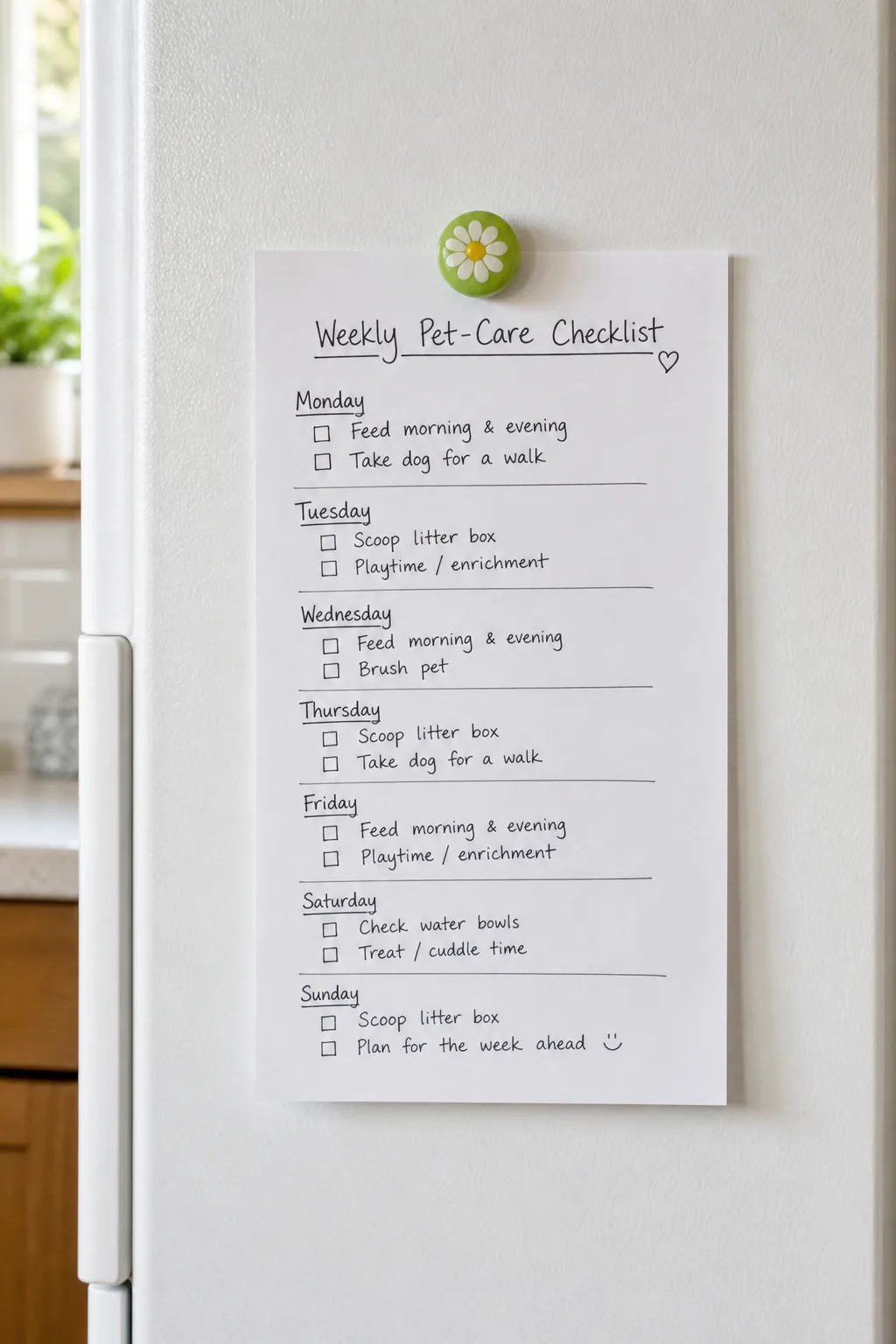 A handwritten weekly pet care checklist stuck to a refrigerator door
Grooming leads the list, and how much you do depends on the coat. A short-coated dog needs a brush-through once a week to pull loose hair before it ends up on your furniture and every dark sweater you own; a long or double coat needs several sessions a week or it mats, and a matted coat is far harder to fix than a maintained one. Cats groom themselves but still benefit from a weekly brushing, especially long-haired cats, and brushing them cuts down on the hairballs that come from swallowing loose fur. Nails are the task people avoid most; check them weekly and trim a little often rather than a lot rarely, since a small regular trim is calmer for everyone than an occasional battle. If nail trims frighten your animal, keep them short and pair them with food, since the goal is an animal that tolerates the handling, not a perfect trim in one sitting.
Cleaning is the other weekly block. Wash food and water bowls thoroughly, launder the pet's bedding, and for cats do a deeper clean of the litter box beyond the daily scooping, since a box that only ever gets scooped will eventually be refused. Vacuum the areas where hair collects. None of this is glamorous, but a household where these happen on a set day stays livable, and one where they happen "when I get to it" slowly turns into the kind of pet zone that feels out of control.
Do a weekly supply check while you are at it. Note whether food, litter, and any regular supplies are running low, so you are not making an emergency run the day you run out. Writing these tasks on a checklist stuck to the fridge is not childish; it is how a weekly routine survives a busy week. The tasks that live only in your head are the ones that get dropped.
Setting up the space so the routine runs itself
A good routine leans on a good setup. When the home is arranged so the right thing is the easy thing, you do not have to rely on willpower to keep the routine going. The physical space carries a lot of the load.
Start with fixed stations. Give the food and water bowls one permanent spot, out of the main traffic path but easy for you to reach at feeding time. Give the pet a defined rest place, a bed or a mat or a crate, in a spot that is part of the household but not in the middle of the chaos, so the animal can rest near you without being stepped over. A dog that has a clear place to settle learns to go there, and choosing a bed that holds its shape rather than flattening in a month is a small decision that pays off daily; the trade-offs there are worth a look in picking a dog bed that lasts. If a crate is the rest place you choose, especially for a dog that settles better in an enclosed den, choosing a dog crate covers sizing it right and when a crate helps. Cats want vertical options too, a perch or a cat tree, because height is where a cat feels secure and a secure cat is a calmer housemate, and giving a cat its own high spot is also the first move in keeping a cat off the kitchen counters.
Manage access on purpose. The single most common new-owner mistake is giving a pet free run of the whole house from day one. A settled pet comes from the opposite move: start the animal in a small, defined area and expand its space gradually over seven to ten days as it earns it. Baby gates and closed doors are the tools here, and they are not punishment; they shrink the world down to something the animal can handle, then let it grow. A pet that learns the house one zone at a time makes far fewer mistakes than one dropped into the whole space at once and left to figure out the rules by trial and error.
Set up for the messes you know are coming. Keep a mat under the bowls to catch spills and stray kibble. Put a bin of chews and toys where you can reach it, so redirecting a bored animal is a two-second move instead of a hunt. Keep cleaning supplies close to where accidents happen. The goal is to remove friction from the good habits, because a routine only runs itself when the correct action is the one that takes the least effort. A pet zone that resets in a couple of minutes stays clean; one that requires a project every time slowly stops getting reset at all.
Adjusting the routine for a new arrival
A new dog or cat does not walk into your routine ready-made. The first stretch is about building the routine with the animal, and the biggest error is expecting too much too soon.
Go slow on space, exactly as described above. A new arrival dropped into the full run of the house is overwhelmed, and an overwhelmed animal makes more mistakes and takes longer to settle. Start it small, keep it near you, and expand over that first week to ten days. This is the single highest-leverage thing you can do in the early days, and the full first-two-weeks arc, day by day, is laid out in bringing home a new dog.
Establish the anchors first: feeding times, a sleep spot, and a bathroom rhythm. For a puppy, the bathroom rhythm is nearly the whole job early on, and it runs on the clock more than on reading the dog, since a young puppy needs to go out on a tight schedule you set rather than waiting for a signal it cannot yet give. A workable schedule for that is the point of a puppy house-training schedule. Keep training sessions short and frequent rather than long. Name recognition and simple cues build fastest with many tiny reps folded into the day, not one long drill, and the reason short reps beat marathon sessions comes down to how the animal connects an action to its reward, which is worth understanding on its own in how dogs learn through reward timing. That same timing principle is what you fall back on when a specific cue stops working later, such as a recall the dog starts ignoring, which is walked through in rebuilding a dog that ignores "come".
Expect the routine to wobble for the first couple of weeks and do not read every stumble as a lasting problem. A new animal is learning your patterns while you learn its quirks, and that adjustment takes time. Hold the anchors steady, keep expectations modest, and let the rest settle. The households that struggle with new arrivals are usually the ones that pushed for a finished, well-behaved pet in week one; the ones that do well treated the early period as setup, not performance.
Seasonal shifts across the year
A routine is steady, but it is not frozen. The year pushes on it, and a routine that ignores the seasons ends up fighting them. A few sensible shifts keep the rhythm working across the calendar.
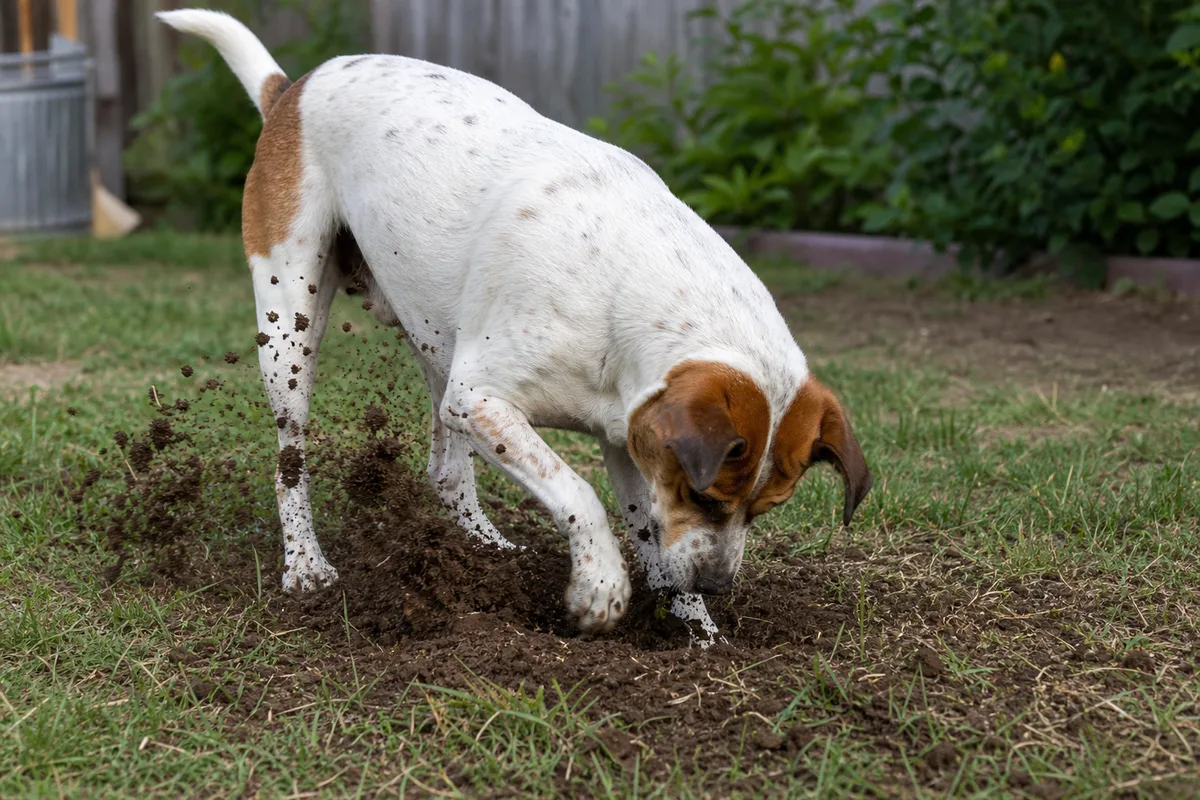
Summer moves the active blocks to the cooler ends of the day. Walk in the early morning and later evening rather than the afternoon, and be honest about pavement, since a surface that is comfortable for your shoes can be too hot for paws in the middle of a summer day. Watch water more closely in heat and refresh it more than once when it is hot. Because a summer yard invites more digging and outdoor mischief, this is often when a bored dog turns the garden into a project, and heading that off is the subject of stopping a dog from digging in the yard.
Winter often shrinks the outdoor time, and that lost activity has to go somewhere or it comes out as indoor restlessness. This is the season to lean harder on indoor enrichment: more food puzzles, more short training games, more play sessions to replace the walk time the weather takes away. Shorter daylight also nudges the whole schedule earlier, and that is fine as long as the sequence holds.
Spring and fall bring shedding for many coats, so the weekly grooming ramps up during those weeks; brushing more often through a heavy shed keeps the loose hair off your floors and out of your cat. The turn of the seasons is also a natural checkpoint to look over the setup: swap in a warmer or cooler bed spot, refresh worn toys, and take stock of supplies before a stretch of weather makes a supply run a hassle. Treat each season change as a small tune-up rather than a reason to rebuild, and the core routine keeps carrying the household straight through the year.
When the routine slips, how to reset
Every routine breaks. A stretch of travel, a busy work run, a houseful of guests, and suddenly meals are random and the pet is back to old habits. This is normal, and it is not a failure. The routine did not betray you; the calendar did. What matters is having a reset you can run rather than starting from zero every time.
Read the slip in the animal's behavior. Renewed begging, counter-surfing, waking you early, more accidents, more chewing, all of it usually traces back to the schedule coming loose rather than the animal deciding to misbehave. When you see those signs, the fix is not more correction. It is more predictability. Tighten the feeding times back to their windows first, because meals are the anchor the rest of the day hangs on, and the begging and surfing tend to fade again within a couple of weeks once meals are reliable, the same way they faded the first time.
Rebuild the blocks one at a time rather than trying to snap everything back at once. Restore the morning block first, then the evening, then fill in midday. If the pet has been getting too much free run during the busy stretch, shrink the space again for a few days and expand it back, the same move you used with a new arrival. Reinstate the five-minute evening reset, since that is the habit that quietly holds the whole thing together and the first one to disappear when things get hectic.
Give it about two weeks and expect the animal to come back to baseline, because a pet that once knew the routine relearns it far faster than it learned it the first time. The routine is not fragile; it just needs re-anchoring after a disruption. Knowing you can reset in a couple of weeks takes the pressure off the disruptions themselves, and that is the real payoff of running care as a rhythm. You are not chasing perfect days. You are keeping a pattern that is easy to fall out of and, just as importantly, easy to fall back into.