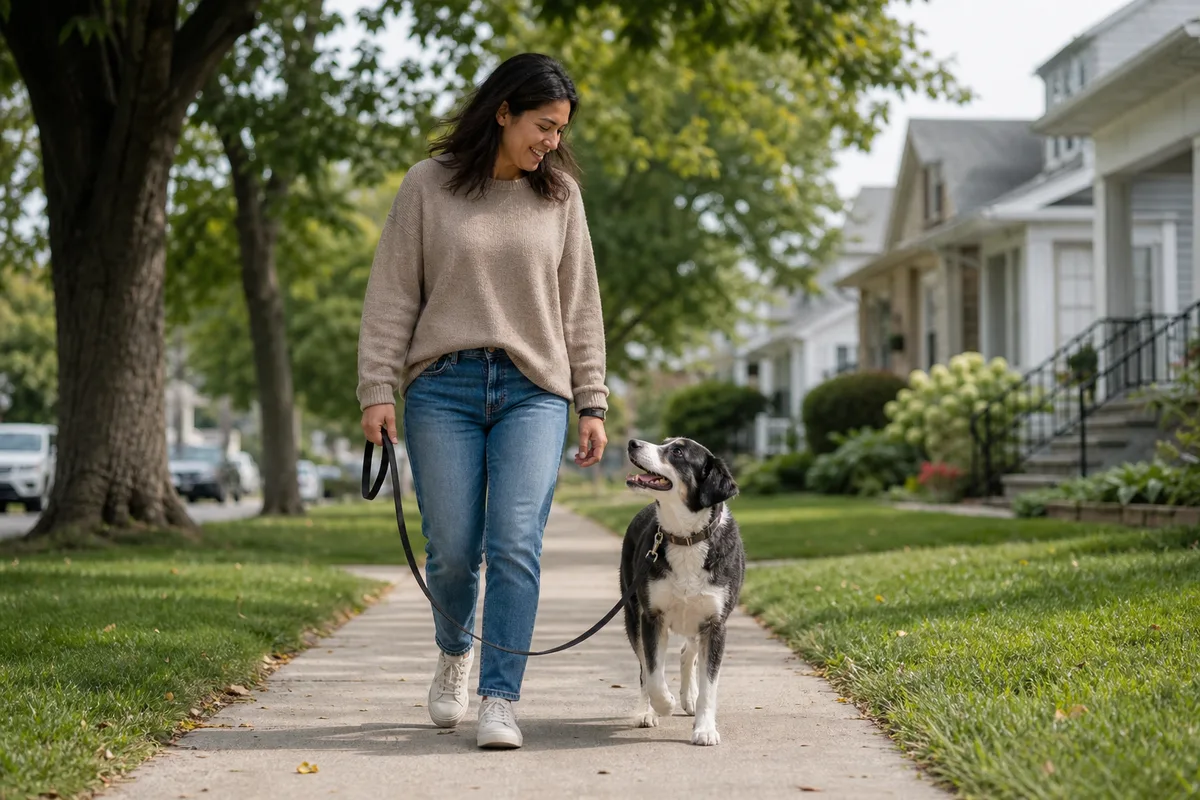
A dog that drags you down the block is not being stubborn or dominant. Pulling is a habit the dog has been paid to keep, one step at a time, for months. Every time the leash goes tight and the dog still gets to the mailbox, the sniff, the other dog, the tightness worked. It moved the walk forward. From the dog's side of the leash, pulling is simply the thing that reliably gets results, and animals repeat what gets results.
That reframe is the whole fix. You are not going to out-muscle a determined 60-pound dog, and the sooner you stop entering that contest, the sooner you stop losing it. What you are going to do is change the payoff so that a tight leash stops the world and a slack leash moves it. Once the dog figures out that arithmetic, and it usually takes days rather than weeks to see the first flicker of it, the tug-of-war ends on its own. This is a retraining job, not a strength contest, and I will walk you through it the way I would if we were standing in your living room with the dog.
Why dogs pull, and why yanking back fails
Start with the mechanics, because they explain every mistake owners make. A dog walks at roughly twice your pace. Left to its own legs, a medium dog cruises at about four miles an hour and a fit one trots faster; most people stroll at two to two and a half. So the dog is always arriving at the end of the leash first, and the leash is always going tight. That tightness is not defiance. It is a speed mismatch that the dog resolves by leaning into the collar and towing you along at its speed.
Here is the part that traps people. When the leash goes tight and you keep walking, you have just rewarded the pull. The dog wanted forward motion, it pulled, and forward motion happened. You paid it. Do that a few hundred times, which is what a couple of months of daily walks amounts to, and pulling becomes the dog's default operating system for getting anywhere.
Now the yank. The instinct when a dog pulls is to jerk the leash back, and it fails for two separate reasons. The first is physical: dogs have an opposition reflex, meaning pressure against the body triggers a push back into it. Pull a dog backward by the neck and its body answers by leaning forward harder. You are not correcting the pull, you are feeding it. The second reason is about learning. A yank is a punishment delivered a full second or more after the pull started, tangled up with everything else happening on the walk. The dog cannot connect a sharp neck jerk to the specific choice of leaning into the leash. All it learns is that walks sometimes hurt, which makes some dogs more frantic and reactive, not calmer.
There is a deeper principle under all of this, which is that dogs learn from consequences that land within about a second of the behavior. Reward or discomfort that arrives late gets attached to the wrong thing. I go into that mechanism in detail in how reward timing shapes what a dog learns, because it is the single idea that makes or breaks loose-leash training. For now hold onto one sentence: the leash going slack is the behavior you want, and it is the moment you have to pay.
Gear that helps without hurting
You do not need much, and you should not spend the training budget on hardware that promises to do the teaching for you. No piece of equipment has ever trained a dog on its own, however confidently the packaging suggests otherwise. The job is done by your timing and your feet. Gear only makes that job a little easier or a little harder.
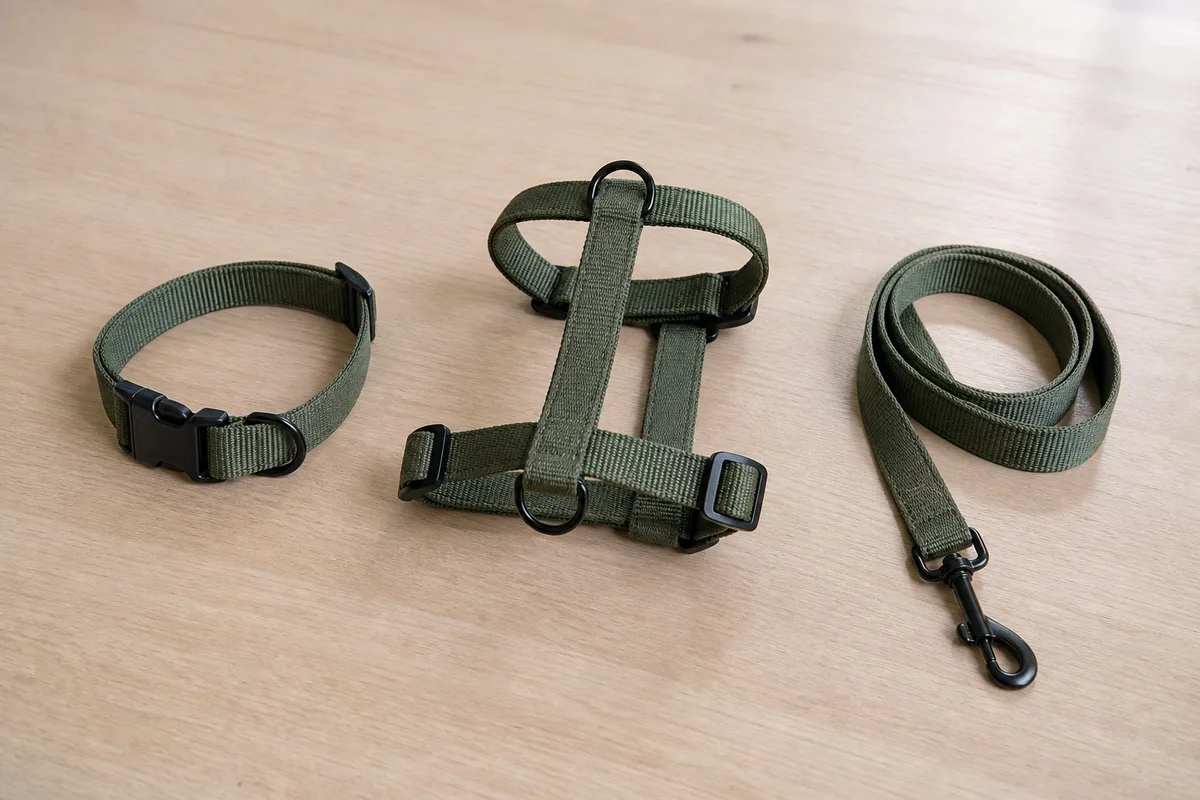 A dog collar, harness, and leash laid out for walk training
A plain flat collar is fine for a dog that does not pull hard yet, like a young puppy. For a dog that already throws its weight into the leash, I prefer a well-fitted body harness, and specifically one with a clip on the chest at the front rather than only on the back. A back clip gives the dog a sled-dog anchor point and, if anything, makes towing more comfortable for it. A front clip turns the dog gently sideways when it lunges, so the pull redirects itself instead of loading straight into your arm. It is not a magic brake. It just takes some force out of the worst moments while the real training does its work.
The leash matters more than people think. Use a fixed length of about six feet, flat webbing, with a handle you can hold without it cutting your palm. Do not use a retractable leash for this. A retractable teaches the exact opposite of what you want, because it pays out more line the harder the dog pulls, so the dog is rewarded with distance for leaning into the handle. That is the pulling habit in a plastic case. Set the retractable aside until the dog already walks on a slack line, if you use one at all.
Skip anything that works by causing pain or startle, the tightening designs and the shock-based ones. Beyond the welfare problem, they suppress the pulling by making the dog anxious about the whole walk, and an anxious dog is a worse learner. You want the dog thinking, not bracing. One more small item: a pouch or a pocket you can get a treat out of in under a second. Fumbling with a zip-lock bag while the leash is slack means you miss the window, and the window is everything.
Step 1: teaching slack indoors
This is where almost everyone starts in the wrong place. They clip the leash on and head straight out to the sidewalk, which is the most exciting, distracting environment the dog knows, and then wonder why it will not listen. Owners who begin on a busy street are asking the dog to pass a final exam before it has had the first lesson. You would not teach someone to drive by merging onto a freeway. Start in the living room, where nothing is competing for the dog's brain.
Clip the leash on indoors and just stand there. Hold the leash so there is a little slack in it, hand relaxed at your waist. The instant the leash is loose and the dog is not straining, mark that moment and pay it. I say a short word, "yes," at the exact second the line goes slack, then hand over a small treat down at my leg where I want the dog to end up. The word is a promise that food is coming; it lets you flag the right instant even if your hand takes another half-second to deliver.
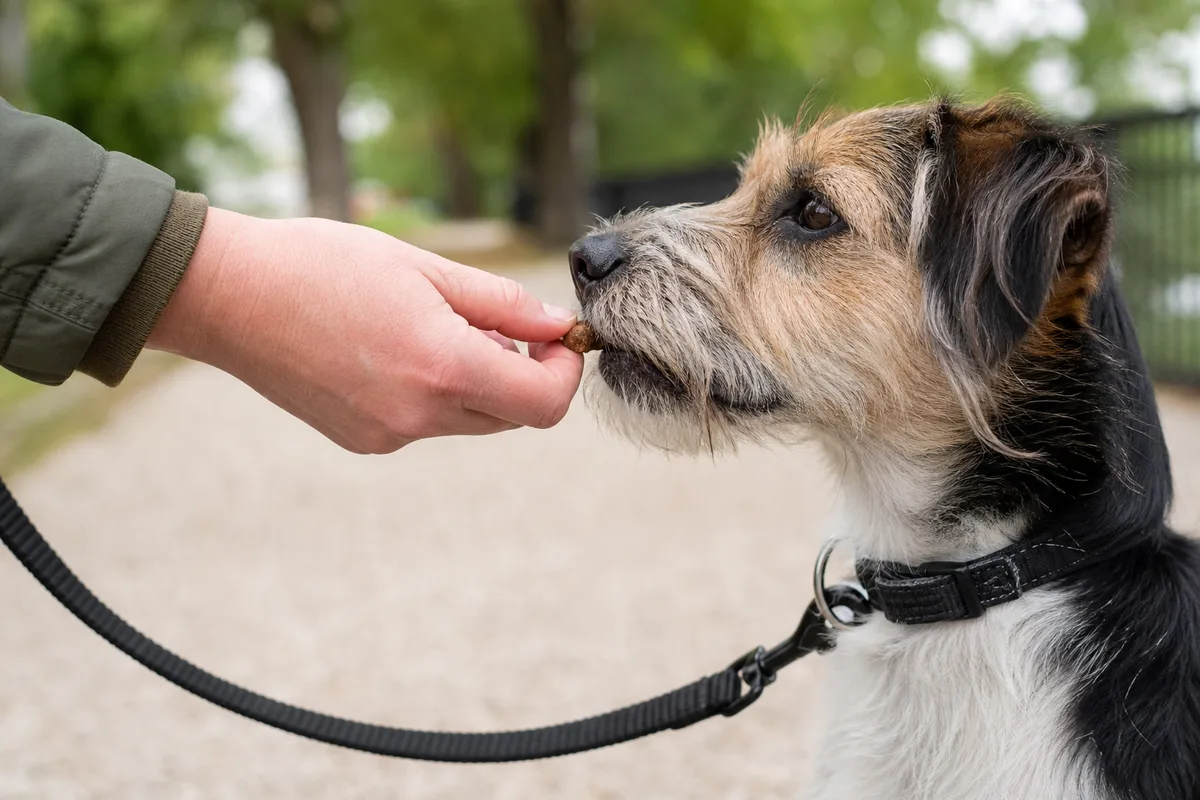 Rewarding a dog with a treat the moment its leash goes slack
That one-second window is not a rough guideline, it is the whole lesson. Reward the exact moment the leash goes slack, within about a second, and the dog learns that slack pays. Reward late, after the dog has already surged forward again, and you have taught the far more common and far more damaging pattern: pull, then ease off, then get paid. Dogs are excellent at spotting that sequence. Miss your timing consistently and you will train a dog that pulses on the leash, tightening and slackening, because that rhythm is what earned the treat. When in doubt, mark early. Slightly too soon is a small error. Too late reverses the whole lesson.
Once the dog will stand on a slack line for a treat, add one step. Take a single stride, and if the dog moves with you and the leash stays loose, mark and pay. Then two strides. You are building the picture of walking beside you with a soft line, one rep at a time, in a room where the dog has nothing better to do. Ten minutes of this is plenty. Keep the sessions short and frequent rather than long: five focused ten-minute sessions across a week will build this skill faster than one long, frustrating walk where you are both worn out. The skill is made of short, successful repetitions, not endurance.
Step 2: the stop-and-wait method
Now you give the dog the rule that runs the rest of its walking life: a tight leash goes nowhere, a slack leash goes forward. This is the engine of loose-leash walking, and it is almost boring in its simplicity, which is why people quit on it too early.
Start walking, still indoors or in a hallway. The moment the leash pulls tight, stop. Not a jerk, not a word, just stop moving and become a post. Let the leash stay taut but do not pull back on it. The dog will lean, then, when leaning does nothing, it will eventually shift, look back, or step toward you and the leash will slacken. The instant it does, mark it and move forward again. Forward motion is the reward, and now the dog is earning that reward with slack instead of tension.
You are teaching cause and effect in its cleanest form. Tight leash: the walk freezes. Loose leash: the walk resumes. Say nothing during the freeze. Talking, coaxing, or repeating the dog's name turns the stop into a conversation and muddies the signal. The silence is doing the work. The first few times, the dog may stand there confused for ten or fifteen seconds, which feels like a long time when you are holding still. Wait it out. If you cave and step forward while the leash is still tight, you have just taught the dog that pulling works if it holds on long enough, which is worse than never having started.
The honest catch with stop-and-wait is that it is slow and you have to be relentlessly consistent. If you enforce it Monday and Tuesday, then let the dog drag you home Wednesday because you are tired, the dog learns that pulling works sometimes, and behavior that pays off intermittently is the hardest kind to erase. That is not a reason to skip the method. It is the reason to run short sessions you can actually commit to, rather than an hour you will abandon halfway.
Step 3: direction changes for focus
Stopping teaches the dog that pulling stalls the walk. Direction changes teach it something more useful: keep an eye on me, because I am unpredictable and staying with me is easier than getting yanked off course. This is the piece that turns a dog that grudgingly stops pulling into one that actually pays attention to you.
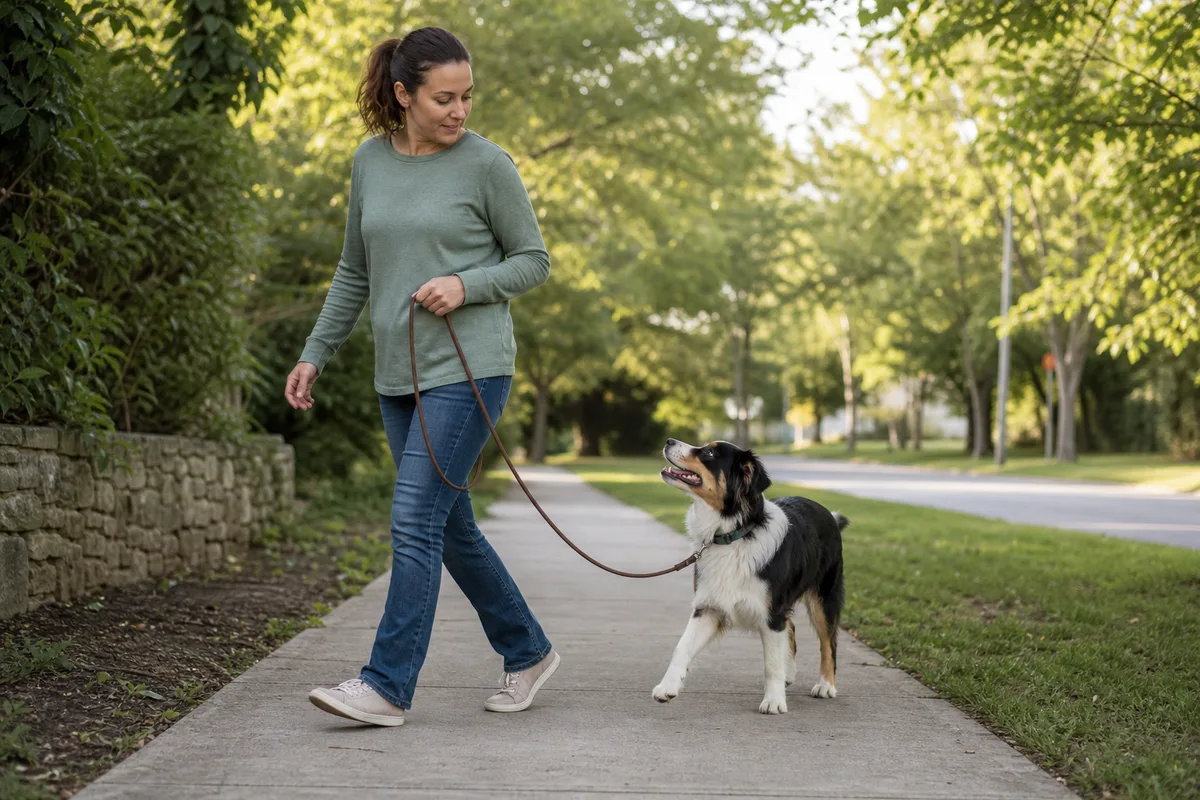 An owner changing direction during a loose-leash training walk
The exercise is simple. As you walk and you feel the dog start to forge ahead and load the leash, turn and walk the other way before the leash even goes fully tight. Do not jerk the dog around. Just change your direction smoothly and keep moving, so the dog has to disengage from whatever it was aiming at and catch up to you. When it does, and it comes back into position beside you with a loose line, mark and pay. You have made the dog's own inattention cost it a little, and made checking in with you the thing that pays.
Mix it up. Turn left, turn right, do a full about-face, walk a lazy figure-eight around two trees in the yard. The point is that the dog can never coast on autopilot toward a fixed target, because you might not be going there. A dog that has to track you cannot simultaneously throw all its weight forward. After a week or so of this, you will notice the dog starting to glance up at you at the first hint of a turn, checking where you are headed. That glance is gold. It is the dog volunteering the attention you used to fight for, and it is the foundation everything else is built on.
One judgment call: keep the turns friendly, not punishing. If you whip around hard enough to snap the dog's neck, you are back to yanking, with all the same problems. The turn should be brisk enough that the dog has to hustle to keep up, gentle enough that it never hurts. You are making staying close the easy, sensible choice, not making leaving your side painful.
Step 4: moving to the yard, then the street
Only now do you go outside, and you do it in stages, because a dog that walks beautifully in the kitchen has learned to walk in the kitchen, not on Main Street. Skills do not automatically travel from one place to another for dogs. Each new environment is close to a fresh start, though a much faster one each time.
The first outdoor step is the most boring patch of ground you own: a quiet backyard, an empty driveway, a still corner of a parking lot early in the morning. Run the same drills you did indoors. Reward slack, freeze on tension, change direction. Expect the dog to be worse than it was inside, because now there are smells and sounds pulling at it. That drop-off is normal and not a sign the training failed. Give it a session or two and the yard version catches up to the indoor version.
Then push the difficulty up one small notch at a time. A quiet residential sidewalk with no other dogs around. A slightly busier one. A street with occasional passing people. The rule is that you only add difficulty when the current level is easy, meaning the dog is holding a loose leash most of the time without you working for it. If you add a step and the dog falls apart, you jumped too far; drop back to the level where it succeeded and stay there another few sessions. Progress in loose-leash walking looks like a staircase, not a ramp, and the steps that are too big are where people lose the whole thing.
Keep paying well out on the street early on, more generously than you think you need to, because the competition for the dog's attention is fierce out there. This is also where the calm daily routine you have built at home pays off; a dog whose whole life is steady and predictable, the kind of foundation I cover in the broader guide to everyday pet care at home, walks into a training session already settled rather than wound up. A dog that is under-exercised and starved for stimulation will pull harder for the same reason a restless person taps a foot: the energy has to go somewhere.
Handling distractions without losing progress
The street is full of things that are, to your dog, far more interesting than a piece of freeze-dried liver: another dog across the road, a squirrel, a jogger, a fascinating patch of grass where three dogs have left messages. Distractions are not an obstacle to the training. They are the actual curriculum. Learning to hold a loose leash while something exciting is happening is the entire skill, and you build it deliberately rather than hoping the dog grows out of it.
The tool is distance. Every distraction has a range at which your dog can notice it but still think and still take a treat, and a closer range where the dog's brain checks out and food no longer registers. Your job is to work at the outer edge, where the dog can win. Spot the other dog a half-block off, get your dog's attention with a check-in, reward the loose leash, and move on before you close the gap to the point of no return. Over many reps at a workable distance, the dog can handle the distraction closer and closer. Charge straight up to it on day one and you will only prove to the dog that you are irrelevant compared to whatever it wants.
When the dog does lock onto something and stops responding, that is information: you are too close, and no amount of treat-waving will pull it back once it has crossed that line. Do not repeat cues into a dog that has stopped hearing you, which only teaches your words to mean nothing. Calmly create distance instead, walk the other way until the dog can think again, mark the moment it re-engages, and reset at a range where it can succeed. Getting a checked-out dog to reconnect with you at a distance is really a recall problem in disguise, and if your dog routinely tunes you out the moment something better appears, the fix for a dog that ignores recall feeds directly back into calmer walks.
Sniffing deserves its own note, because owners often treat every nose-to-the-ground moment as pulling to be stamped out. It is not. Sniffing is how a dog reads the neighborhood, and a walk with zero sniffing is a joyless march for the dog. The workable compromise is to make sniffing a reward you grant on a loose leash rather than something the dog drags you into. When the line is slack and you choose to, walk the dog over to the interesting spot and release it to sniff. Now the good smells reinforce the loose leash instead of the pull.
Realistic timelines and setbacks
Here is where I will be straight with you, because the vague promises are what set people up to quit. Loose-leash walking is one of the slower things to teach a dog well, slower than sit, slower than most tricks, because you are overwriting a habit that has been practiced and paid off hundreds of times. You are not filling a blank page. You are editing a page the dog has already written in ink.
A rough shape of what to expect: within the first several ten-minute sessions indoors, you will see the dog start to offer slack and check in, which feels like a breakthrough and is a real one. The first couple of weeks outdoors are where it gets frustrating, because the dog that was a star in the kitchen forgets everything on the sidewalk and you feel like you are back at zero. You are not; the relearning in each new place goes much faster than the first time. Getting a solid, reliable loose leash in genuinely distracting places, a busy street with other dogs, usually takes a couple of months of short, consistent sessions, and some big or high-drive dogs take longer. That is normal. It is not a sign you are doing it wrong.
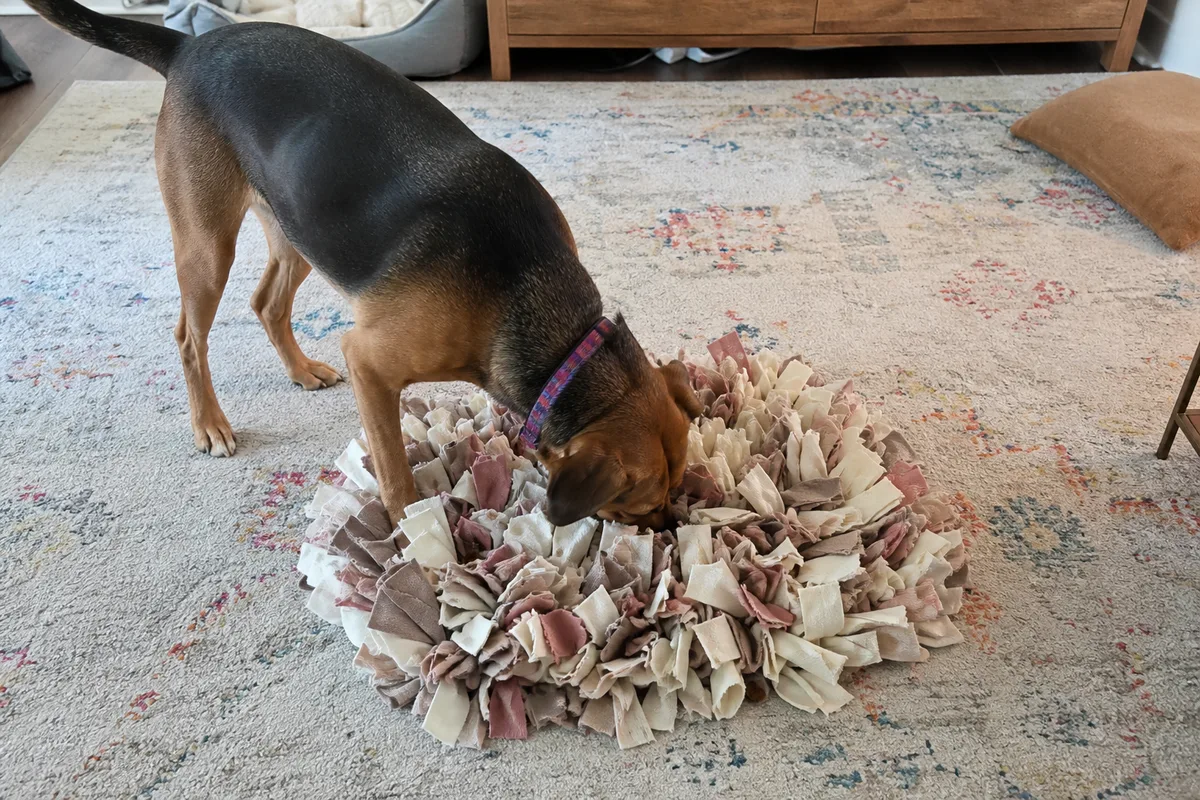
Setbacks are built into the process, so plan for them instead of being demoralized by them. A dog that walked nicely all week will have a terrible day for no reason you can name, and one great walk does not mean you are done. The single most common cause of backsliding is inconsistency: the days you are rushed or tired and you let the dog tow you home to save time. Every one of those trips reinstalls a little of the old habit, because behavior that occasionally works is exactly the kind dogs cling to hardest. If you genuinely do not have ten minutes to train on a given day, it is better to carry the dog's energy off some other way and skip the formal walk than to take a walk where you let pulling win. Scent games and food puzzles do that job indoors in a few minutes, and wearing out a dog without a yard collects the ones that actually work.
Two practical guardrails will save your progress. First, separate training walks from bathroom breaks in your own head. A five-minute rushed potty trip on a tight leash is not a failure of your training as long as you are not pretending it is a training session; just do not confuse the two. Second, keep your criteria honest. Do not decide the dog is trained the first time it manages a good block, and do not slide backward into accepting a tight leash because enforcing the rule is tiring today. The dogs that end up walking beautifully belong to the owners who held one clear standard, in short sessions, for longer than felt necessary. The method is not complicated. The discipline to apply it the same way every single time is the actual work, and it is entirely within your reach.