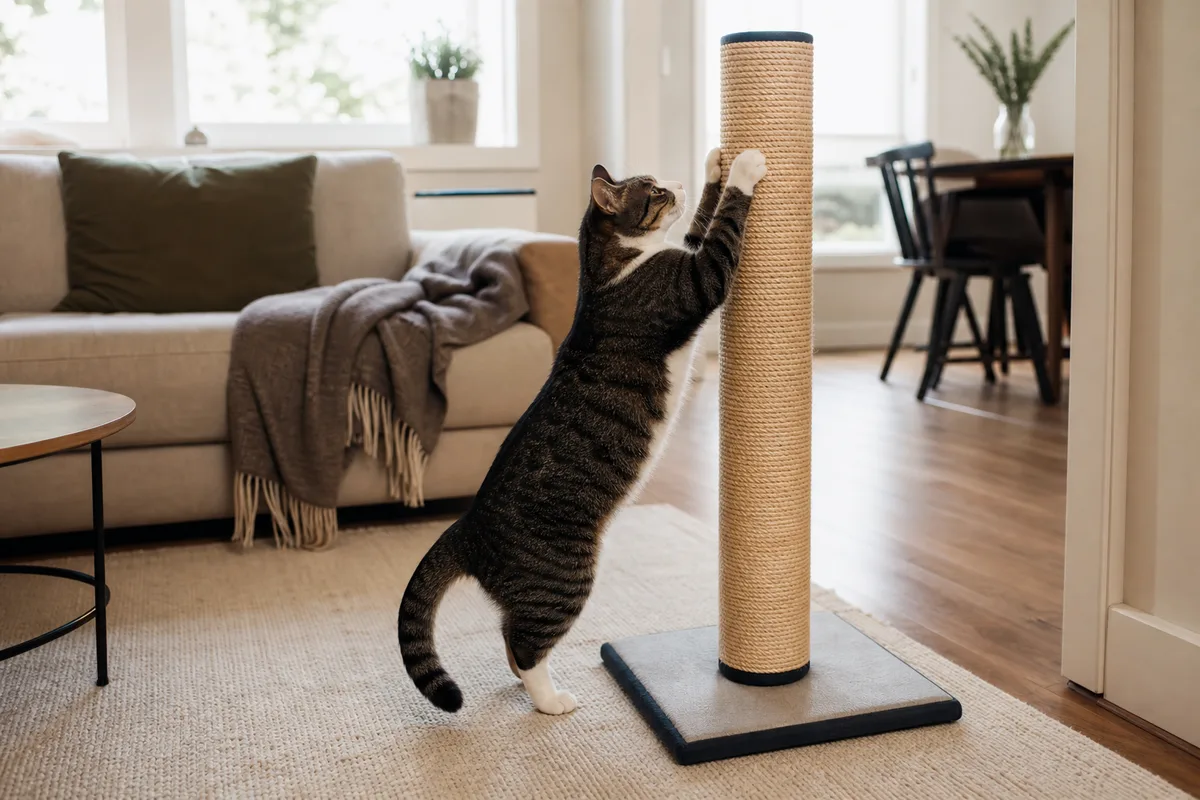
The first thing I tell anyone who calls me about a shredded couch is to stop thinking of it as damage. Your cat is not vandalizing the sofa. It is doing three jobs it is built to do, and the couch corner just happens to be the best tool in the house for all three. Once you see the behavior for what it is, the fight drains out of it, and the fix stops being about stopping the cat and starts being about giving it somewhere better to do the exact same thing.
I have lived with cats for most of my adult life, and I have redirected a lot of them off furniture, my own and other people's. The pattern almost never changes. People buy a post, wedge it into a corner nobody uses, and are baffled when the cat walks right past it to the armrest it has always preferred. The post was fine. Everything around the post was wrong. This article is about the everything-around-the-post, because that is where the whole thing is won or lost.
The behavior that frustrates every cat owner
Here is the scene I hear described almost word for word every time. There is one corner of one couch, usually the arm nearest the doorway, that is worn down to threads while the rest of the furniture is untouched. The cat goes at it in the morning after waking up and again in the evening when the household comes home. If you clap or shout, the cat stops, waits until you leave the room, and goes right back. It has, in effect, out-waited you, which it is prepared to do all day. You may have already bought a post, and it is sitting somewhere the cat has never touched.
The frustration is real, and it is made worse by a simple misread: it looks personal and it looks random, and it is neither. The cat is not testing you and it is not choosing at random. It is repeatedly picking the single best surface in the room for what it needs, and doing it at the two times of day when the urge is strongest. Those two peaks, just after sleep and at reunions or high-energy moments, are the clue that this is wired-in behavior, not a bad habit that crept in.
The other thing owners get wrong is the timeline in their heads. They expect a scratched spot to be a recent development they can reverse by catching it early. In most homes the cat has been scratching that same corner for months and simply escalated to the point of visible ruin. You are not stopping a new behavior. You are relocating an established one, and established behaviors move when the environment gives them a reason to, not when you tell them to.
So before anything else, drop the framing of misbehavior. Nothing that follows works if you are still trying to win an argument with an animal that does not know you are having one.
Scratching as scent marking
The part most people never learned is that scratching is partly about smell, not just about claws. Cats have scent glands in the soft pads of their paws, and dragging those pads down a surface leaves a deposit you cannot smell but every cat in the house can. Scratching is a signpost. It says this is a lived-in place and I am part of it. That is why the marks show up on the routes and corners the cat cares about most: the doorway arm of the couch, the edge of a bed, the side of a chair by the window it watches from.
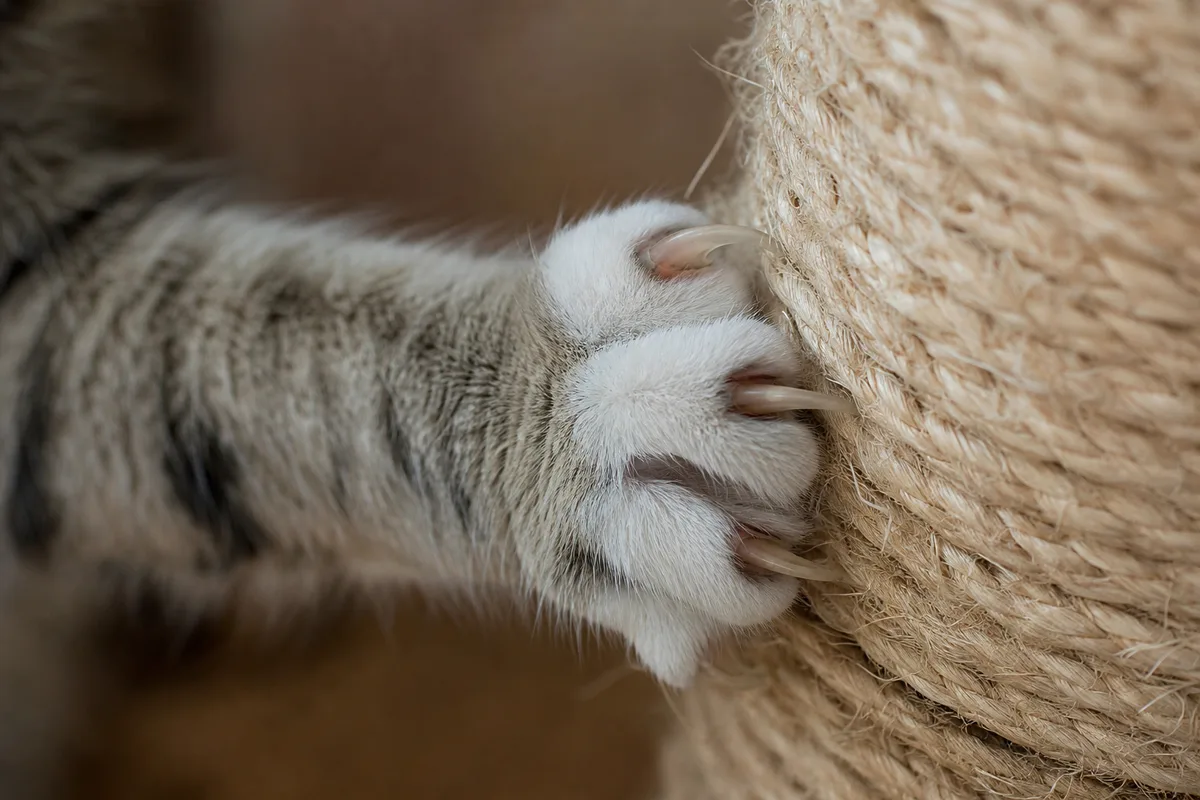 A close-up of a cat's extended claws on a scratching surface
This single fact rewrites the whole placement problem. Cats scratch partly to leave scent, so a post tucked away in a spare room gets ignored no matter how nice it is. The cat has no reason to mark a room it barely occupies. The mark belongs where life happens. A post has to sit where the cat already chooses to leave its signature, which is almost always the busiest, most trafficked spot in the home, the exact spot you were hoping to keep a post out of, for the sake of the living room.
I have watched this play out over and over. Move a rejected post from the guest bedroom to within a foot of the ruined couch arm, and a cat that ignored it for weeks will often use it the same day. Nothing about the post changed; it did not get taller or fluffier overnight. It finally landed on the map the cat actually uses.
There is a second implication people miss. Because part of the drive is territorial, high-stress or high-change periods tend to bring more scratching, not less. A new person in the house, a rearranged room, a second cat, a move: any of these can push the marking behavior up. If the scratching suddenly intensifies, look first at what changed in the environment rather than at the cat. The behavior is often a response to the room, and the room is the thing you can actually adjust.
Why cleaning the spot does not solve it
Owners sometimes scrub the scratched corner hoping to erase the smell and break the cycle. It rarely helps, because the visible fray and the scent are both saying the same thing, and the cat will simply re-mark. Cleaning without offering a better surface nearby just resets the same job on the same spot. If you want the scent to move, you have to give the cat a more appealing place to lay it down, close enough that switching is the path of least resistance.
Scratching as claw maintenance
The second job is the one everyone already half-knows: scratching keeps claws in working order. A cat's claw grows in layers, and the outer layer wears out and needs to shed so a sharper one underneath can take over. Scratching hooks into a surface and pulls that spent outer sheath free. If you have ever found what looks like a whole tiny curved claw shell stuck in a cat bed or wedged in a rug, that is the shed layer, not a lost claw. You can put the emergency panic away; nothing fell off. It is a sign the system is working the way it should.
This is why texture matters as much as location. The surface has to give the claw something to catch and drag against. Loose-woven fabric, sisal rope, rough cardboard, and bark-like bark all work because the claw can sink in slightly and pull. A smooth, hard, or slick surface does nothing for the job, which is one reason cats bypass a slick plastic post for the coarse weave of an upholstered arm. The couch is not just conveniently placed. Its fabric actually does the maintenance work.
Different cats also prefer different orientations for this. Many go for vertical surfaces they can reach up and rake down, dragging the claw the full length of the stroke. Others prefer horizontal: a flat pad, a cardboard tray, a doormat, a stretch of carpet they hunch over and pull backward on. If your cat ignores every upright post you own, it may simply be a horizontal scratcher, and no vertical post in any location will win it over. Watching which way your cat orients on the furniture tells you which shape to buy before you spend a cent.
A common misread is thinking a cat that scratches a lot has a claw problem. It usually does not. Frequent scratching is normal upkeep, especially in a healthy adult cat with the energy to do it. The goal is never to reduce how much the cat scratches. It is only to move where it happens. Trying to suppress the behavior itself works against something the cat needs to do, and a need you block does not disappear; it comes out somewhere you like even less.
Scratching as a stretch
The third job is the one that quietly decides whether a post ever gets used, and it is the one most posts fail at. Watch a cat scratch a tall surface and you will see it is not just working its claws; it is anchoring high and pulling its whole body into a long stretch, extending the spine, the shoulders, and the back legs in one motion. Scratching and stretching are the same movement for a cat. That is why it so often follows a nap: the cat wakes, walks to its spot, hooks in, and stretches itself awake through the pull.
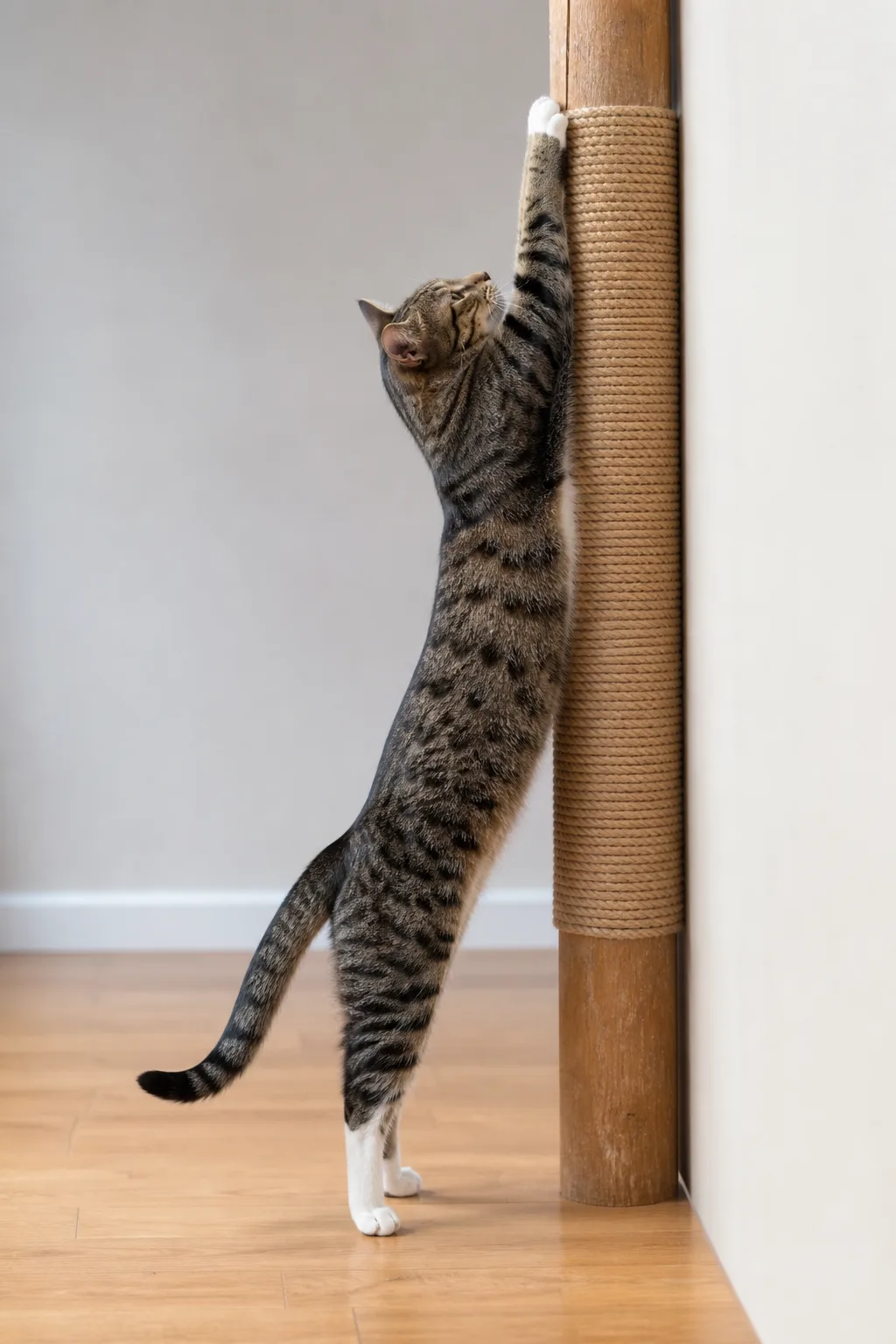 A cat stretching its full length against a scratching post
This is where post height stops being a detail and becomes the whole thing. Cats favor a vertical full-body stretch, so a post shorter than the cat's stretched length simply will not be used. The cat cannot get the extension it came for. Most of the "rejected" posts I get asked about are not rejected for taste or placement. They are just too short. The cat reaches up, finds the top before it has fully extended, and walks off to the couch arm, which runs floor to seat and gives it the full pull.
Measure your cat before you buy. Have it stretch up against a wall or a door frame (most cats will do it if you hold a toy or a treat high) and mark where the front paws reach. A grown cat commonly needs a post around 28 to 32 inches tall to stretch out completely, and taller is safer than shorter. A post that clears the cat's full reach with a little room to spare will beat one sized to look tidy in the room every time. If you are choosing between a post that is too short but attractive and one that is tall but plain, buy the tall plain one. The cat is not decorating.
Why sturdiness is not optional
The stretch also explains something about stability that surprises people. When a cat anchors high and pulls its full weight into the stroke, it is putting real force through the surface, and it wants that surface to hold firm. The couch corner gets targeted because it is sturdy and prominent, and a wobbly post loses every time to a solid armrest, so stability is the whole game. A post that rocks, leans, or tips even slightly when leaned on teaches the cat in one try that it cannot be trusted, and the cat goes back to the immovable furniture.
I test every post the same way: I grab it near the top and lean my own weight into it the way a cat would pull. Yes, this looks faintly absurd in the middle of a store; do it anyway. If it shifts, wobbles, or the base slides on the floor, it will fail. A heavy, wide base matters more than the material wrapped around the pole. A cheap post on a broad, weighted base beats an expensive one on a base too small to stay planted. If a post you already own is tall enough but tippy, screwing its base to a scrap of plywood to widen the footprint can rescue it.
Why punishment backfires
Once you understand the three jobs, it becomes obvious why yelling, clapping, squirt bottles, and the like never fix scratching. None of them address a single one of the reasons the cat is scratching. The scent still needs leaving, the claws still need working, the body still needs stretching. All punishment does is add a fourth variable: you, as a source of unpleasant surprises. And the cat draws the lesson you least want.
What the cat learns is not do not scratch. It is do not scratch while the human is watching. This is why the couch keeps getting worse even though the cat "never does it in front of you anymore." It has simply moved the behavior to when you are out of the room or out of the house. You have taught it to be discreet, not to stop. The wear keeps accumulating, only now you do not see it happen, so you cannot even interrupt and redirect in the moment.
There is a worse cost. Because part of scratching is territorial and tied to feeling settled, a cat that starts to associate you with random unpleasant events can become more anxious, and more anxiety often means more marking, not less. Punishment can drive the exact behavior it is aimed at. I have seen households where the squirt bottle made the scratching noticeably worse over a few weeks, and the owners could not understand why until they connected it to the stress they had added.
There is also a plain timing problem. For a consequence to shape behavior, it has to land in the instant of the act, every time, and it has to be something the cat does not trace back to you. Households cannot deliver that, and should not try. You are not present for most of the scratching, your timing will be late more often than not, and the moment the cat connects the consequence to you rather than to the couch, you have damaged the relationship without changing the behavior. The whole approach asks you to win a war of attrition against an instinct, from a position where you are absent most of the time. It does not work, and the collateral damage is the trust between you and the animal.
Drop it entirely. Not because punishment is merely unkind, though it is, but because it is aimed at the wrong target. You cannot punish away a need. You can only give it a better outlet.
What this means for post choice and placement
Everything above collapses into a short, unglamorous checklist. A scratching surface a cat will actually use has to satisfy all three jobs at once, and it has to do it in the right spot. Get any one of these wrong and the cat votes with its claws for the furniture instead.
Tall enough for the full stretch. Measure the cat's reach and buy a post that clears it, commonly 28 to 32 inches or more for an adult. If it is too short, nothing else matters.
Stable enough to lean into hard. Wide, heavy base. Do the lean test yourself before you trust it. A post that moves under load is a post that has already lost.
The right texture and orientation. Match what your cat already scratches. If it rakes vertical fabric, get a tall upright wrapped in sisal or rough weave. If it hunches over the rug, get a horizontal pad or an angled cardboard scratcher. Watch the cat, then buy for the cat you have.
In the right place, not the tidy place. This is the one people fight hardest and it is the one that decides everything. The post goes where the cat already scratches: right beside the ruined couch corner, out in the busy room, on the route it walks after waking. Not the guest room, not behind a door, not the far corner nobody uses.
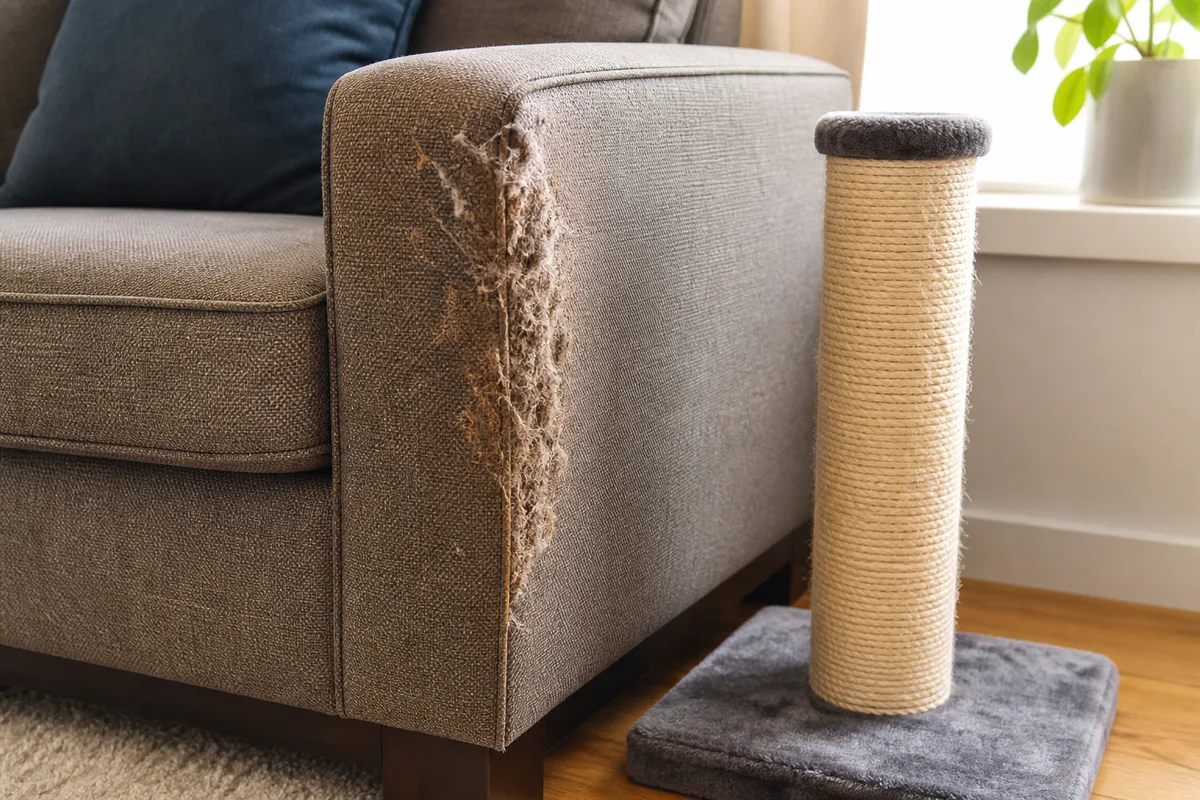 A scratching post placed beside a couch corner a cat had targeted
The instinct to hide the post for the sake of your decor is exactly backward. A post in a corner the cat does not care about is furniture you paid for and the cat will never touch, which is a strange thing to own on purpose. A post the cat uses every day earns its place in the room, threads and all. If you cannot stand it in the living room permanently, start it right next to the couch and, once the cat is committed to it, move it a few inches every few days toward a spot you prefer. Move too fast and the cat drops it and returns to the couch, so patience here pays. Some of this is basic home routine, and it fits into the same rhythm as the rest of your everyday pet care at home. You are shaping the environment so the animal makes the choice you want on its own.
If you have more than one cat, you need more than one surface. Cats do not reliably share a single post, and part of the point is each one marking its own territory. Spreading two or three posts through the shared spaces of the home costs less grief than a war over one.
Redirecting without a battle
The redirection itself is almost boring once the setup is right, and boring is what you want. Put the correct post (tall, stable, right texture) directly beside the spot the cat has been ruining. Not across the room. Beside it, so that when the urge hits, the good surface is closer and better than the couch. You are not asking the cat to cross the room to a worse tool. You are giving it a better one within reach.
Then make the couch corner temporarily less rewarding while the post is more rewarding. Covering the targeted spot for a couple of weeks with something the claw cannot catch (a smooth throw, a piece of hard plastic sheet, tightly tucked fabric) takes the maintenance payoff out of the couch without any confrontation. The claw finds nothing to hook, and right beside it is a surface that hooks perfectly. The cat is not being scolded off the couch. The couch just quietly stopped being the best option in the room. This is subtraction, not punishment, and the cat never has a reason to connect it to you.
You can pull the cat toward the post at the same time. A few minutes after the cat wakes, when the scratching urge peaks, is the moment to draw it to the new surface: trail a toy up the post so the cat reaches and hooks in, and let the first successful scratch happen there. Rubbing a little catnip into the post, if your cat responds to catnip, makes it more inviting. Never take the cat's paws and drag them down the post. Forcing the motion sours the whole object; most cats that get manhandled onto a post start avoiding it. Let the cat find the good scratch on its own, because a scratch the cat chose is the one that sticks.
Give it time. A well-placed, well-sized post usually starts pulling traffic within days, but the couch has months of scent and habit behind it, so expect a few weeks before the old corner is fully abandoned. Keep the couch covered through that stretch. Once the cat is committed to the post and the covering comes off, most cats stay on the post because it genuinely does the job better. If your cat truly will not touch a post, go back to the checklist before giving up: nine times out of ten it is too short, too wobbly, the wrong texture, or in the wrong place. This approach has limits: it works far less well if the post is compromised on any of the three jobs, and it will not override a cat that is scratching more because of stress you have not addressed. Fix the environment and the scratching almost always moves.
One last thing worth its own mention: the same read-the-behavior-first approach that solves scratching solves most of the other complaints people have about cats. The methods overlap heavily with how you keep a cat off counters: you figure out what the cat is getting from the spot, remove the payoff, and offer a better option nearby. Cats are not stubborn. They are consistent. Understand what they are actually doing, aim the fix at the reason instead of the symptom, and the furniture stops being a battleground.