The most useful thing I ever learned about tiring out a dog is that the yard was never doing the work. People move to a house with a fenced yard expecting the dog to run itself ragged, then discover the dog walks out, stands in the middle of the grass, sniffs for two minutes, and asks to come back in. A yard is a bigger crate with better lighting. What actually spends a dog's energy is engagement, and engagement fits in an apartment.
This matters because the standard advice, just walk it more, both misreads the problem and quietly fails the dogs it is aimed at. A dog bouncing off the walls in a small space is rarely under-walked in miles. It is under-worked in the parts of its brain that plain walking does not touch. Once you understand which kind of tired you are trying to produce, the lack of a yard stops being the obstacle it looks like.
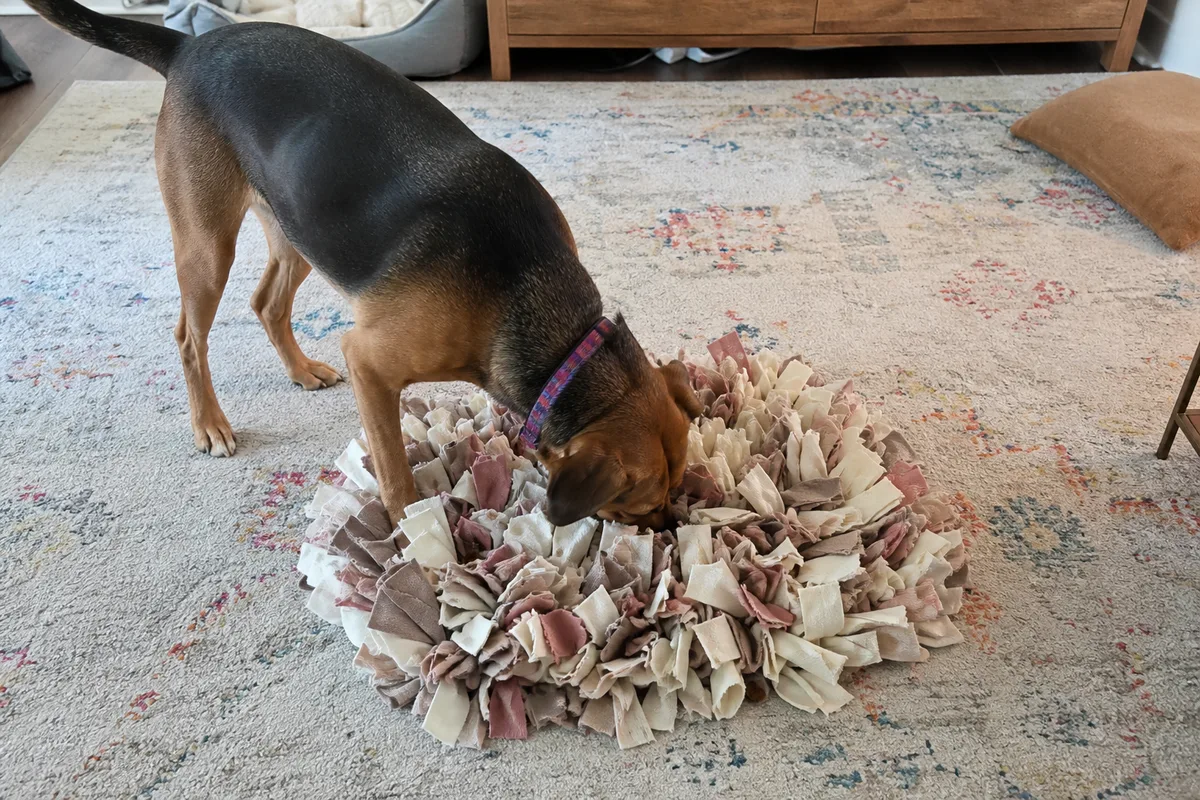 A dog working a snuffle mat on a living room floor
This is the movement-and-enrichment piece of our guide to everyday pet care at home, taken further than a pillar section can go.
Two kinds of tired, and only one of them fills a room
There is physical tired and there is mental tired, and they are not interchangeable.
Physical tired is what a run produces: muscles worked, heart rate up, a body that wants to lie down. It is real, and some dogs need a genuine dose of it. But physical exercise alone has a trap built in. Repetitive hard cardio, the classic being a dog sprinting after a thrown ball forty times in a row, builds fitness. A fitter dog needs more of the same to reach the same tiredness. You can spend a summer turning a restless dog into a canine athlete who now requires two hours of fetch to feel what one used to deliver, and you have made your problem worse while feeling like you addressed it.
Mental tired is different. Ask a dog to solve problems, use its nose, work for its food, and hold itself together in the face of something exciting, and it drains in a way that does not build a bottomless tolerance. Ten focused minutes of nose work often settles a dog more thoroughly than half an hour of plain fetch, and it does not train the dog to demand ever-larger sessions. This is the lever that works in a small space, because none of it needs distance.
The practical target, then, is not "how do I run this dog without a yard". It is "how do I get this dog to think, sniff, work, and then switch off", and that is entirely doable indoors.
Sniffing is the cheapest, most underrated tool you have
Before the indoor games, the walk. Not a longer walk, a different one.
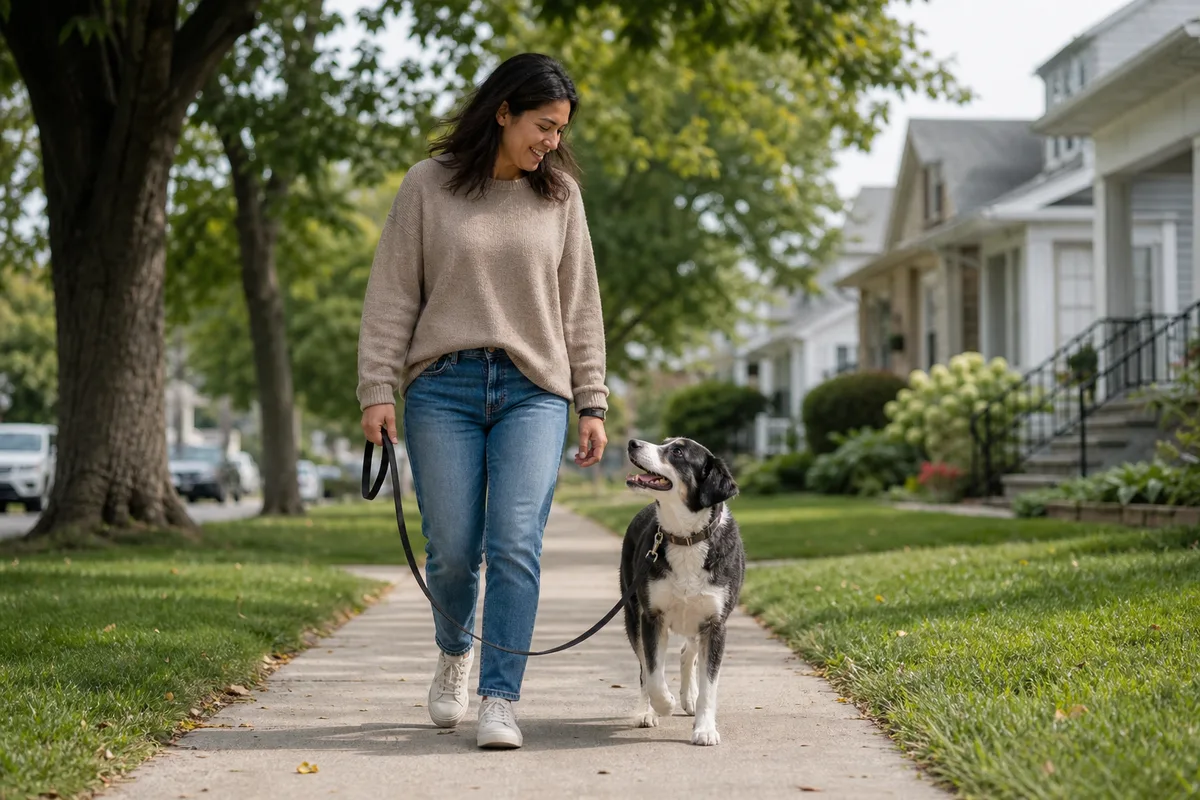
A dog gathers information through its nose the way you do through your eyes, and letting it read the ground is mentally taxing in the best way. A twenty-minute walk where the dog is allowed to stop and sniff every few feet does more to settle it than a brisk forty-minute march where you drag it past everything interesting. The brisk march produces a fitter, more frustrated dog. The sniff-heavy amble produces a satisfied, tired one.
The name for this in training circles is a decompression walk, and the whole idea is to hand the dog the agenda. You go where it wants to sniff, within reason, and you slow down to its pace instead of yours. A long line in a quiet green space, fifteen to thirty feet of light lead, lets a dog range and investigate while you keep control. Even a boring stretch of sidewalk works if you stop fighting the stops.
If your walks are a constant tug of war, none of this decompression happens, because a dog straining at the end of the leash is in an aroused state, not a settled one. Fixing the pulling is worth doing on its own terms, and the method is in teaching a dog to walk on a loose leash. A dog that ambles beside you turns every outing into the calm, sniffy work that actually tires it.
For an apartment dog, two shorter sniff-led outings usually beat one long forced march, and the second one late in the day sets up the evening well.
Food is the engine: stop using a bowl
Here is the single highest-value change most people can make, and it costs nothing. Stop feeding the dog out of a bowl.
A bowl delivers a meal in ninety seconds and asks for nothing. That same food, made into a task, becomes fifteen or twenty minutes of the exact mental work that settles a dog. You already buy the food. You are simply routing it through the dog's brain instead of past it.
The ways to do this run from free to fancy:
Scatter feeding. The simplest version. Take a handful of the dog's kibble and toss it across a towel, a bath mat, or just the floor, and let the dog nose every piece out. This turns a meal into a search. It is genuinely tiring and it costs nothing but the willingness to not use a bowl.
A snuffle mat. A mat with dense fabric strips you push food down into, so the dog has to work each piece loose with its nose. You can buy one, or you can make one by knotting strips of fleece through a rubber sink mat, which is an hour of couch work and produces the same result. Either way, a mat that took the dog ten minutes to clear has done more than a lap of the block.
A stuffed rubber toy. Pack a hollow rubber toy with part of the meal, softened kibble, a bit of plain wet food, whatever the dog eats, and let it work the food out. Freezing it first makes it last far longer and turns a five-minute job into a twenty-minute one. This is the workhorse of indoor enrichment and the thing I reach for when I need a dog occupied while I get something done.
Puzzle feeders. Boards and toys with sliding lids, spinning covers, and compartments the dog has to manipulate. Good ones are genuinely challenging. A cheap stand-in is a muffin tin with a piece of kibble in each cup and a tennis ball dropped over each one, so the dog has to lift the balls to eat.
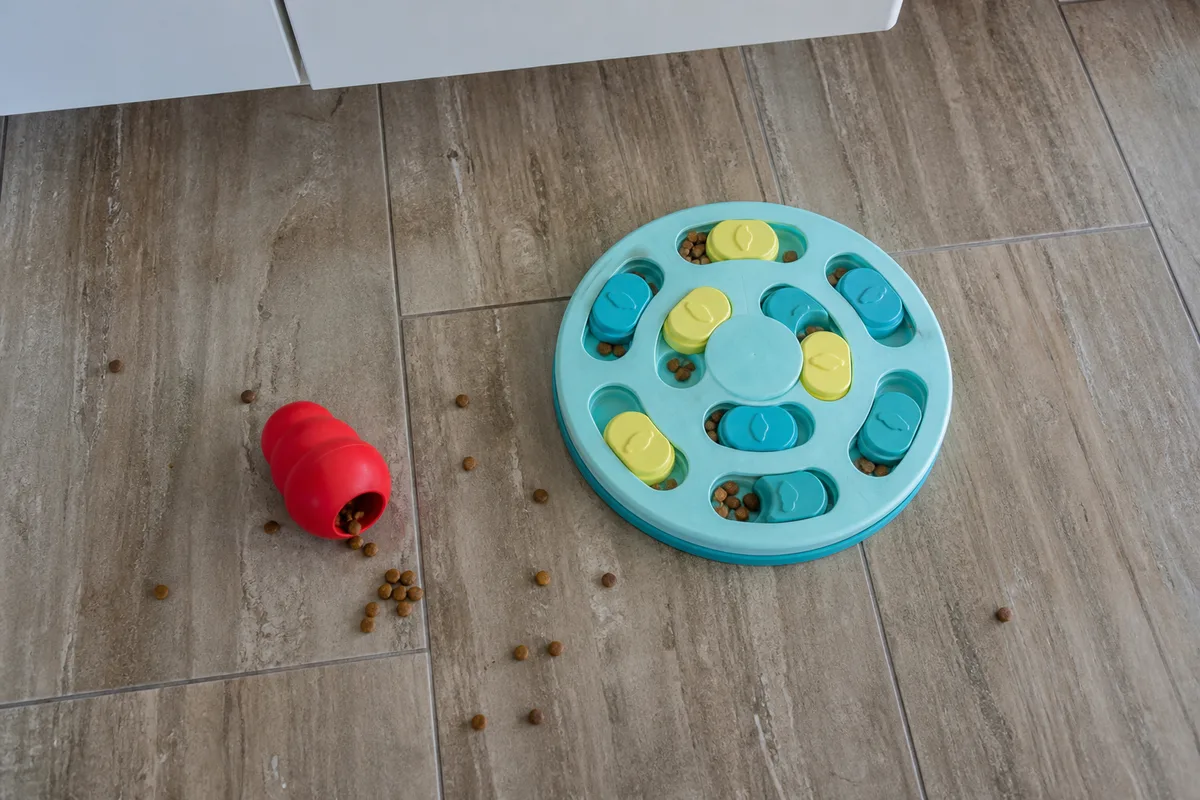 A rubber food-stuffed toy and a puzzle feeder on a kitchen floor
The honest limit on all of this: it only works if the dog is a little motivated by food, which most are, and it works best if the food is not also available for free in a bowl an hour later. If the dog can wander over and eat any time, the puzzle stops being worth the effort. Route the actual meals through the work.
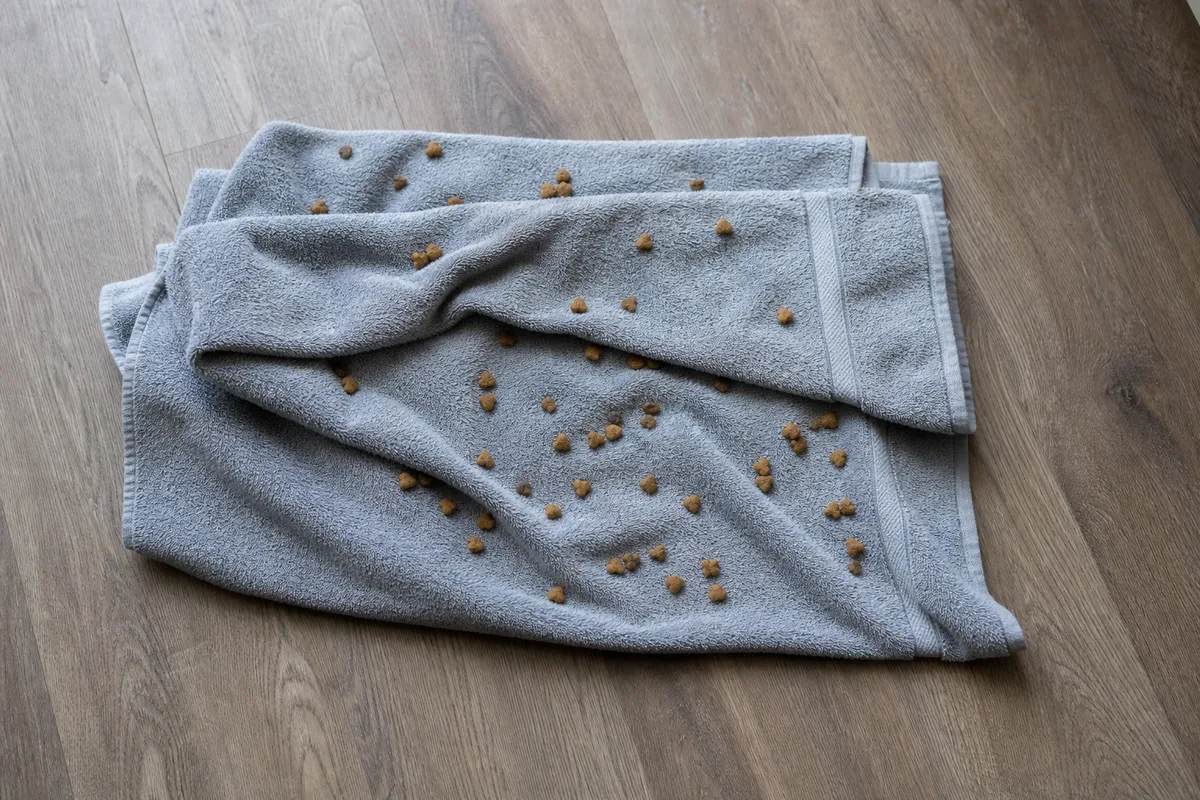 Kibble scattered across a folded towel for a dog to nose out
Scent games that turn a hallway into a workout
Beyond feeding, the nose is a whole category of indoor exercise, and it scales from thirty seconds of setup to a real hobby.
The find-it game. Put the dog in a sit-stay, or have someone hold it, and toss a treat where it can see it land. Release, let it get the treat. Do a few of those, then start hiding the treat behind a chair leg, under the edge of a rug, on a low shelf, so the dog has to search rather than watch. Within a week most dogs understand a cue like "find it" and will hunt a room hard.
Which hand. Two closed fists, a treat in one, let the dog choose. Trivial to set up, and it makes the dog use its nose and offer a decision. Good filler for a rainy afternoon.
A hidden-food hunt. While the dog is out of the room, place five or ten pieces of food around a space, on the floor, low furniture, tucked against a table leg. Bring the dog in and let it clear the room. Start easy so it learns the game pays off, then make the hides harder.
Scent work has a quality the physical games lack: it is self-limiting and calming rather than winding-up. A dog that has been searching is focused and then satisfied, not cranked. It is the closest thing to a reset button an apartment dog has.
Movement games for the dog that genuinely needs to run
Some dogs, the young ones and the working breeds especially, need real physical output, and a living room can supply more of it than people expect.
The flirt pole. A long pole with a rope and a lure on the end, which you sweep along the ground so the dog chases, catches, and tugs. This is the most physically intense thing on the list, and it spends a lot of energy in a small footprint because the dog does all the running while you stand and move your arms. It suits a dog with a strong drive to chase.
Two real cautions with it. First, keep the lure low and moving along the floor rather than yanking it up into the air, because a dog leaping and twisting to catch something overhead can land badly. Second, do not run it on hardwood, tile, or any slick floor where a hard cut can slide a leg out from under the dog. A rug or a carpeted room is the place for it. Used sensibly it is excellent. Used as a jerk-it-in-the-air game on a kitchen floor it is a way to hurt a dog.
Tug. Long dismissed on a myth that it makes dogs aggressive, tug is fine and useful with a couple of rules. Teach a reliable "drop" so the game has an off switch, let the dog win often because winning is the fun, and stop while the dog still wants more rather than grinding it into over-arousal. It is a good energy burner and it builds engagement with you at the same time.
Fetch down a hallway. Not glamorous, but a straight hallway is a fetch lane. Roll or toss a ball down it and back. The caution here is the same as with any repetitive fetch: a dozen throws to take the edge off is fine, forty throws every day builds the tolerance problem described earlier. Use it as a tool, not the whole plan.
Stairs. If your building has a stairwell you are allowed to use, a few controlled trips up and down are real exercise. Keep it measured rather than a frantic race, and skip it entirely for a very young puppy or a large-breed dog whose joints are still developing.
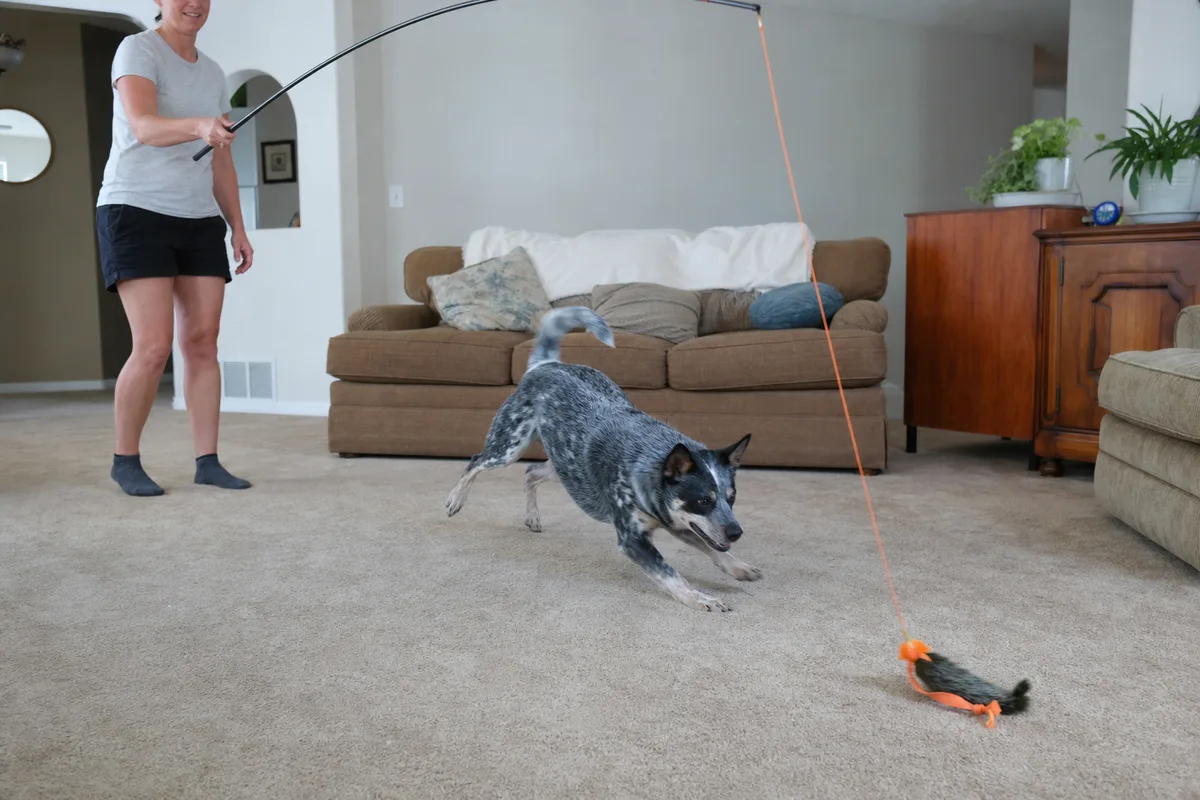 A dog chasing a flirt pole lure across a living room
Trick training is exercise disguised as cuteness
People file trick training under showing off, but from the dog's side it is concentrated mental work, and it is one of the best small-space options there is.
Teaching a dog to spin, to weave between your legs, to back up, to touch a target with its nose, to fetch a named object, all of it makes the dog think hard, and thinking hard is tiring. A ten-minute training session where the dog is problem-solving leaves it more settled than a much longer bout of plain movement. It also has no space requirement worth mentioning; most tricks can be taught in the area of a bath mat.
The thing that makes training either productive or frustrating is timing, specifically how fast you mark and pay the behavior you want. Reward a fraction of a second late and you teach the dog something other than what you meant. That mechanism, and how to get the timing right, is the whole subject of how dogs learn through reward timing, and it is worth reading before you spend a week accidentally training the wrong thing. Get the timing right and a dog learns a new trick in a few short sessions, each of which doubles as a workout.
Keep sessions short, a few minutes at a time, several times a day, and stop while the dog is still winning. A dog that ends a session having just succeeded comes back to the next one eager.
Chewing and licking: the quiet decompressors
Not everything has to be active. Chewing and licking are self-soothing behaviors for dogs, the canine equivalent of something to do with your hands, and they bring an animal down out of an excited state.
A long-lasting appropriate chew, or a rubber toy smeared with something the dog has to lick clean, gives a dog a job that ends in calm. This is especially useful in the evening, when the goal is not to spend energy but to shift the dog toward settling. It is also what you hand a dog that has to be quiet while you work or eat.
Match the chew to the dog and supervise new ones, since a determined chewer can break pieces off something too hard or too small. But as a category, chewing is an underused tool for turning a wired dog into a resting one without any exertion at all.
The most overlooked skill: an off switch
Here is the piece that separates a genuinely manageable apartment dog from an exhausting one, and it is not exercise at all. It is the ability to switch off.
A dog that only ever experiences its home as either full activity or frustrated waiting never learns to simply rest while nothing is happening. Some of the most tightly wound dogs I have met were not under-exercised. They were over-stimulated and had never been taught that lying down and doing nothing is an option, so any downtime felt to them like a problem to solve, usually loudly.
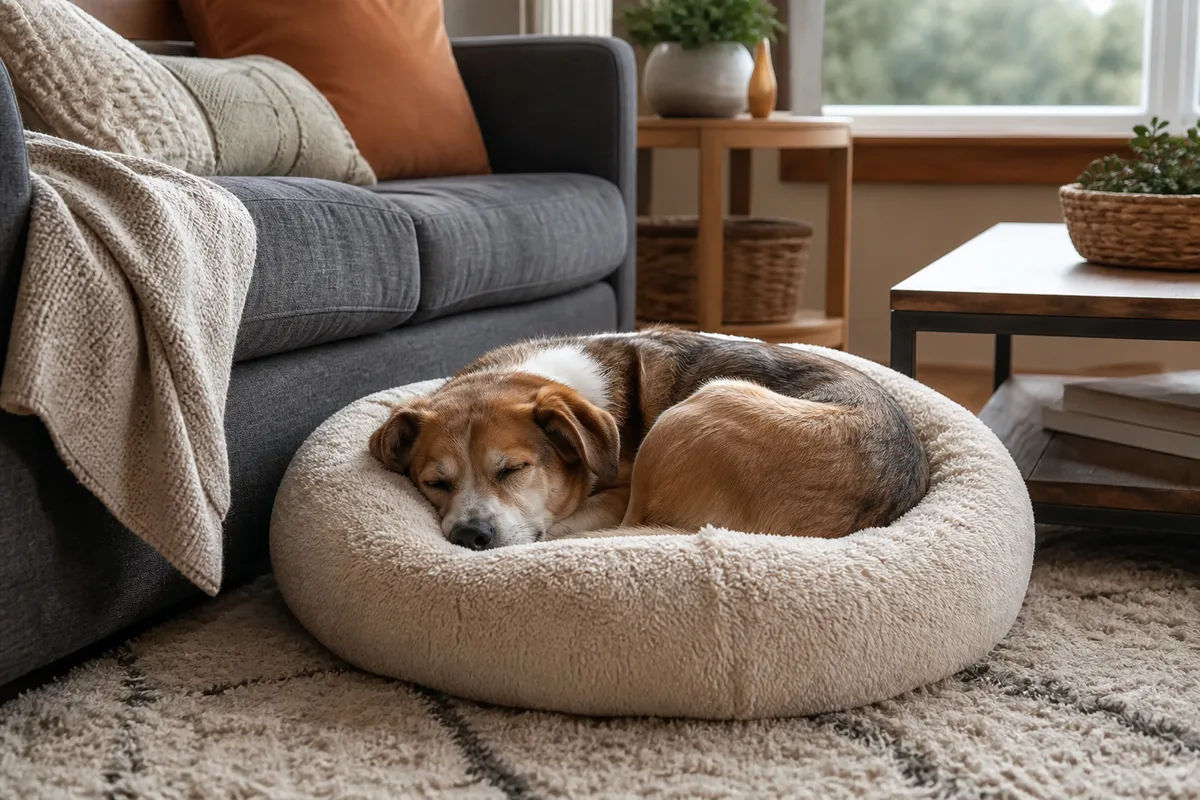
You build the off switch on purpose. After an active session, guide the dog to a mat or bed with a chew and let the arousal come down, rather than going straight from a game into hovering for the next thing. Reward calm when you see it: a dog that lies down and sighs is a dog offering you the exact behavior you want more of, and a quiet word or a calmly delivered treat tells it so. Over a few weeks a dog learns that settling is both allowed and rewarded, and it starts doing it on its own.
This is why "more exercise" so often fails as advice. A dog with no off switch treats every walk as a wind-up, comes home more aroused than it left, and the owner concludes it needs even more. The fix is not more fuel. It is teaching the dog how to stop.
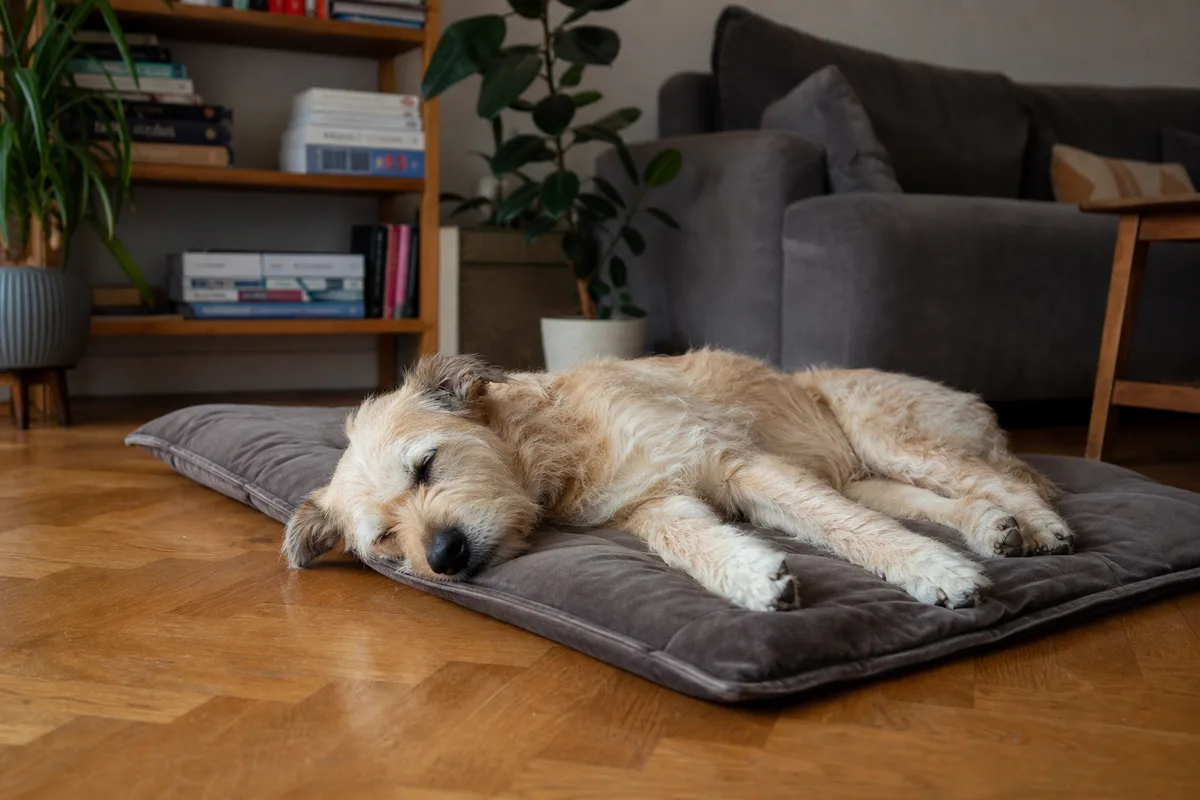 A dog asleep on a mat after an enrichment session
Fitting it to the dog in front of you
None of this is one-size-fits-all, and pretending otherwise is how people end up frustrated.
Puppies need less hard physical exercise than their energy suggests, not more, because their joints and growth plates are still developing and repetitive high-impact work can do harm. Skip the forced stair sprints and the forty-throw fetch marathons. Lean heavily on the mental side, short training sessions, scent games, food puzzles, and a lot of sleep, because a puppy that seems wired is very often a puppy that is overtired and cannot settle itself. Enforced naps are a real technique.
Adolescent and working breeds, the border collies, shepherds, spaniels, and their crosses, have the highest need and are the hardest to satisfy in a small space. Be honest if you have one of these: they can genuinely need more structured physical and mental work than an apartment easily provides, and they do best with a real daily job, whether that is long decompression sniffs, serious training, or a dog sport. The indoor tools here take real pressure off, but for a high-drive working dog they supplement outdoor work rather than fully replace it.
Older dogs often still want engagement long after their appetite for hard running fades. Scent games and food puzzles are ideal here, since they deliver satisfaction without demanding a body that no longer wants to sprint.
The average medium-energy adult, which is most dogs, does very well on a couple of sniffy walks plus a rotation of the indoor work above. This is the dog the apartment suits best.
A realistic daily rhythm
Structure beats intensity. A dog thrives on a predictable shape to the day far more than on any single big outing. A workable pattern for a small-space dog looks roughly like this:
Morning: a sniff-led walk to start the day, then breakfast fed through a puzzle or scattered rather than bowled.
Midday: something short, a few minutes of find-it or a stuffed toy, to break up the stretch when the dog might otherwise be idle and bored.
Evening: the bigger block. A more active game if the dog needs it, a flirt pole or tug session on carpet, followed by a training session, then dinner as a food puzzle, then a chew on the mat to bring everything down before the household settles for the night.
The exact contents matter less than the rhythm. Rotate the games so they stay novel, put toys away between uses so a toy that vanishes for a week comes back interesting, and end the active parts with something calming rather than leaving the dog cranked. A dog on a routine like this, with no yard at all, is a more settled animal than a bored dog with an acre.
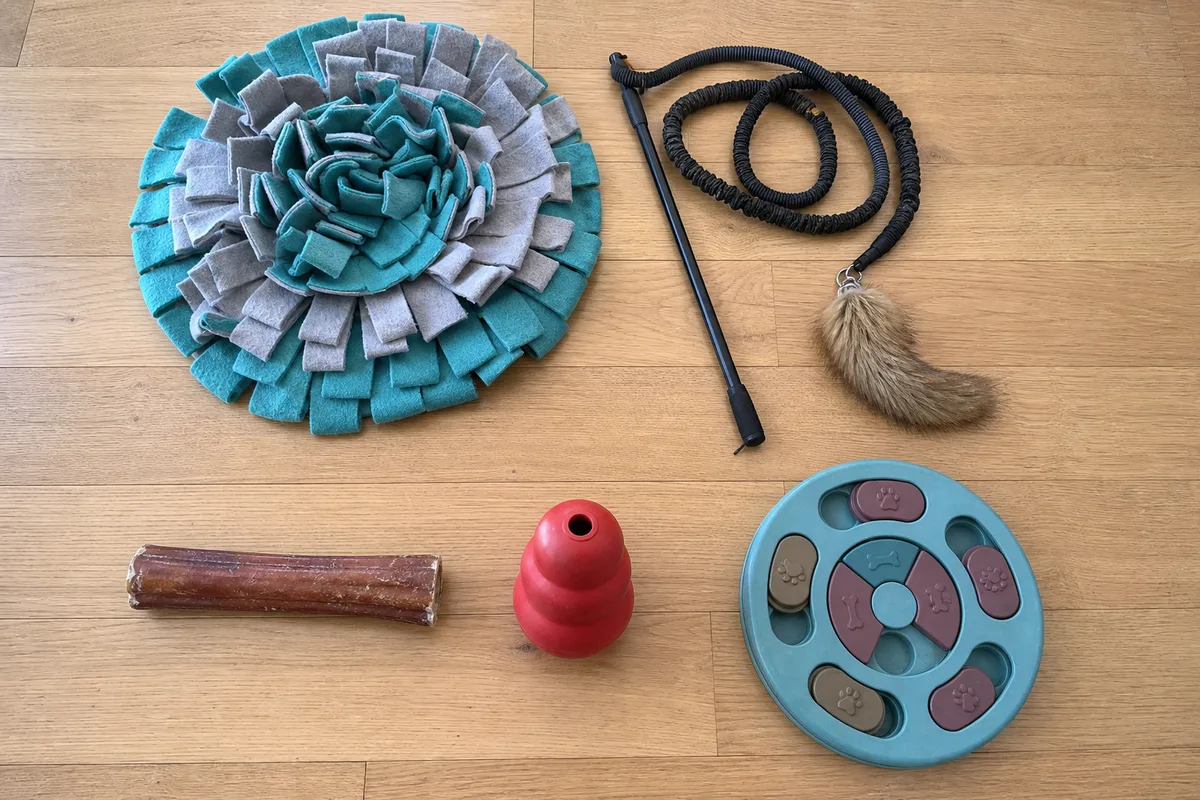 Indoor dog enrichment gear laid out on the floor: snuffle mat, flirt pole, chew, and puzzle toy
The mistakes that keep a dog wired
Relying on fetch alone. It builds the fitness that raises the bar. Cap it and lean on the mental work instead.
Skipping the sniffing. A route-march walk with no stopping to sniff spends less mental energy than a slow amble half the length. Let the dog read the ground.
Feeding from a bowl out of habit. The single easiest win on this page, wasted. Route the meals through work.
Running the flirt pole on a slick floor or yanking the lure overhead. A good tool turned into an injury waiting to happen. Carpet, and keep it low.
Winding the dog up with no way to come down. Ending every session at peak arousal and expecting the dog to then settle. Build in the chew, the mat, the calm finish.
Never teaching the off switch. Treating restlessness as a fuel problem when it is a settling problem. More exercise makes this dog worse, not better.
Assuming enrichment must be bought. A towel, a muffin tin, and the dog's own dinner cover most of it. The gear is convenient, not required.
A yard is a nice thing to have and it changes nothing about the fundamental job, which is to engage a dog's nose and brain, give it a sensible amount of real movement, and then teach it how to switch off. All three fit inside four walls. The dogs that struggle in apartments are almost never struggling for lack of grass. They are struggling for lack of a plan, and a plan is the one thing the space cannot take away from you.
For where this fits into the wider routine, from feeding rhythm to the weekly tasks that keep a household running smoothly, see everyday pet care at home.