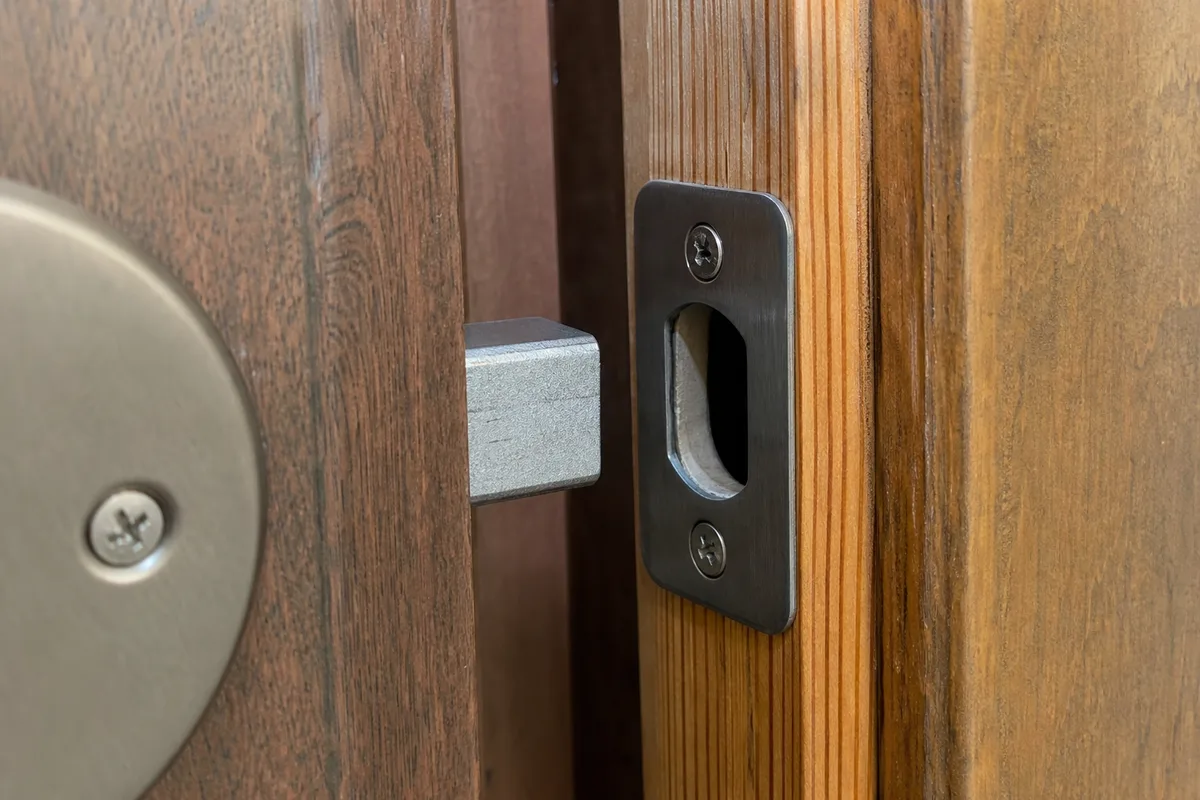
A lock only asks for your attention when it starts to fight you. For months, maybe years, you turn the key without a thought. Then one morning the key goes in fine but the deadbolt drags halfway and stops, and you find yourself shouldering the door like it owes you money while you crank it the rest of the way. That is the moment most people decide the lock is dying and start pricing a replacement. Nine times out of ten, they are about to spend money on the wrong thing.
I have pulled apart a lot of locks that homeowners had already written off, and the mechanism inside is almost never the problem. A deadbolt is a simple device. When it acts complicated, the cause is usually somewhere you would not think to look: a strike plate a couple of millimeters out of line, a keyway that got a shot of the wrong lubricant last summer, or a key that has been copied so many times it barely resembles the original cut. Once you understand what is actually happening inside the barrel and behind the door frame, you can tell those causes apart in a minute or two, and you stop replacing hardware that had years of life left in it.
This article walks through the mechanism from the inside out. Not to turn you into a locksmith, but so that when your lock starts sticking you can name the real cause instead of guessing. Knowing which annoyance is a five-minute fix and which one means the lock is genuinely worn is the difference between a screwdriver and a trip to the store.
The annoyance that starts the question
Sticky locks announce themselves in a handful of distinct ways, and each one points somewhere different. Learning to read the symptom is half the diagnosis, so it is worth slowing down on the specifics before we open anything up.
The most common complaint is a deadbolt that will not throw smoothly when the door is closed, but glides perfectly when the door is open. Try that test right now on any lock that bothers you: swing the door open, and with it hanging free, turn the thumbturn or key. If the bolt shoots out and retracts like butter with the door open, and only fights you when the door is shut, the lock itself is fine. The bolt is dragging against the strike, not failing inside. That single test rules out the entire internal mechanism in about ten seconds, and it is the first thing I do every time.
A different symptom: the key goes into the keyway but the whole plug refuses to rotate, or turns in gritty little jerks. That is an internal issue, either contamination in the pin chambers or a key that no longer matches the cuts the lock expects. A third: the key barely wants to slide into the slot at all, catching before it seats. That points at burrs on the key itself or debris packed into the keyway. And a fourth, the loose and rattly feeling where the whole cylinder wobbles in the door, which is almost always mounting screws that have backed out, not a lock defect.
Four symptoms, four different roots. The mistake is treating them all as one thing called "bad lock" and reaching for a replacement. Once you can sort them, most of the fixes are trivial and cost nothing but a few minutes. To do that sorting confidently, it helps to know what is behind the keyway in the first place.
Inside a pin-tumbler lock
Almost every residential lock and deadbolt in North America uses the same core mechanism: the pin-tumbler cylinder. It has been the standard for well over a century, and once you see how it works, the reasons it sticks become obvious.
Picture a metal cylinder with a rotating core in the middle, called the plug. That is the part the key slides into and that turns when the lock opens. The plug is held from turning by a row of little pins, usually five of them in a residential lock, sometimes six on a higher-grade deadbolt. Each pin is actually a stack of two: a lower pin, called the key pin, that rests on the key when you insert it, and an upper pin, called the driver pin, sitting above it. A small spring pushes each stack downward.
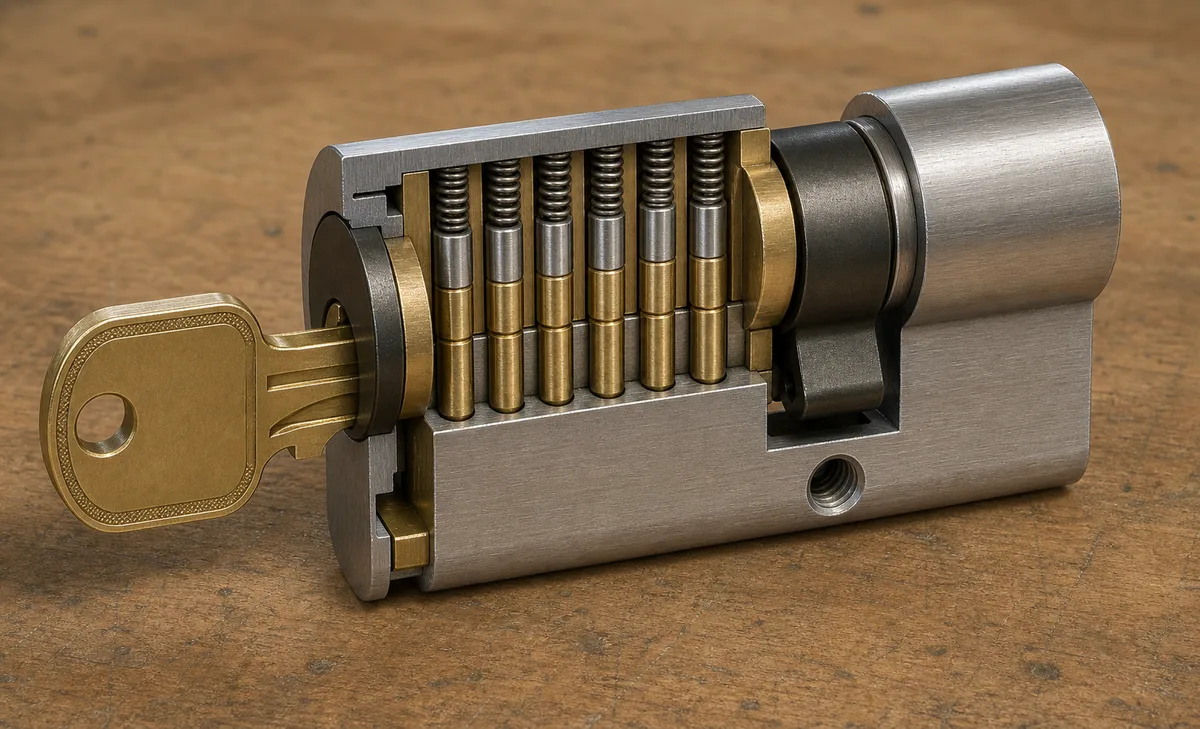 An exposed pin-tumbler lock cylinder on a workbench
The magic is in a single line called the shear line, the boundary between the rotating plug and the fixed housing around it. When no key is in, the driver pins straddle that line, poking down into the plug and locking it to the housing so it cannot turn. When you push in the correct key, the peaks and valleys cut into its blade lift each pin stack to exactly the right height, so the gap between key pin and driver pin lands precisely on the shear line for all five pins at once. With nothing crossing the boundary anymore, the plug is free to rotate, and turning it drives the bolt.
Why the tolerances are so tight
Here is the part that explains the stickiness. Those pins are lifted to fractions of a millimeter of accuracy. A residential lock separates its pin heights into a handful of depth increments, and the difference between one depth and the next is often only around a third of a millimeter. That is a tiny margin, roughly the thickness of a few sheets of paper, which is not much room for a lock to have opinions. It means a key that is worn down even slightly, or a cylinder holding a little grit, can push a pin a hair too high or too low, and a plug that would have spun freely now binds. Everything about how a pin-tumbler lock feels comes down to whether those five pins reach the shear line cleanly and all at the same instant.
What actually moves the bolt
Turning the plug does not directly shove the bolt out. The back of the plug drives a cam or a tailpiece, a flat bar that rotates with the plug and hooks into the bolt mechanism behind it. On a deadbolt, that tailpiece cranks a small gear or lever that pushes the bolt straight out into the frame. This matters because it means there are two separate places a lock can bind: inside the cylinder where the pins live, and in the bolt mechanism itself. When you are diagnosing, keeping those two zones separate in your head saves you from tearing apart the wrong one.
How a deadbolt differs from a latch
Most exterior doors carry two locking devices, and people blur them together even though they work on completely different principles. Telling them apart matters, because they stick for different reasons and one is far more forgiving than the other.
The latch is the spring-loaded part in the knob or lever set. Its bolt has an angled face, the beveled side, so that when you pull the door shut the ramp rides over the strike and snaps back into the hole on its own. That spring is what lets a door latch closed without you touching the handle. It is convenient, but a spring latch holds against almost nothing; a firm shoulder or a plastic card can defeat it, which is why it is a convenience device more than a security one.
The deadbolt is the opposite philosophy. Its bolt has a flat, square end and no spring. Nothing throws it automatically; it only moves when you turn the key or thumbturn, and once thrown, it has no give in it at all. That is the whole point. A properly installed deadbolt should extend a full inch, sometimes labeled as a one-inch throw, into the frame. That depth is what makes it hard to force, because a short bolt that only catches a quarter inch of the strike can be popped by spreading the frame. When people fit a new deadbolt and complain it feels weak, the throw depth is usually why.
Why this changes your diagnosis
Because the latch is spring-driven, it forgives a lot of misalignment; the ramp finds its way into a slightly off hole. The deadbolt forgives nothing. Its square end has to line up with the strike opening within a small margin or it jams flat against the metal. So when a door locks fine with the knob latch but the deadbolt is the one that fights, that is not two failing locks. It is one alignment problem that the tolerant latch hides and the unforgiving deadbolt exposes. That distinction sends you straight to the strike plate instead of the cylinder.
Why locks get stiff: grit, wear, alignment
Step back and the causes of a hard-turning lock sort into three families. Almost every stiff lock I have handled falls into one of them, and knowing the three lets you narrow down fast instead of poking around blind.
The first family is contamination. The keyway is an open slot exposed to the weather and to whatever rides in on the key. Dust, pocket lint, sand tracked in on a copied key, and the sticky residue of old oil all work their way down into the pin chambers. Grit is the quiet killer: it packs around the pins, adds drag to their travel, and keeps them from lifting cleanly to the shear line. An exterior deadbolt facing wind and rain collects this faster than an interior lock, which is why the front door is usually the first to go stiff.
The second family is wear. Every turn drags metal across metal. Over thousands of cycles the key pins round off, the plug loosens in its housing, and, most of all, the key itself erodes. This is the one people underestimate. Keys are cut from soft brass, and each use files a whisker off the high points. A key that has ridden on a keyring for a decade may sit a fraction of a millimeter low on two or three cuts, enough to make the plug bind even though nothing inside the lock has failed.
The third family is alignment, and it is by far the most common, even though it has nothing to do with the lock's insides. When the door, the frame, or the strike shift, the bolt no longer meets its hole squarely and drags on the metal edge. This is the family that masquerades as a broken lock and sends people shopping for hardware they do not need. We give it its own section below because it deserves the attention.
Sorting the three quickly
The open-door test separates alignment from the other two: if the bolt is smooth with the door open and stiff only when shut, you are looking at alignment, full stop. If it is stiff even with the door hanging free, you are into contamination or wear, and the tell there is the key. Try a different copy, or better, a fresh key, and if the action improves, it was wear on the key rather than the mechanism. Three families, two simple tests, and you have narrowed a vague "it sticks" down to a specific cause.
The strike-plate problem that mimics a bad lock
If you take one thing from this article, make it this: most complaints about a "bad lock" are really strike-plate misalignment. The bolt is dragging against the frame, not failing inside, and it is a screw-adjustment fix that costs nothing. I have lost count of the locks handed to me as dead that were simply aimed a few millimeters off their hole.
The strike plate is the metal plate on the door jamb with the hole the bolt drops into. For the deadbolt to throw freely, its square end has to enter that hole without touching the edges. When the alignment drifts, the bolt catches the lip of the strike or the wood behind it, and you feel that as grinding resistance exactly at the point where the bolt should be sliding home. Because the feeling shows up during locking, the brain blames the lock. The lock is innocent.
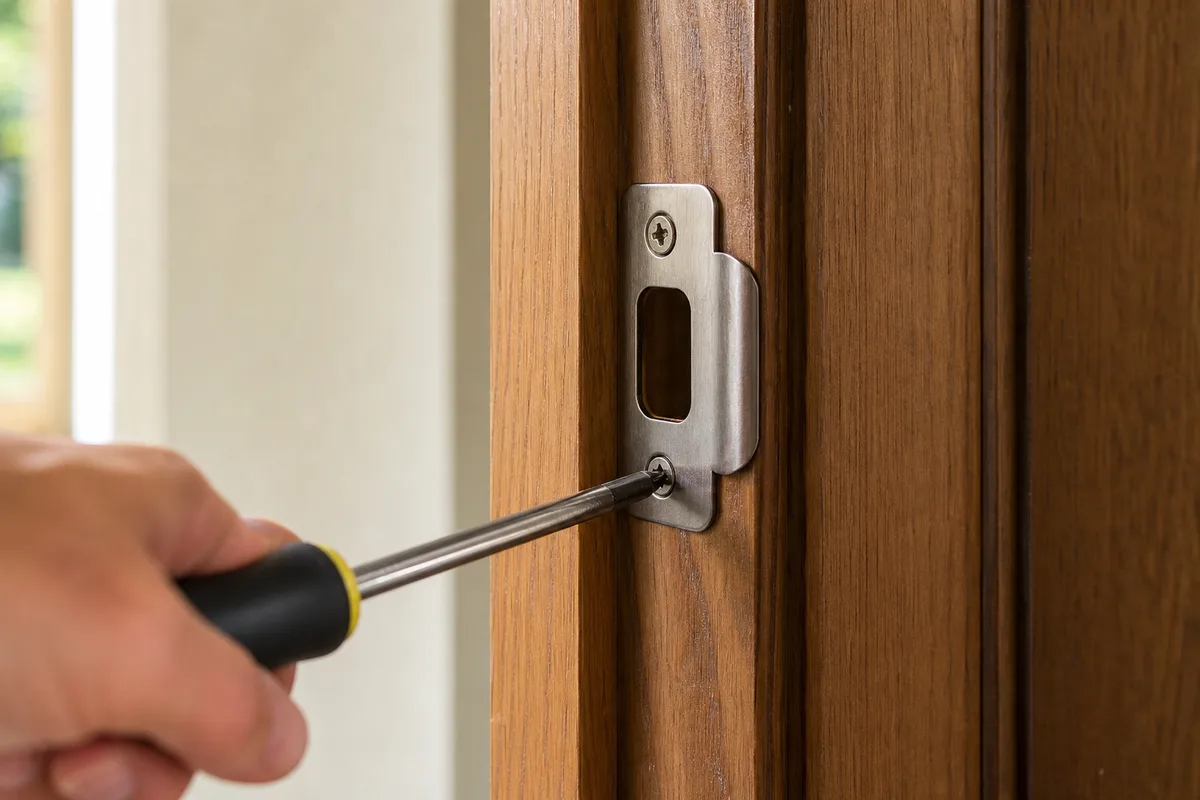 Adjusting a strike plate on a door frame with a screwdriver
Why does it drift? Houses move, yours included, slowly and without asking permission. Wood-frame doors swell in humid months and shrink in dry ones, and the whole slab can settle on its hinges over a season, dropping the bolt a few millimeters below where the strike hole sits. Hinge screws loosen and let the door sag. A frame can shift as the house settles. None of this touches the mechanism, but all of it moves the target the bolt is trying to hit.
Finding the drag direction
You can read exactly where it is binding. Extend the deadbolt with the door open and look at the bolt's end, or run a soft pencil or lipstick around the tip, then close the door and throw the bolt against the strike. The smear left on the strike plate shows you which edge it is hitting, top, bottom, or one side. That tells you which way the door has moved and which direction to correct. It turns a vague fight into a precise, measurable misalignment you can actually fix.
The fixes, from easiest up
The simplest correction is to enlarge the strike hole slightly in the direction of the drag with a round file, giving the bolt a hair more room, and that alone resolves a great many cases in a few minutes. If the door has sagged, the fix is often at the hinges rather than the strike: tightening the hinge screws, or replacing the short top-hinge screw with a longer one that bites into the framing stud, can lift the slab back into line and re-center the bolt. Sometimes the strike plate itself needs to shift, which means removing its two screws, moving it a couple of millimeters, and drilling fresh pilot holes. Related door-sag and binding issues overlap heavily with this, and the mechanics of getting a slab hanging square again are worth reading alongside this in the guide to why doors stick and how to fix them. The point is that all of these are adjustments, not replacements, and none of them involve buying a new lock.
Lubrication done right
Once contamination is on the table, people reach for lubricant, and this is where a well-meaning fix quietly makes things worse. The rule is short: use a dry lubricant in a lock, never oil.
Graphite or a dry PTFE lubricant belongs in a keyway. Oil, and that includes the popular spray penetrating oils people grab off the garage shelf, does not. Here is why it matters. A liquid oil coats the pins and feels slick for a day or two, but it is sticky, and the same keyway that collects dust now collects dust that adheres to a film of oil. Within a season that oily grit turns into a gummy paste that packs the pin chambers and makes the lock stiffer than it was before you touched it. I have opened cylinders that were nearly seized solid with a black tar that started life as a helpful squirt of oil. Good intentions, bad chemistry. A dry lubricant leaves a slick film with nothing for grit to stick to, so it keeps working instead of collecting grime.
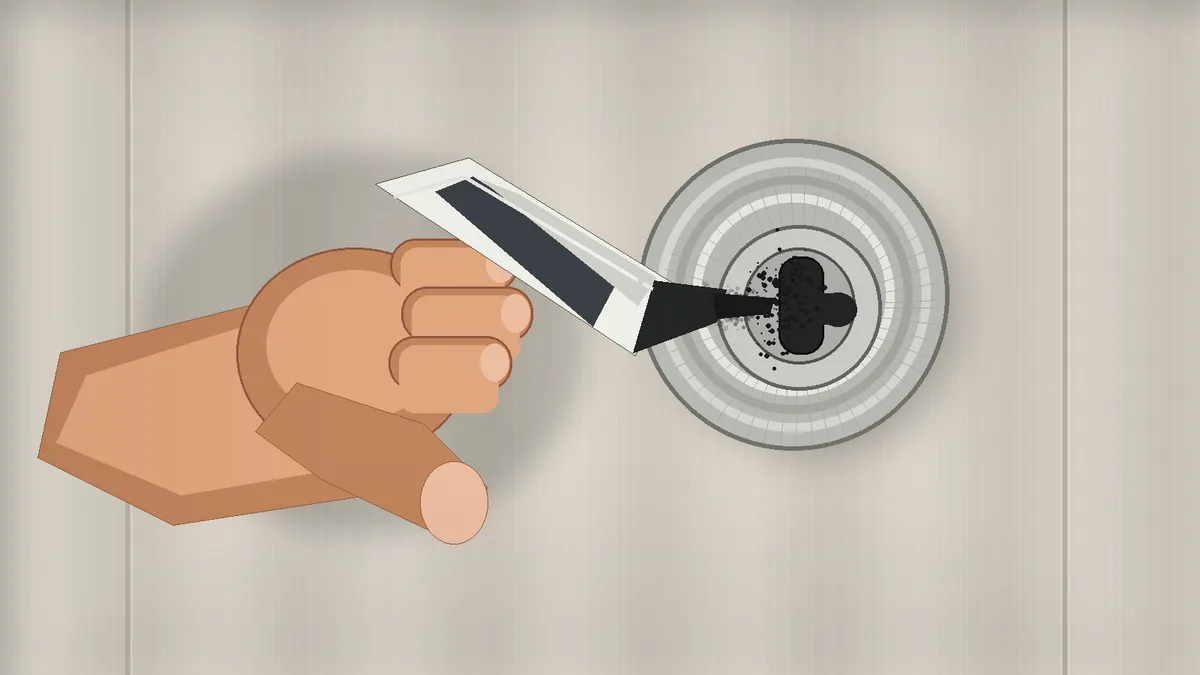 Applying dry lubricant to a door lock keyway
How to apply it
Powdered graphite comes in a small squeeze tube with a fine nozzle. Aim it into the keyway and give one or two light puffs, no more; a heavy load of graphite can cake up on its own. Then insert the key and work it in and out a dozen times, turning it partway if the plug allows, to carry the powder down onto the pins. A dry PTFE spray works the same way, but use the straw and a very short burst, because the propellant can carry the film deeper than you want if you flood it. Wipe the key and the face of the lock afterward, since loose graphite will smudge a light-colored door and anyone's hands, and it has a real talent for finding a white shirt.
When lubricant is the wrong answer
Be honest about what lubrication can and cannot do. It fixes a lock that is stiff from grit or dryness in the cylinder. It does nothing for a strike-plate alignment problem, because that drag is out at the frame, not among the pins; greasing the keyway there just wastes graphite while the door keeps fighting. It also will not save a genuinely worn cylinder or rescue a key cut too shallow. If you have lubricated correctly and the plug still binds with the door open, lubricant was not the answer and you have moved into the wear category. Knowing that boundary keeps you from puffing graphite at a problem that lives somewhere else entirely.
When to adjust, when to replace
At some point every diagnosis reaches the question of whether to keep fixing or to replace. There is a rational order to this, and following it keeps you from throwing out hardware that had years left while also stopping you from endlessly babying a lock that is genuinely finished.
Start with the cheapest, most reversible move and climb only as needed. Run the open-door test first. If the bolt binds only when the door is shut, it is alignment, and you go to the strike plate and hinges, never the lock. If it binds with the door open, try a different key. And here is a detail that surprises people: a key that goes in but will not turn smoothly is often the worn part, not the lock. A fresh key cut from the original, the one that came with the lock, rather than a copy of a copy of a copy, frequently brings the action right back. Each duplication carries small errors, and after a few generations the cuts drift enough to bind good pins. Cutting a new key from the source is cheap and fixes more sticky locks than most people expect.
If a fresh key and correct lubrication both fail, and the plug still turns in gritty jerks or the key feels like it is grinding over internal ridges, you are into real wear on the cylinder. That is the point where replacement earns its cost. Even then, you often do not need a whole new deadbolt. On many locks you can swap just the cylinder, or have it re-pinned, and keep the existing bolt and hardware. Replacing the entire assembly makes sense when the bolt mechanism itself is sloppy, when the throw no longer reaches a full inch into the frame, or when you want to re-key the house anyway after a move or a lost key.
The honest limits
Some situations are not yours to fix, and it is worth naming them. A lock that has been forced or drilled in a break-in is compromised and should be replaced outright, not patched. Electronic and smart deadbolts add motors and circuit boards that sit outside the scope of a screwdriver and a tube of graphite; when those fail electronically the mechanical diagnosis in this article only covers the bolt half of the device. And if the door itself is racked out of square badly enough that no strike adjustment brings the bolt to its hole, the real repair is the door and frame, not the lock at all. Working out which repair skills are worth learning first, and where the line falls between a homeowner fix and a call for help, is the larger subject this piece sits under, mapped out in the guide to essential home repair skills.
Understand the mechanism and the whole thing gets calmer. A pin-tumbler lock is five little stacks reaching a shear line, a deadbolt is a square bolt that has to meet its hole squarely, and nearly every annoyance traces back to grit, a worn key, or a strike plate a few millimeters off. Before you decide a lock is dead, throw the bolt with the door open, try a fresh key, and put a dry lubricant, not oil, into the keyway. Most of the time the lock you were about to replace just needed to be aimed straight and cleaned out, and the fix cost you a screwdriver and ten minutes instead of a new lock and a service call.