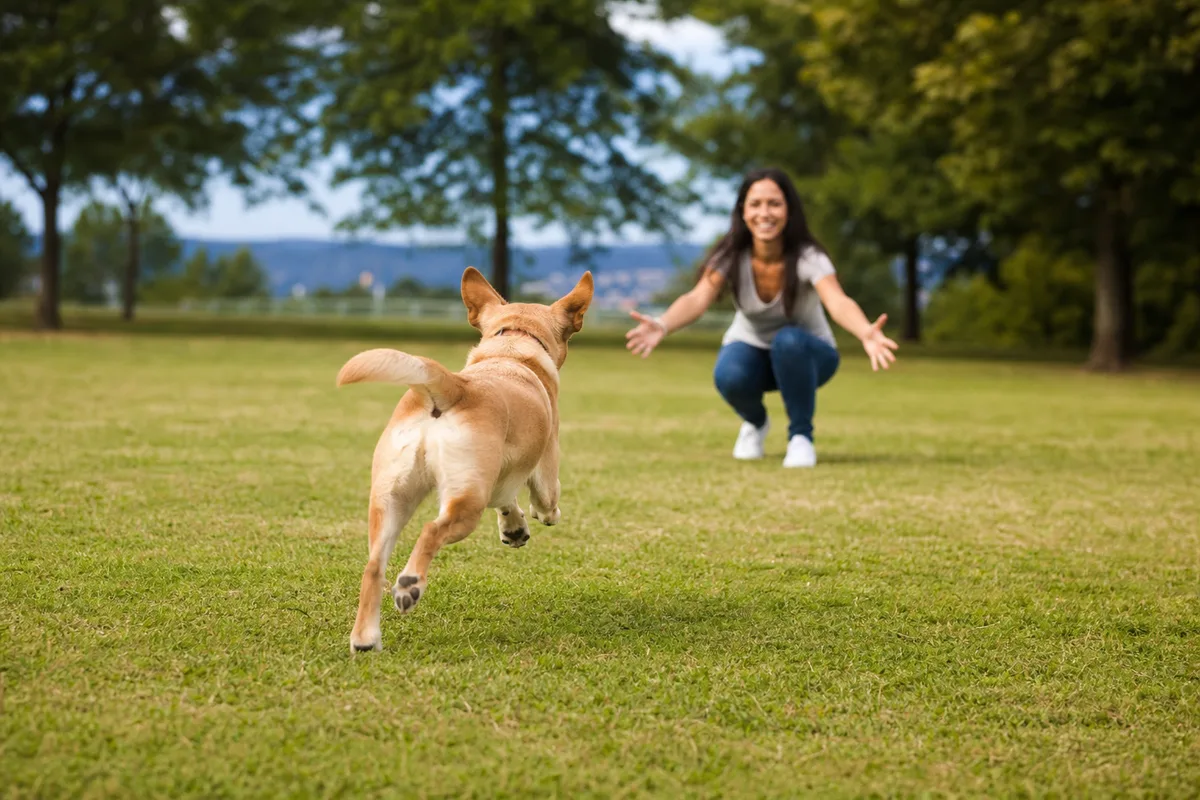
There is a specific kind of embarrassment that only dog owners know. You are standing in an open field, your dog is forty feet away with its nose in something, and you call "come" in your normal voice. Nothing. You call again, a little firmer. The ears twitch, and the dog keeps sniffing. By the third call you are using the voice that tells every other person at the park that your dog does not, in fact, come when called. You end up walking over to collect the dog yourself, which teaches it exactly the wrong lesson, and you drive home wondering whether off-leash freedom is ever going to be safe.
I have stood in that field. The good news is that a recall that has fallen apart is almost always fixable, and the reason it fell apart is usually not stubbornness or a "dominant" dog or any of the other stories people tell themselves. It is a training problem with a clear cause and a clear repair. This article walks through why the word stopped working and how to rebuild a recall you can actually trust, starting on a long line in a quiet spot and working up to real distraction. It takes weeks, not days, and it asks for patience more than talent, which is good news for most of us. But the method is not complicated, and it holds.
The park moment every owner dreads
Let me describe the failure precisely, because the details tell you what went wrong. Your dog is off doing something rewarding: sniffing a scent trail, greeting another dog, eating something unspeakable in the grass. You call. The dog does a quick cost-benefit calculation, and the current activity wins. That is the whole event. The dog is not defying you; it is choosing the better-paying option, and in that moment you are offering less than a fresh rabbit smell. Being outbid by a patch of grass is humbling, but that is the honest state of the negotiation.
This matters because it reframes the fix. If the problem were disobedience, the answer would be more authority, a sterner tone, maybe a jerk on the leash. But the problem is economics. Your dog has learned, over dozens of repetitions, that coming when called is a mediocre deal, and that whatever it is currently doing pays better. To fix the recall you have to flip that math so thoroughly that coming to you becomes the best offer available, reliably, every time, until the choice stops being a choice and becomes a reflex.
The other thing this moment reveals is timing. Notice that the dog ignores you specifically when it is far away and busy, and comes readily when it is bored and near the door at dinnertime. That gap between the easy recall and the hard one is the entire training project. A dog that comes in the kitchen but not the park does not have a recall; it has a habit that only survives when nothing competes with it. Real reliability means the word works when it costs the dog something to obey, and that reliability is built deliberately, not hoped for. If you want the underlying reason a dog weighs one payoff against another the way it does, the piece on how dogs learn through reward timing lays out the mechanism that everything here depends on.
How a recall cue gets poisoned
Here is the part most owners have never heard, and it explains almost every broken recall I have seen. A cue gets "poisoned" when the word reliably predicts something the dog does not want. And the single most common way people poison "come" is by calling the dog only when the fun is about to end.
Think about the dog's day at the park from the dog's point of view. It runs, sniffs, plays, and has the time of its life. Then, once, at the very end, you call "come," clip the leash on, and leave. Do that every visit and the dog builds a rock-solid association: the word "come" predicts the party ending. After enough repetitions, "come" stops meaning "good things over here" and starts meaning "the good part is over now." A smart dog responds to that by getting slower, drifting wider, and eventually just declining the invitation. It has learned the word perfectly. It simply learned the wrong meaning.
There are other ways to poison the cue, and they all share the same logic: the word comes to predict something unpleasant. You call the dog and then give it a bath. You call the dog and then trim its nails or shut it in the crate while you leave for work. You call the dog over and then scold it for something it did three minutes ago, which in the dog's mind means it got punished for coming. From the dog's side of the ledger, you set a small trap and then acted surprised when it stopped walking into it. Every one of these teaches the dog that answering the call sometimes leads somewhere bad, and a recall that is sometimes a trap is a recall the dog will hedge against.
The reason this is worth understanding before you start retraining is that you cannot simply drill the same word harder. If "come" already carries a load of "this ends the fun," repeating it just deepens the association. You would be practicing the poison. That is why the rebuild does not start with the old word at all.
Starting over with a fresh word
The cleanest way to escape a poisoned cue is to stop using it and pick a brand-new one. The dog has years of associations attached to "come" or "here" or whatever you have been calling; rather than fight all of that, you sidestep it. Choose a word or short sound the dog has never heard in this context. People use "here," "front," "close," a whistle, or a nonsense word. The word itself does not matter to the dog. What matters is that it arrives clean, with no history, so you get to decide what it means from the first repetition.
I usually suggest something you can say sharply and consistently, in the same tone every time. Dogs read the sound pattern, not the dictionary, so "to me" said brightly and identically every time works far better than "come" said ten different ways depending on your mood. Pick it, say it out loud a few times to make sure it feels natural under pressure, and then commit to protecting it. From this point on, that new word only ever gets used when you are about to pay the dog well and you are confident the dog will succeed. You do not spend it. You do not test it early. You do not call it across a park in week one to see if it is working. Treat it like a savings account: the early weeks are for making deposits, not withdrawals. Every single time the new word comes out of your mouth, something wonderful happens for the dog, with no exceptions, because the exceptions are what wrecked the last one.
Meanwhile, you keep the old word alive as a low-stakes, no-pressure "hey, this direction" cue if you like, or you retire it entirely. It does not need to carry weight anymore. All of your real reliability is going to live in the new word, built from scratch, one clean repetition at a time.
Paying the recall like it always matters
This is the heart of the rebuild, and it is where people quietly cheat and then wonder why it did not hold. For the first several weeks, the new recall word gets paid like a jackpot every single time. Not a piece of kibble. Not a pat on the head and a "good boy." A genuinely high-value payment: a handful of small soft treats delivered one after another, or a few seconds of the dog's favorite game, something the dog would cross the field for.
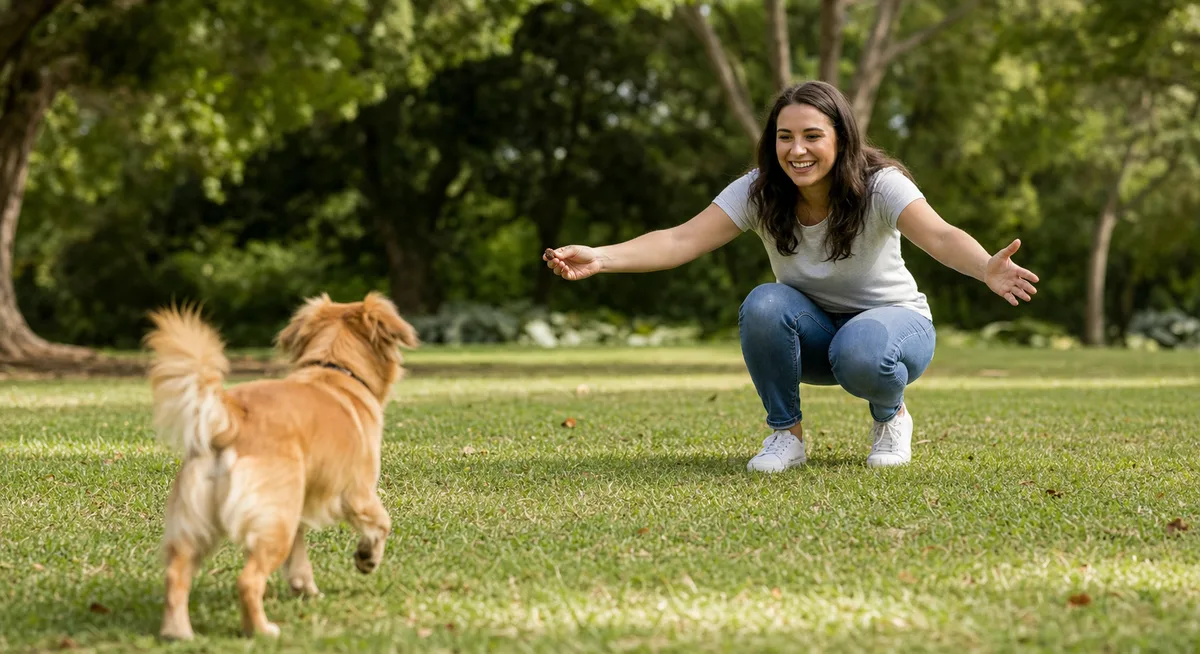 An owner crouching and calling a dog for recall practice
The reason for the extravagance is the math from earlier. You are trying to make coming to you the highest-paying option in the dog's world, and you are competing against squirrels, other dogs, and interesting smells. A single dry biscuit does not win that competition. Ten seconds of chicken and enthusiasm might. The mistake I see constantly is an owner who pays richly for the first week, sees it working, and then starts thinning the rewards to "wean the dog off treats." The dog keeps meticulous books, and it notices the pay cut immediately. A recall that sometimes earns a jackpot and sometimes earns nothing becomes a gamble, and a dog that has been burned before will decline a gamble. Consistency of payment is what turns the word from a gamble into a sure thing, and a sure thing is what gets a dog to leave a good smell and sprint to you.
Timing matters as much as size. Mark the moment the dog commits to you, ideally with a marker word or a clicker the instant it turns and starts coming, then pay when it arrives. The association window a dog works with is short, roughly a second or two, so a reward that lands late teaches the wrong lesson. If you are hazy on why that one-second gap decides what the dog actually learns, the explainer on how dogs learn through reward timing is worth reading alongside this, because recall is where sloppy timing shows up most painfully.
A few practical rules keep the payment honest during this phase:
- Never call the word when you are not prepared to pay. No treats on you, no game available, do not say it. Use the dog's name or a clap to get attention instead and save the word for when you can back it up.
- Pay for slow recalls too, at first. If you only jackpot the fast ones, a nervous dog stops trying. Get the coming happening reliably, then start paying the enthusiastic ones a little more.
- Make the arrival worth staying for. A common error is snatching the collar the instant the dog arrives, which teaches the dog that coming close means getting grabbed. Feed first, reach for the collar second, and make the whole event pleasant.
Do this for weeks, in easy settings, before you ever ask the dog to do it somewhere hard. The word is becoming a promise, and you are keeping it every time.
The long line as a safety bridge
There is a gap between a recall that works in your living room and one you can trust with the dog off-leash near a road, and the tool that safely bridges that gap is a long line. This is the single piece of equipment I will insist on, because skipping it is the reason so many recalls collapse the first time they actually count.
A long line is simply a lightweight lead, usually 15 to 30 feet, that clips to the dog's harness. A 30-foot line lets the dog range out far enough to feel free while you keep a physical connection, so the dog never gets to practice the one thing that destroys a recall: ignoring you and getting away with it. Clip it to a well-fitted harness rather than a collar, because a dog hitting the end of a long line at a run can jolt its neck, and let it trail or hold the end loosely as the situation calls for.
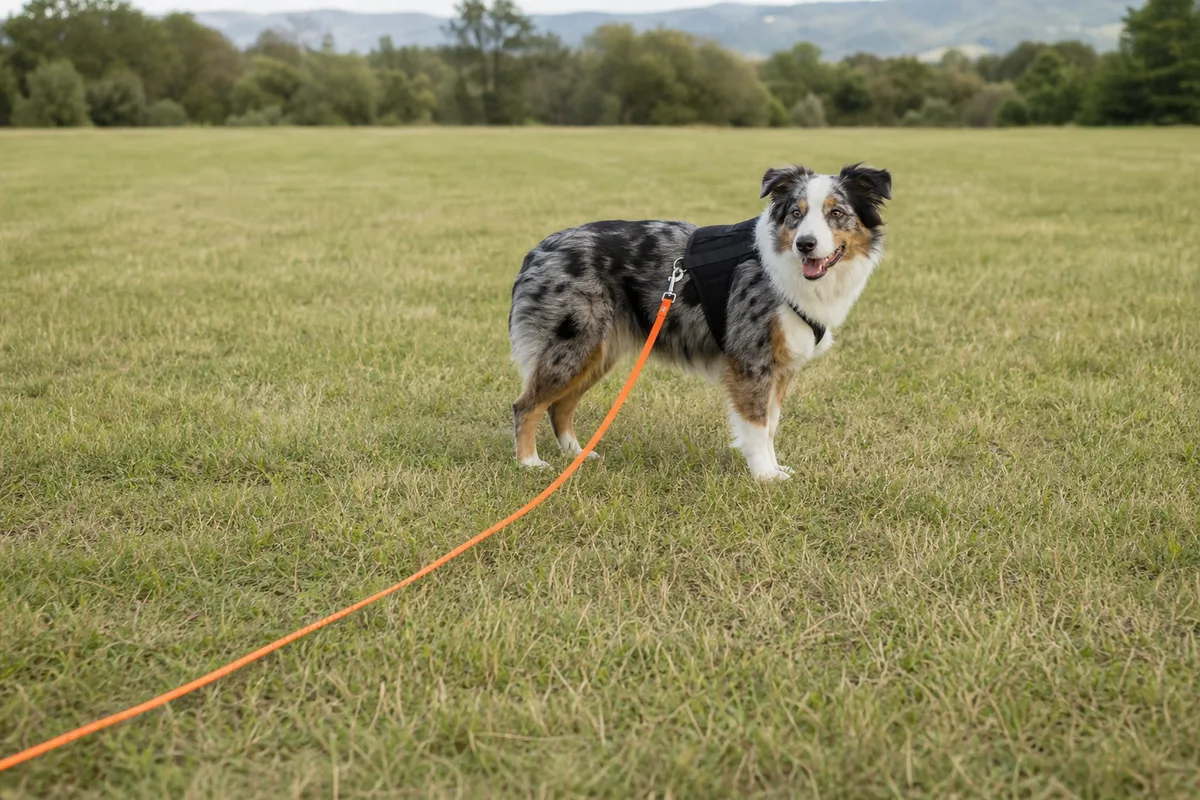 A long training line attached to a dog's harness in a field
The way you use it matters more than the line itself. The long line is not a steering wheel. You are not reeling the dog in like a fish when you call. If you call and the dog ignores you, you do not yank; you gently prevent the dog from getting farther away, take a step backward to make yourself more interesting, and encourage the dog to choose you, then pay it enormously when it does. The line guarantees the dog cannot self-reward by running off, which means every repetition ends the right way, with the dog choosing to come and getting paid. Over dozens of reps, the dog builds a history in which the recall word always, always leads to good things, because the line quietly removed the option of it leading anywhere else.
Two field notes from using these for years. First, wear gloves the first few sessions; a long line running through a bare hand when a dog lunges after a bird leaves a burn. Second, watch the line around your own legs and the dog's, because a fast dog can wrap a leg and take you both down. Nobody has ever looked dignified being reeled off their feet by a spaniel. A little care in an open, obstacle-free field solves both. The long line is not a lifetime tool. It is the training wheels that come off once the recall is genuinely reliable, and taking them off too early is exactly the mistake it exists to prevent.
Adding distance and distraction gradually
Once the new word pays reliably and the long line is on, the actual training is a slow, deliberate ramp. The principle is that you only ever raise one difficulty at a time, and you only raise it when the current level is easy. Push two things at once and you set the dog up to fail, and a failed recall is a repetition of the old poison. Ambition is the enemy here; the dog awards no bonus points for degree of difficulty.
Think of it as three dials you turn independently: distance (how far the dog is when you call), distraction (how much competition there is), and duration (how long the dog has been engaged in something before you call). Start with all three low. Dog five feet away, quiet backyard, called after just a moment of sniffing. Nail that a dozen times over a few short sessions. Then turn exactly one dial up a notch. Maybe distance to fifteen feet, everything else the same. When that is solid, drop distance back down and raise distraction instead, moving from the backyard to a quiet park with the long line on.
A sensible progression looks roughly like this:
- Inside, no distractions, short distance. Hallways and living rooms, building the pattern.
- Backyard, mild distractions, on the long line. Birds, smells, but familiar territory.
- Quiet park at a low-traffic hour, long line, moderate distance. New smells, few dogs.
- Busier park, long line, with real distractions at a distance. Other dogs visible but not right there.
- Close distractions, still on the line. Calling the dog away from a sniff spot, a person, eventually another dog.
Keep sessions short, five to ten minutes, several times a week rather than one long grind, because recall practice is mentally taxing and a tired dog starts failing. And keep the win rate high. If the dog misses more than about one call in ten, you have turned a dial too far; back down to where it succeeds and rebuild from there. The whole ramp might take a couple of months of casual practice, and that is normal. You are laying down a deep track of successful repetitions, and depth is what makes a recall hold when it counts. This same principle of building from zero distraction up to the real world drives other on-leash skills too; the walkthrough on teaching loose-leash walking uses the identical ramp, and practicing both together reinforces the pattern for the dog.
Never calling for something the dog hates
This rule is short and absolute, and it is the one that keeps the rebuild from quietly rotting the way the original did. Never use your recall word to summon the dog to anything it dislikes. Ever.
That means the recall word is never the thing you say before a bath, before nail trims, before the vet's parking lot, before you leave the house and crate the dog, or before you scold it. If you need the dog for any of those, walk over and collect it, or use a different, throwaway phrase you do not care about. Your golden word stays golden. The moment you spend it on something the dog would avoid, you begin rebuilding the exact association that poisoned the last cue, and the dog's cost-benefit calculation shifts back against you.
The hardest version of this is leaving the park, because leaving is unavoidable and the dog loves being there. The trick is to break the link between the recall and the ending. Call the dog to you many times during the visit, pay it, and release it back to play, so the overwhelming majority of recalls at the park predict a treat and more freedom, not the leash and the car. Then, when it is genuinely time to go, either call and pay especially well before clipping the leash, or better, just walk over and clip it without using the word at all. Some visits, call the dog, leash it, walk twenty feet, and let it off again to play, so even the leash does not reliably mean the end. You are teaching the dog that the word and the leash are almost never bad news, which is the opposite of the lesson that broke the recall in the first place. This is the same logic of predictable, positive routines that keeps a household calm overall, covered more broadly in the guide to everyday pet care at home.
Testing reliability honestly before trusting it
The last skill is the one owners are worst at, because it requires resisting the urge to declare victory. Before you trust a recall off-leash in an unfenced space where a mistake could mean a road or a lost dog, you have to test it honestly, and honestly means you assume it is not ready until the dog proves otherwise across the exact conditions you plan to trust it in.
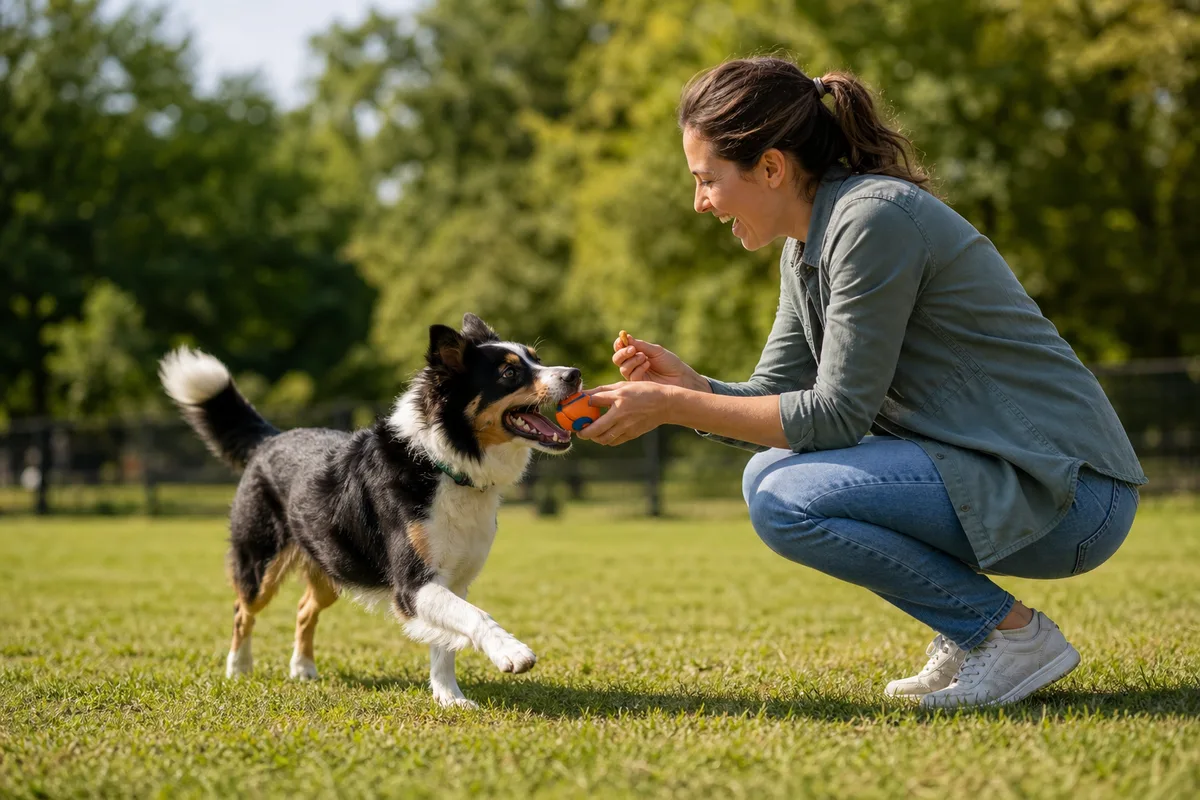 A dog reaching its owner and receiving a reward during recall training
Here is the test I use. With the long line still attached but held loose so the dog does not feel it, run recalls in the real environment, at real distances, with real distractions present, and count. Not "it mostly works." Count. If the dog comes promptly on nine or ten of ten calls across several sessions, on different days, with distractions like other dogs and fresh smells genuinely present, you have evidence. If it is coming eight of ten, you are not there yet; eight of ten means that on the tenth call, the one where a car is coming, the dog keeps sniffing. A recall you would stake the dog's safety on has to be close to automatic, and the long line lets you gather that evidence without ever risking the dog.
A few honest caveats, because pretending otherwise gets dogs hurt. Reliability is contextual: a dog that recalls perfectly at your usual park may fall apart at a beach full of new dogs, because the distraction level jumped. Expect to rebuild some reliability in each genuinely new environment, faster each time, but do not assume it transfers whole. Certain breeds and certain individuals, especially strong scent-driven or prey-driven dogs, may never be fully trustworthy off-leash around specific triggers, and that is not a training failure; it is honesty about the animal in front of you. For those dogs, a long line in open areas is not a training phase, it is the permanent, responsible answer, and there is no shame in it. And a recall, once built, is not permanent maintenance-free. It needs an occasional paid rep and a protected word to stay sharp; let months go by calling the dog only to end the fun and the poison creeps back.
The payoff for doing all of this properly is not just a party trick. It is the difference between a dog you constantly manage and one you can relax with, and it is a genuine safety margin the day the dog slips a gate or bolts toward a road. Build it slowly, pay it honestly, protect the word, and test it before you trust it. Do that, and the dreaded park moment stops being your story.