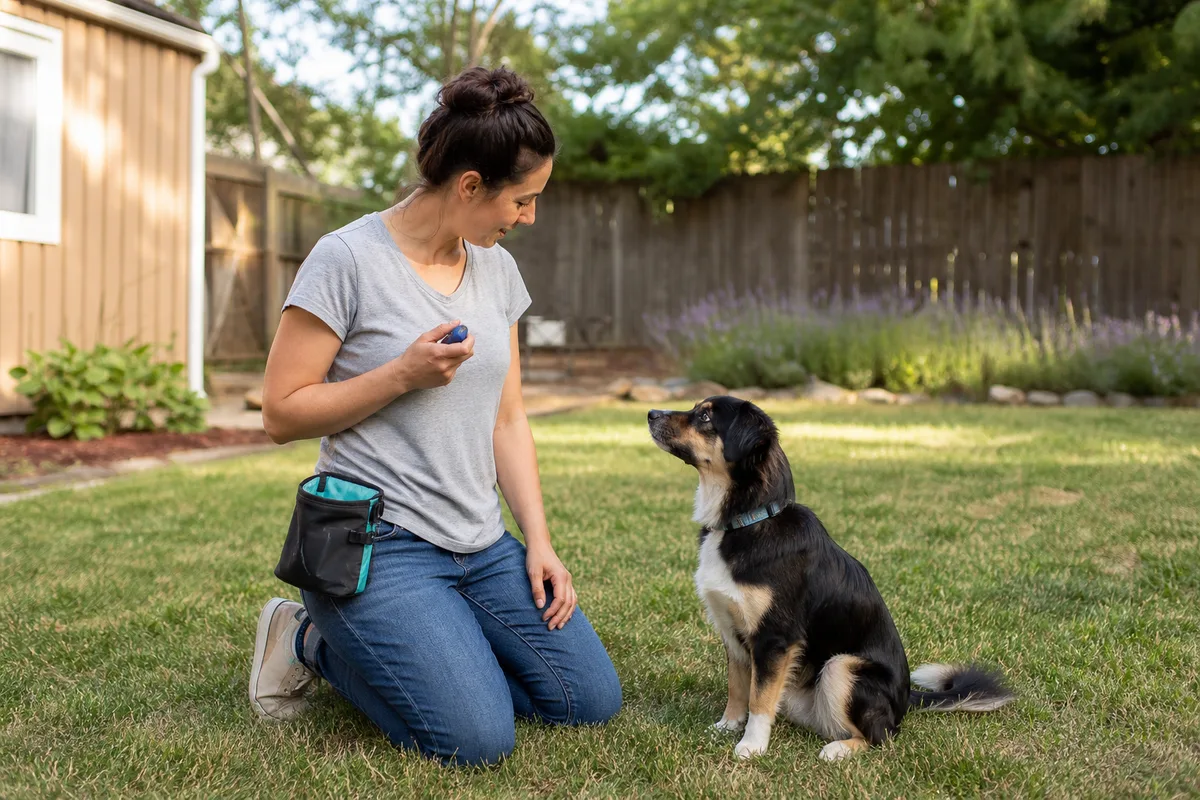
I have watched two people train the same dog, with the same treats, in the same kitchen, and get completely different results inside a week. One of them ended up with a dog that dropped into a sit the moment a hand moved toward the treat pouch. The other ended up frustrated, convinced the dog was stubborn, feeding twice as many treats for half the response. The dog was not the variable. The timing was.
Once you understand how a dog actually connects what it did to what it got, most of the mystery drains out of training. You stop asking whether you have the right treats and start asking whether you are marking the right moment. This is the mechanism underneath every specific skill you will ever teach a dog, from a sit to walking on a loose leash to coming back when called. Get the timing wrong and no amount of premium food fixes it. Get it right and cheap kibble works fine, which is a rare bargain in dog ownership.
Why the same training works for one owner and not another
Here is the scene that plays out in living rooms constantly. A dog sits. The owner says "good boy," reaches into the pouch, digs around for a treat, and finally hands it over three or four seconds later. In those three or four seconds the dog has already stood back up, sniffed the floor, and looked at the door. The treat lands on that last behavior, not on the sit. Repeat that fifty times and you have accidentally trained a dog that sits for half a second and then pops back up, because popping back up is what keeps getting paid.
The owner who succeeds usually is not more skilled with dogs in any general sense. They are faster and more precise about one specific thing: they deliver feedback the instant the behavior happens, before the dog moves on to the next thing. The gap between the sit and the signal that says "yes, that" is the whole game. When I coach someone who says training "isn't working," I do not watch the dog first. I watch the human hand. Nine times out of ten the hand is a full second or two late, and the dog is learning exactly what it is being taught, just not the thing the person meant to teach. The dog, for its part, is a model student. It simply enrolled in a slightly different course than the one you thought you were running.
This is also why advice that works beautifully for one household falls flat in another. The instructions are the same, but the execution runs on split-second timing that no article can hand you directly. You have to build it. The good news is that it is a mechanical skill, not a talent. If you can learn to clap on the beat of a song, you can learn to mark a behavior. And if you want a broader picture of how training fits into daily life with a dog, the pet care fundamentals in our guide to everyday pet care at home set the stage that this article drills into.
How association actually forms
A dog does not learn by understanding. It learns by association, which is a plain word for a specific thing: two events that happen close together in time get wired to each other. The dog notices that when X happens, Y tends to follow. It does not reason about it. It does not decide to cooperate. It simply starts predicting, and its behavior shifts toward whatever pattern pays off.
That word "close" is doing enormous work. Association forms between events that are close in time, and it weakens fast as the gap widens. If you drop a treat the moment the dog's rear touches the floor, the sit and the reward are close, and they wire together. If you drop it after the dog has stood up, the standing and the reward are close, and those wire together instead. The dog is not being difficult. It is being consistent. It is associating the reward with whatever it happened to be doing when the reward appeared.
The dog is always learning something
This is the part people miss. You cannot turn learning off. Every interaction is teaching the dog something, whether or not you meant to run a session. When you fumble a treat and it lands on the floor while the dog is barking, you just paid the bark. When you let the dog out the back door the moment it whines at it, you just paid the whine. The association machine runs constantly, and it does not care about your intentions. This is not a reason for anxiety. It is a reason for attention. Once you accept that the dog is wiring cause and effect all day long, you start noticing the accidental lessons and you start being deliberate about the ones you actually want.
It also explains why punishment delivered late does nothing useful. A correction that arrives even a couple of seconds after the act cannot associate with the act. The dog simply connects your reaction to whatever it was doing when your reaction arrived, which is usually just standing near you. That is how dogs learn to look guilty when you walk in the door without having any idea what the mess on the floor has to do with anything.
The one-second window that decides everything
If you take one number away from this article, take this one: the association window is short, roughly a second or two. A treat delivered five seconds after the sit does not reward the sit. It rewards whatever the dog did in between, which is often nothing useful at all. That single fact reorganizes how you should train.
Five seconds feels like nothing to a human. It is the time it takes to say a short sentence. But in that window a dog can sit, stand, turn its head, sniff, take a step, and look away. If your reward lands at the end of that chain, you have paid the last link, not the first. People routinely take three to five seconds to reach into a pocket, isolate a treat, and extend a hand. That delay is why so many dogs learn a sloppy, half-second sit that immediately bounces back up. The behavior that gets paid is the bounce.
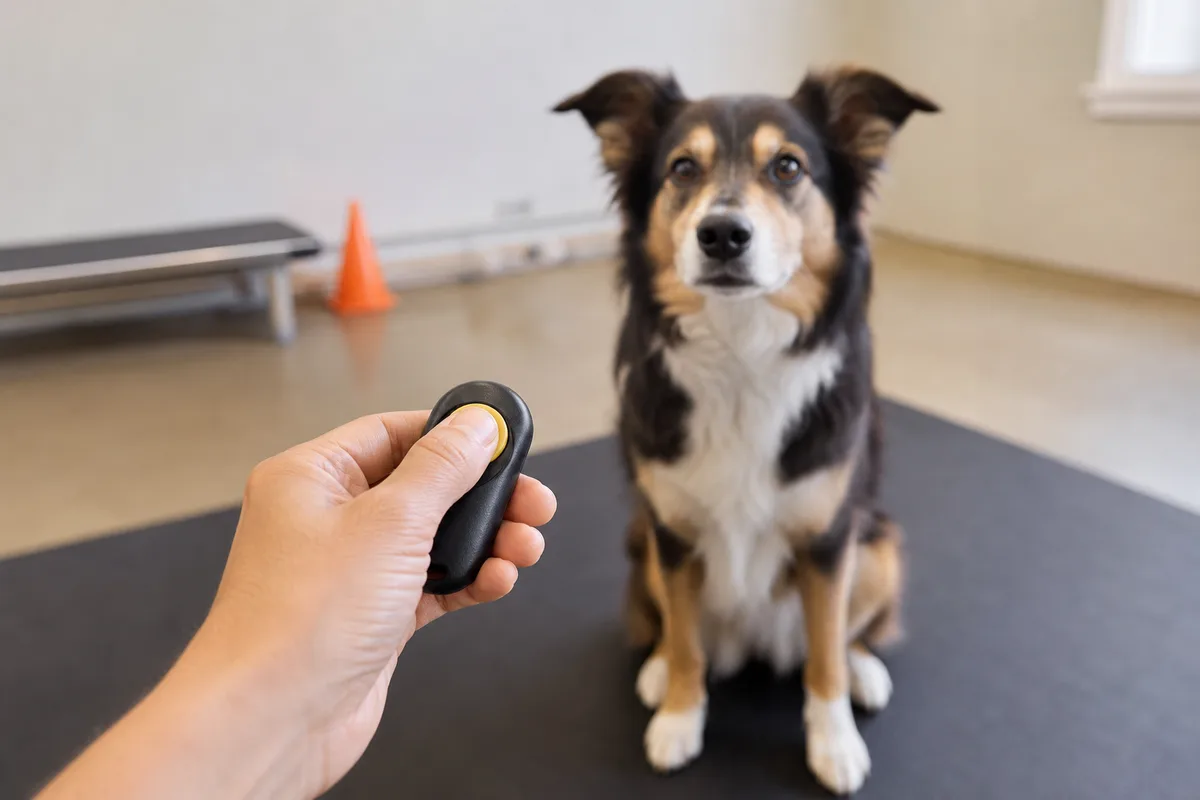 Pressing a training clicker as a dog sits
Try a small experiment to feel this for yourself. Set a timer, sit at a table, and count out loud: "one one-thousand, two one-thousand." That is your window. Now imagine a dog sitting on "one" and standing on "two." If your treat is still in your pocket at the end of that count, you have missed the sit entirely. The behavior is over and gone. Whatever the dog happens to be doing on "two one-thousand" is your new lesson plan, and it did not consult you about it. This is not a subtle effect you can ignore with enough repetitions. It compounds. Every late reward slightly reinforces the wrong thing, and the dog's version of "sit" drifts further from yours session by session.
The window being short is also why great trainers look almost unhurried. They are not moving fast in a frantic way. They have simply set themselves up so the important signal can happen instantly, and they have separated that instant signal from the slower business of handing over food. That separation is the next piece.
Markers: bridging the gap between act and reward
You cannot physically hand a treat to a dog inside one second, every time, from any position. Your hand is too slow and the food is in a pouch. So you need something that can happen in that one-second window even when the food cannot. That something is a marker.
A marker is a signal, a specific sound, that means one exact thing to the dog: "that, right there, is what earned the reward, and the reward is coming." It works because it bridges the gap between the act and the reward. You mark the instant the dog's rear hits the floor, and now you have all the time in the world to reach for a treat, because the marker already froze the right moment. The clicker most people use is popular for a reason: it makes a sharp, identical sound every time, with no emotional tone attached, which makes it easy for the dog to pin down precisely.
Building the marker before you use it
A marker means nothing on its own. You have to charge it first, which takes one short session. Sit with the dog and a handful of small treats. Click, then immediately feed. Click, feed. Click, feed. Ten or fifteen times, no behavior required, no cues, just building the link between the sound and the food. Within a session or two most dogs snap their head toward you the instant they hear the click, expecting food. That reaction tells you the marker is loaded and ready to work.
A word can serve the same purpose if you keep it clean. Pick a short one, "yes" is common, and say it the same way every time, in the same clipped tone. The click has an advantage here because it never varies. Your voice carries mood, and a dog reads mood. The marker word you say when you are relaxed and the one you say when you are annoyed sound different to the dog, which muddies the signal. If you use a word, discipline your delivery so it stays identical whether the session is going well or badly.
The most common marker mistake
The mistake I see most often is marking and then pausing to admire the sit before feeding. The moment you mark, feeding should follow reliably, or the marker starts to lose its meaning. The marker is a promise. Break the promise often enough and the sound stops predicting food, at which point it stops freezing the moment and you are back to needing impossibly fast hands. Mark, then feed, every single time, even if you marked the wrong thing by accident. If you clicked at the wrong instant, pay it anyway and just do the next rep better. Protecting the promise matters more than that one wasted treat.
Why consistency beats a bigger treat
People reach for better treats when training stalls, and it almost never helps, because the size of the reward is rarely the problem. A well-timed marker with an ordinary piece of kibble teaches faster than a fumbled hunk of chicken delivered three seconds late. The dog is not weighing the value of the food against the effort of sitting. It is trying to figure out what makes the food appear. Clarity is what it is starved for, not calories.
There is a place for higher-value food, and it is narrow. When you are working somewhere distracting, a park, a sidewalk, near another dog, the competition for the dog's attention goes up, and something more interesting than kibble can help hold focus. But that is about attention in a hard environment, not about the learning mechanism. In a quiet kitchen with no distractions, the treat value barely registers. If a session is failing at the kitchen table, upgrading the snack is treating the wrong disease.
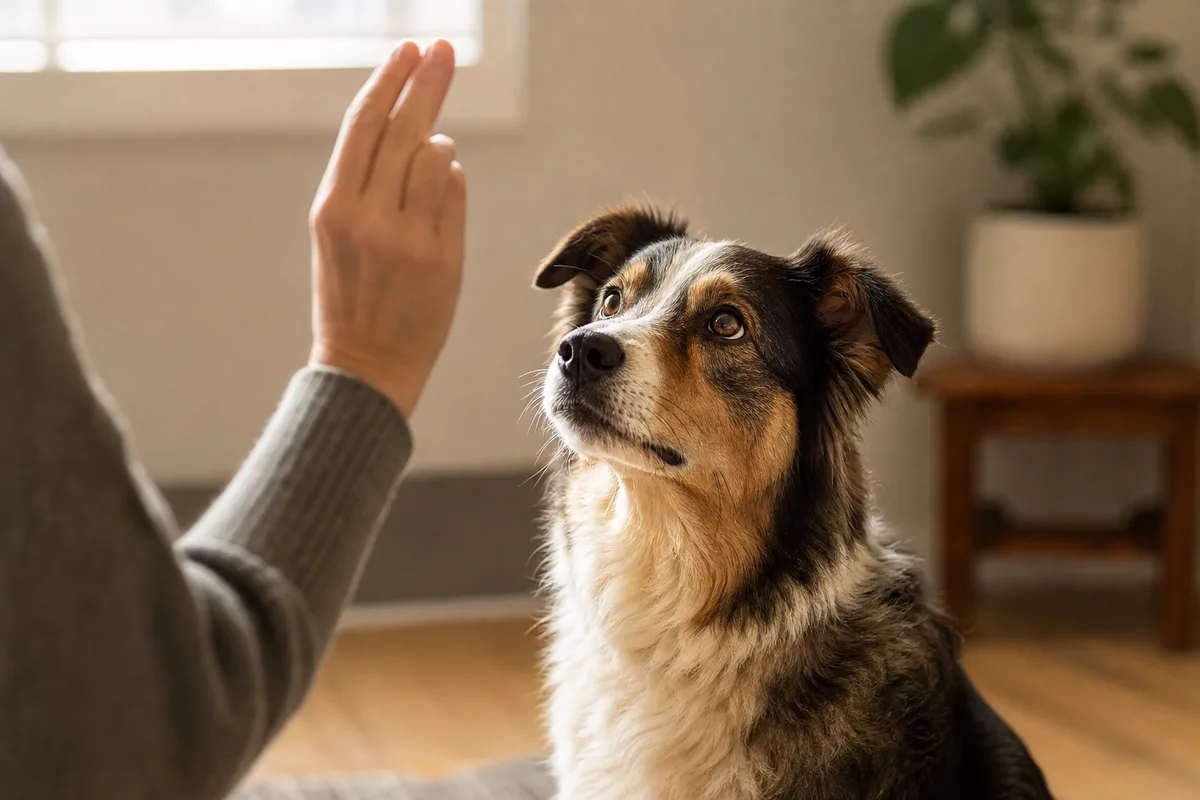 A dog watching its owner's hand signal during training
Consistency shows up in another place people underrate: the cue itself. Dogs read patterns, not English. When you say "sit" one time, then "sit down" the next, then "come on, sit," then a long drawn-out "siiiit" in a sing-song voice, you are not repeating one cue with encouragement. You are presenting the dog with several different sound patterns and expecting it to know they all mean the same thing. It does not. Each variation is, to the dog, potentially its own signal. This is why consistency out-performs vocabulary every time. A dog that reliably responds to one flat, identical "sit" is far better trained than one drowning in ten warm, varied versions of the word.
The same goes for tone and body. If you always lean forward and raise your hand when you cue a sit, the dog is probably reading your posture as much as your word, maybe more. That is fine, as long as you know it, but it means the day you cue from across the room standing still, the dog looks confused. It was never responding purely to the word. Keeping your cue, your tone, and your body position stable is what lets the dog lock onto a clear, single pattern instead of guessing among a dozen fuzzy ones.
Reading the dog's read of you
Training runs in two directions. While you are watching the dog for the behavior to mark, the dog is watching you for the pattern that predicts food. Good handlers stay aware of what the dog is picking up, because dogs are relentless readers of the small stuff. The hand that drifts toward the pouch, the slight bend of the knees, the intake of breath before you speak, all of it is data to the dog, and the dog will latch onto whatever predicts the reward most reliably.
This is why a dog can look brilliantly trained in the kitchen and lost in the yard. In the kitchen it may have been reading your position by the counter, the pouch on your hip, the time of day, as much as your actual cue. Change the setting and those side signals vanish, and the behavior falls apart. The dog did not forget. It was never responding only to what you thought it was. When a behavior collapses in a new place, do not assume disobedience. Assume the dog was leaning on a context clue that just disappeared, and go back a step to rebuild the cue where the surroundings are simpler.
You can use this two-way reading on purpose. If you want a hand signal to mean something, pair it with the marker consistently and the dog will start offering the behavior on the gesture alone, often before it has the spoken word down at all. Many dogs read a hand signal more sharply than a word, because a gesture is visual and stable while a voice carries all that variable mood. Watch which one your dog responds to faster and lean into it. There is no rule that the word has to come first.
One honest limit here: this will not work if the dog is over threshold, meaning so aroused or stressed by the environment that it cannot take food or attend to you at all. A dog that will not eat a treat it normally loves is telling you it is past the point where learning happens. No timing fixes that in the moment. The answer is to increase distance from whatever is overwhelming it until the dog can eat again, then work there. Reward timing is a tool for a dog that is calm enough to learn, not a way to force learning onto one that is not.
Applying this to any behavior you want
Everything above is the engine. Here is how you drive it for a behavior you actually care about, in a sequence you can reuse for anything.
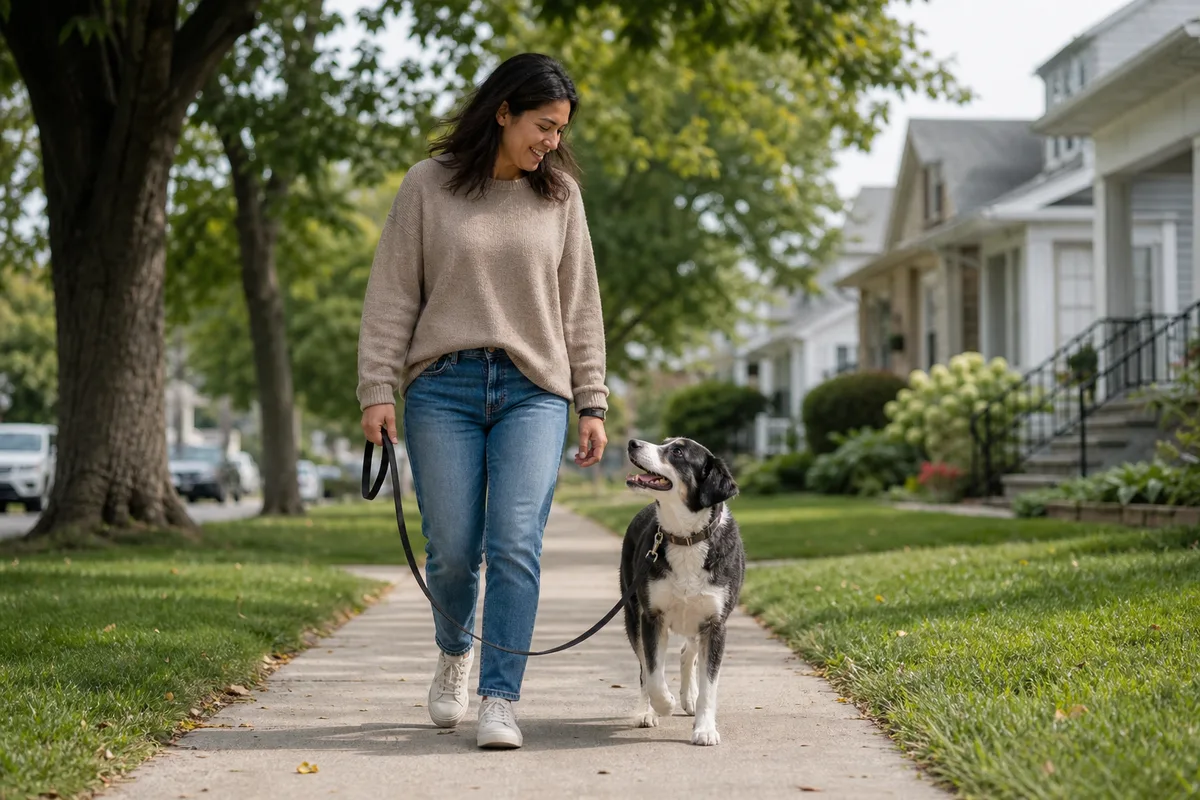
First, decide the exact instant you want to mark. For a sit, it is the moment the rear touches the floor. For a recall, it is the moment the dog commits and moves toward you, not the moment it arrives. For loose-leash walking, it is the moment the leash is slack and the dog is beside you, not straining ahead. Naming the precise instant in advance is half the work, because you cannot mark a moment you have not defined. Vague goals produce vague timing.
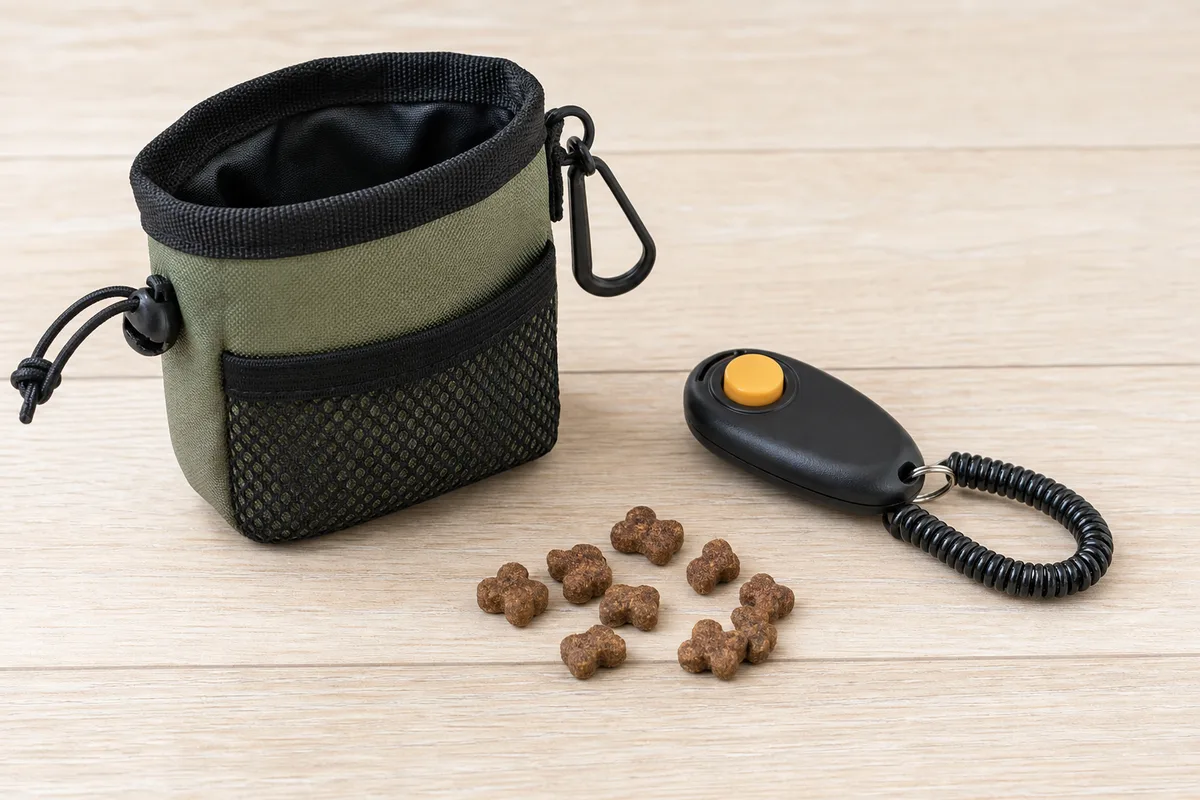 A dog training treat pouch and clicker laid out on a table
Second, set yourself up so the marker can fire inside that one-second window. That means the treats are already in a pouch on your hip, not in a bag across the room. It means you are holding the clicker or you have your marker word ready. Fumbling for food after you mark is fine because the marker bought you time, but fumbling before you mark is fatal, because the window closes while you dig. Remove every source of delay between the behavior and the mark.
Third, keep sessions short and end while the dog is still winning. Two or three minutes of clean, well-timed reps beats fifteen minutes of a tired dog and a tired handler both getting sloppy. When your timing starts slipping, or the dog starts guessing, stop. A short session that ends on a good rep leaves the dog eager to try again. A long one that ends in mutual frustration teaches the dog that training is where good moods go to die.
Fourth, raise difficulty one factor at a time. Once the behavior is solid in a quiet room, change exactly one thing: add a mild distraction, or move to a new room, or increase distance. If you change three things at once and the behavior breaks, you will not know which factor broke it. This is exactly the mechanism behind fixing a recall that has fallen apart in the real world, which our guide on the dog that ignores recall walks through step by step, and it is the same principle that makes loose-leash walking stick instead of unraveling the moment something interesting appears.
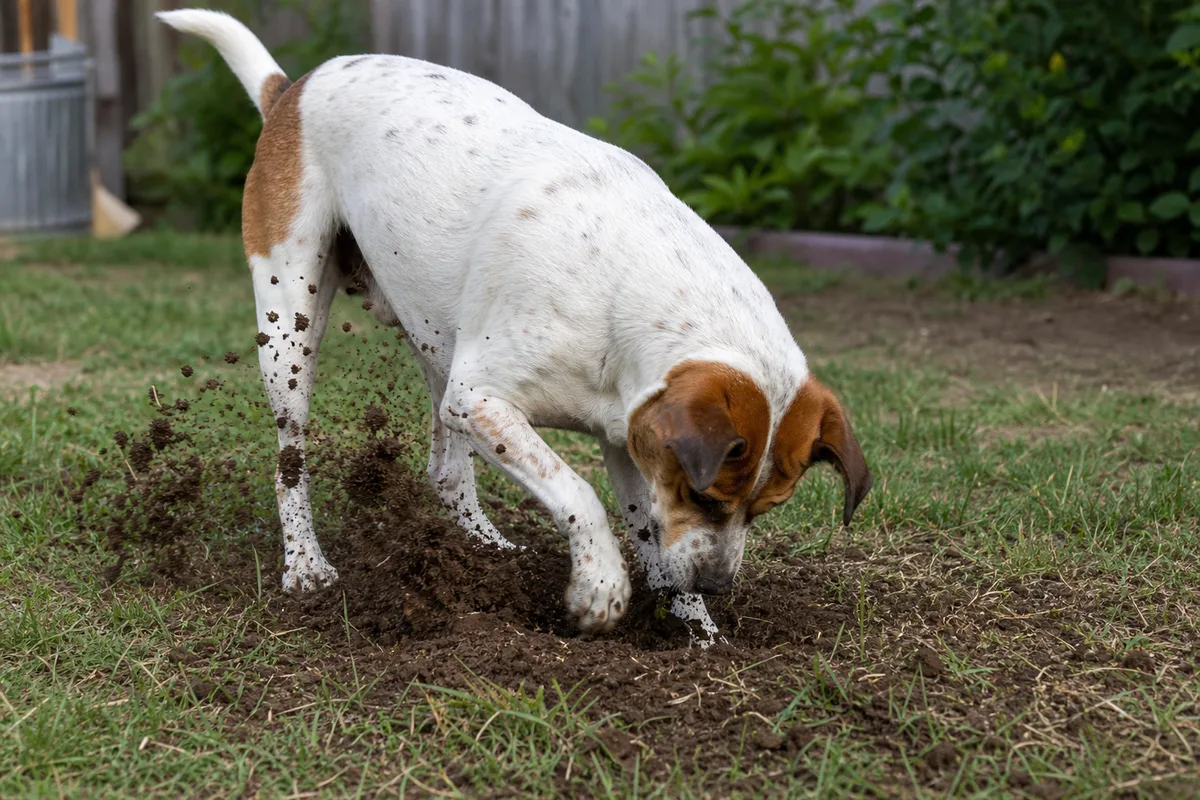
This also applies in reverse, to behavior you did not ask for. Some things a dog does are paid by the world rather than by you, and digging is the clearest example: the hole is cool, the soil smells interesting, and the reward arrives instantly whether you are watching or not. You cannot out-time a reward that fast, so the approach shifts to changing what the yard offers and paying an alternative well, which is what stopping a dog digging in the yard works through.
Fifth, once the behavior is reliable, start thinning out the treats. You do not feed forever. After the dog is offering the behavior fluently, you shift from paying every single rep to paying intermittently, and eventually to paying only the better reps. Keep the marker honest during this stage, though. The click still means food is coming, so when you click, still pay. What changes is that you stop clicking every rep, not that you start clicking without paying. Done gradually, this actually makes the behavior more durable, because a dog that is not sure which rep pays tries a little harder on all of them.
None of this requires special talent or an expensive setup. It requires you to respect a one-second window, to protect the meaning of your marker, and to keep your cues boringly consistent. The dog was always going to learn something from every interaction. The whole skill is making sure that what it learns is what you meant to teach. Once you see training that way, the treats stop being the point. They were never the point. The timing was.