I have bought more dog beds than I want to admit, and most of the early ones went in the trash inside a year. One was a round cushion my old retriever flattened into a pancake by month four. One was a foam mat a foster dog turned into confetti in a single afternoon while I was at the store. One was a beautiful woven thing with no removable cover that started to smell like a wet dog after two weeks of rain and never came back from it. None of those failures were bad luck. Each one was a mismatch between the bed and the dog in front of me, and I could have predicted every one if I had bought for the dog instead of for the corner of the room I wanted to fill.
This is a buying guide, but it is really a matching guide. The bed that lasts is not the most expensive one or the one with the best photos. It is the one that fits how your particular dog sleeps and how much your dog chews, made from materials that survive that dog and a washing machine. Get those two things right and a cheap bed can outlast a pricey one. Get them wrong and it does not matter what you paid.
Why the last bed failed
Start by figuring out how the last bed died, because the failure mode tells you what to fix. There are only a handful of ways a dog bed ends its life, and each points at a different decision.
The first is flattening. You bought a plush or foam bed, and over months of a heavy dog lying in the same spot, the fill compressed and stopped springing back. You can see it: the bed is an inch thick where the dog lies and three inches thick around the edge. When your dog's hip bones are resting on the floor through the fabric, the bed has quietly retired from being a bed while still technically showing up for work. Flattening is a materials problem, and I will come back to what actually resists it.
The second is destruction. The bed did not wear out; your dog took it apart. Corner seams pulled open, the zipper got chewed off, or a bored dog gutted it for the stuffing. This is not a durability rating problem so much as a supervision and chew-risk problem, and no fabric survives a determined chewer left alone with a soft object.
The third is the smell that never leaves. The bed held up structurally, but it soaked up mud, drool, dander, and the occasional accident, and because you could not properly wash it, it became the thing you move to the garage. A bed you cannot clean has a short life whether or not it falls apart, because you will get rid of it out of disgust. That is worth saying plainly, because people treat washability as a nice-to-have and it is closer to the whole ballgame for daily living.
The fourth is the quietest failure: the dog just never used it. You brought home a bed and the dog kept sleeping on the cold tile or the sofa instead. That is almost always a shape mismatch, and it is the one most people never diagnose. They assume the dog is being stubborn, when really the dog has quietly reviewed the bed and voted with its body.
If you know which of these killed your last bed, you already know most of what to shop for. Usually it is a combination, so keep all four in mind.
Reading how your dog sleeps
Before you look at a single product, watch your dog sleep for a few days. This is the step that saves the most money, and it costs nothing, since your dog was going to do the sleeping regardless. Dogs sleep in fairly consistent postures, and the posture decides the shape of bed that will actually get used.
Match the bed to how the dog sleeps: sprawlers need a flat mat, curlers want a bolstered edge. A sprawler is a dog who flops out on their side with legs extended, or lies belly-down with the back legs kicked straight out behind like a frog. Sprawlers want surface area and a flat plane. Put a sprawler on a small round bolstered bed and they will drape half their body off the edge onto the floor, which defeats the point. Buying the wrong shape means the dog sleeps on the floor beside it, and you will swear the dog hates beds when really the dog hates that bed.
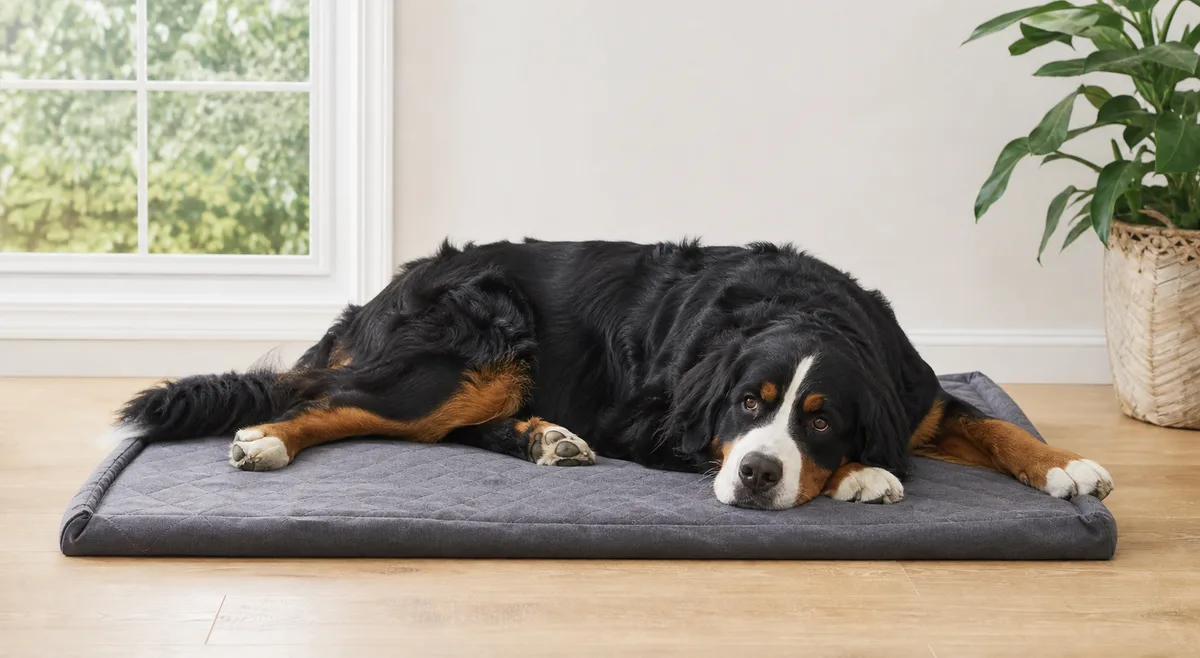 A large dog sprawled flat on a mat-style bed
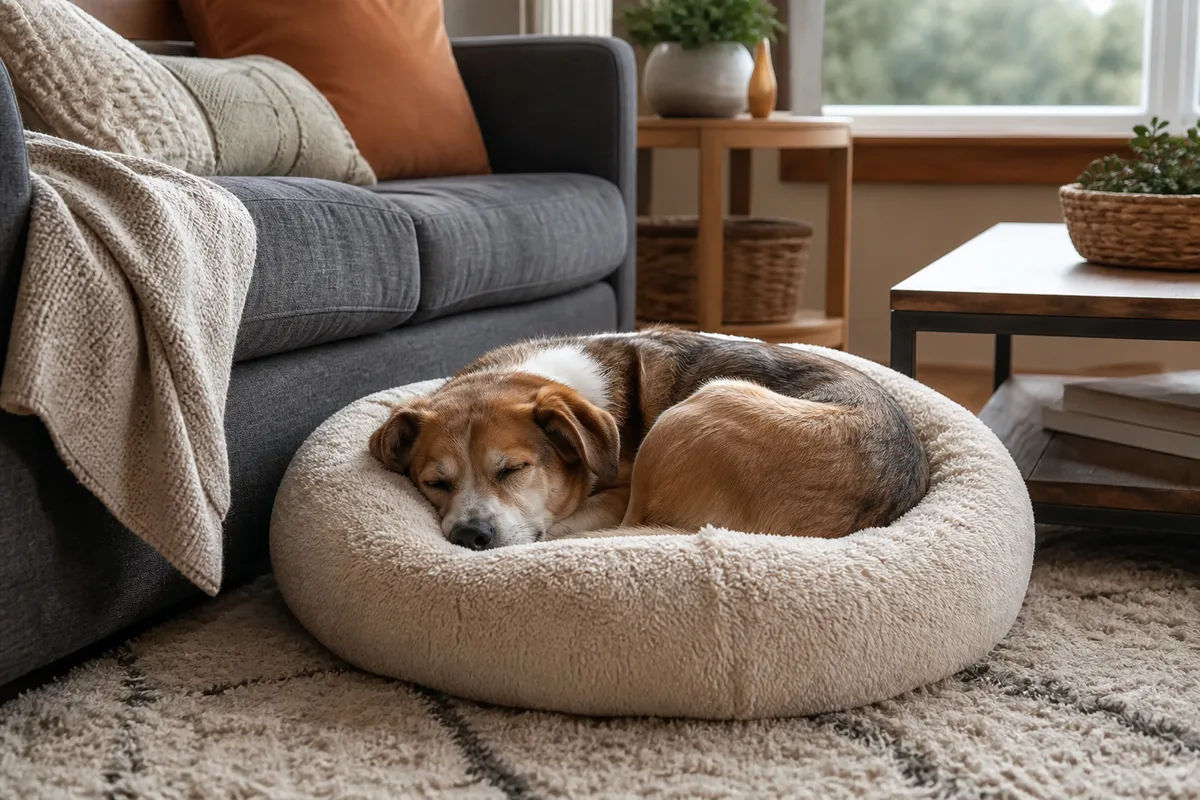
A curler is a dog who tucks into a comma, nose to tail, often shoving their back against something. Curlers want a raised bolster or wall to press into. For them the bolstered round or oval bed is not decoration; the raised edge is a headrest and a sense of enclosure, and they will sleep more soundly with it. A donut or bolster bed that is genuinely too small forces the curl but leaves no room to shift, so you still want the sleeping surface to fit the dog's curled diameter with a little to spare.
Plenty of dogs do both depending on the season. Mine sprawls flat in July and curls tight against the bolster in January, because a raised edge traps warmth and an open mat sheds it. If your dog switches, a large rectangular bed with bolsters on two or three sides covers both, giving a flat middle to sprawl on and a wall to tuck against.
Size the surface to the stretched-out dog, not the curled one. Measure your dog lying on their side, fully extended, from the tip of the nose to the base of the tail, and add roughly six to twelve inches. A dog that measures 30 inches stretched out wants a sleeping surface around 36 to 42 inches, and on a bolstered bed you measure the inside dimension, not the outside, because the bolsters eat several inches on each side. This is where a lot of beds disappoint: the box says "large" but the usable flat area is small once the padded rim takes its cut.
Chew risk and destructibility
Honest self-assessment here saves you the most heartbreak. A bed is a soft object full of stuffing, which to a certain kind of dog is a project waiting to happen. No consumer dog bed is truly chew-proof, and any product that promises it is overselling. What varies is how much friction the design puts between a bored dog and the fill.
Rate your own dog on a simple scale. A dog who has never destroyed a soft toy and settles down calmly is low risk, and you can buy on comfort and washability alone. A dog who dismantles plush toys within the hour, digs at bedding, or chews when anxious or under-exercised is high risk, and you need to shop differently or manage the situation rather than expecting a fabric to save you.
For higher-risk chewers, look for a few concrete features. Seams should be double-stitched or bound rather than a single line of thread you can catch a claw under. Zippers should be hidden under a flap or on the underside so the pull is not sitting there like a chew toy; an exposed zipper pull is often the first casualty. Tightly woven ballistic-style or ripstop fabrics resist puncture far better than a soft plush that a tooth sinks straight into. A raised cot-style bed, which is a taut fabric sling on a frame with no loose stuffing at all, removes the temptation entirely for some dogs because there is nothing soft to disembowel, though a real chewer will still go after the fabric edge or the frame.
The most important durability feature is not a feature at all: it is not leaving a destructive dog alone with the bed until you know how they treat it. I learned this the expensive way with the foster dog and the confetti. New bed, new dog, left alone, gone in an afternoon, and I only had myself to blame for trusting a stranger with stuffing. Now a new bed gets supervised for the first week the way you would supervise a new toy, and if the dog starts working a seam I take it away and rethink rather than come home to stuffing across the floor. If your dog is a committed destroyer, accept that you are buying a consumable and spend accordingly, or manage their space so the bed is only out when you are around. A crate can help here by giving the dog a defined, calmer space; if you are still setting that up, see choosing a dog crate.
Fills: foam, poly, and what flattens
The fill is what you are actually paying for on the inside, and it is where marketing gets vaguest. There are three common types and they behave very differently over time.
Polyester fiberfill is the loose, fluffy stuffing in most cushion and donut beds. It feels great in the store because it is airy and thick. It is also the fastest to compress. Under a medium or large dog, fiberfill packs down within months and does not recover, and re-fluffing buys you a week at most. It is fine for a small light dog or a rarely used guest bed, and it is cheap, but do not expect a heavy dog to keep a fiberfill bed lofted for a year.
Shredded foam is chopped foam pieces, somewhere between fiberfill and a solid slab. It resists flattening better than fiberfill and has the side benefit that you can often add or remove filling through a zipper to tune the loft. The downside is it can migrate and clump, leaving thin spots you have to redistribute by hand every few weeks.
Solid foam, a single slab, holds its shape the longest and is what most beds mean when they say supportive. But foam is only as good as its density, and this is the number that actually predicts whether a bed lasts. Foam-fill beds flatten under big dogs within a year when the density is low, and the density is rarely printed on the listing. High-density foam, the kind that springs back when you press a fist into it and hold, resists that permanent compression. Cheap low-density foam feels similar on day one and takes a set within months. When a listing does not state a foam density figure, treat the loft claims skeptically, because the manufacturer had every reason to print a good number and chose not to.
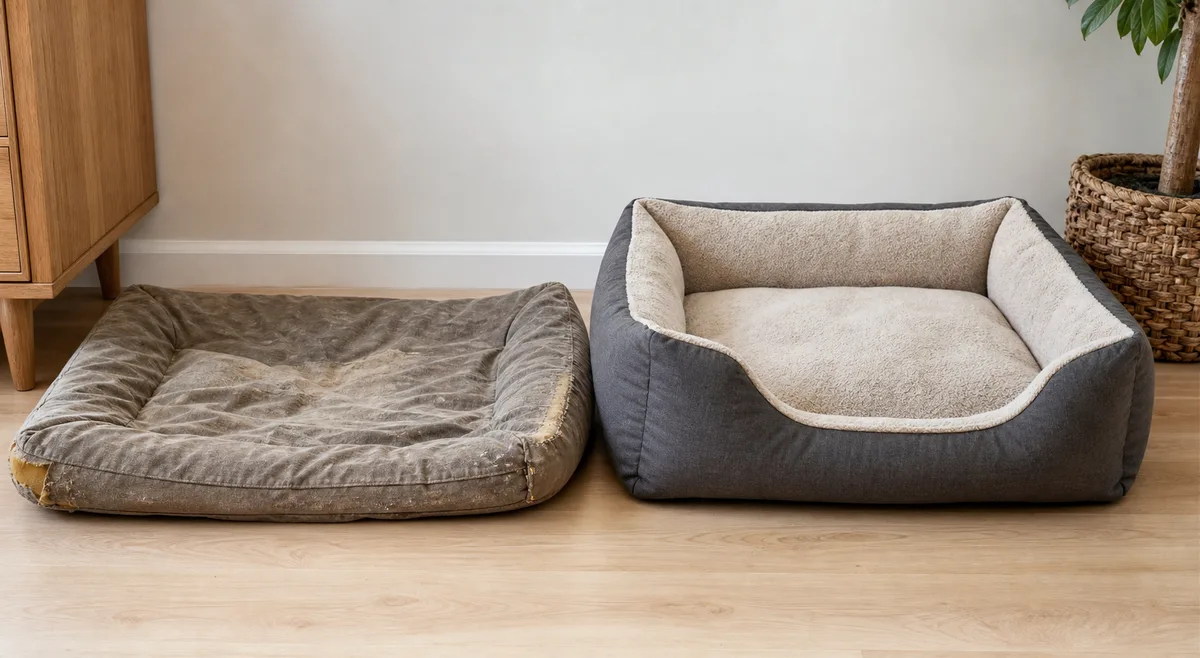 A flattened worn dog bed beside a newer replacement
There is a simple in-store test for solid foam if you can get your hands on it. Press your fist firmly into the center, hold for a slow count of five, and let go. Good dense foam pushes back and returns to flat almost immediately. Poor foam stays dented for a beat or feels like it bottoms out to the floor under your knuckles. That five-second press tells you more than any label adjective. For a bed you cannot handle before buying, the return policy becomes your test instead, so favor sellers who let you send it back after your dog has actually slept on it for a couple of weeks.
Covers: washable beats fancy
If I could give a new dog owner one rule, it would be this: a removable, machine-washable cover matters more than the fill for daily life. The fill decides comfort; the cover decides whether the bed stays in your house. A bed you cannot wash gets banished within a month once it smells, no matter how good it felt on day one. Dogs track in mud, shed constantly, drool, and roll in things you would rather not name, and all of that ends up in the bed.
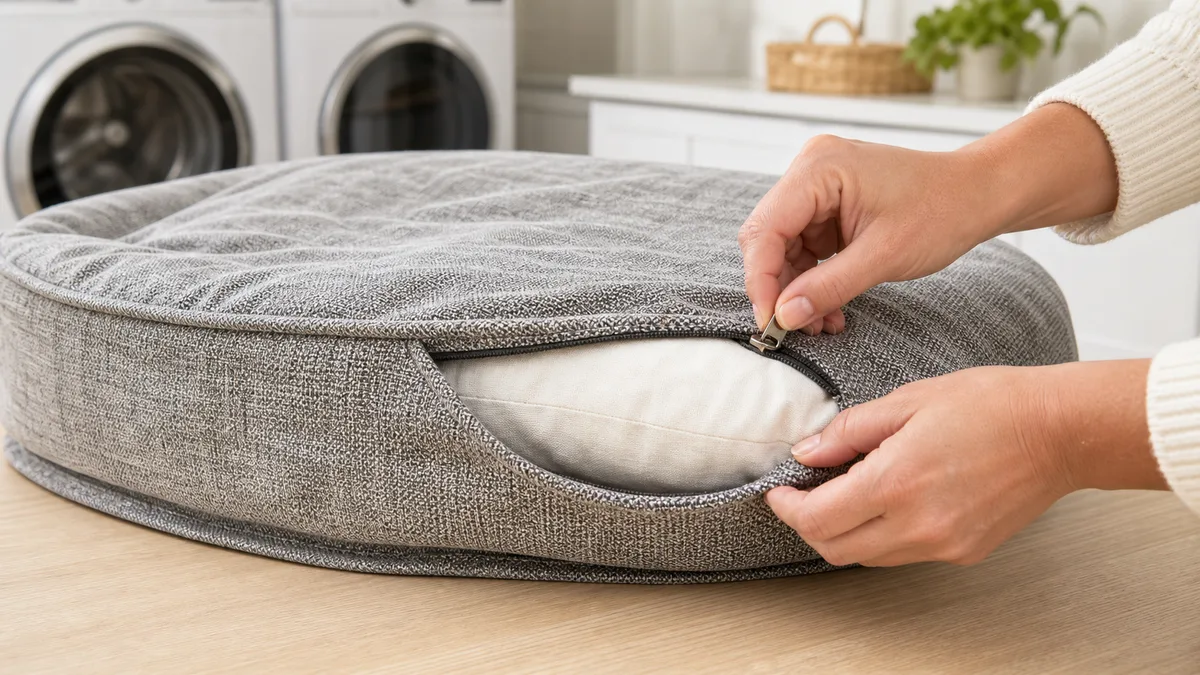 Unzipping a removable dog bed cover for washing
So before comfort, before looks, check how the cover comes off and goes back on. The zipper should run far enough around the bed that you can actually wrestle the fill out and back in without a fight; a stingy little opening on one side makes reassembly a twenty-minute wrestling match that the fill usually wins, and you will stop bothering. Look for a cover rated machine washable and, ideally, dryer safe on low, because air-drying a thick cover in a humid week is how the mildew smell starts. A waterproof or water-resistant inner liner around the fill is worth a lot, especially for a young dog or an old one, because it stops a single accident from soaking into foam you cannot launder. When liquid reaches the foam, the bed is essentially over, since foam holds odor and never fully dries in the middle.
Two covers is a quiet upgrade people overlook. If a bed offers a spare cover, or if the cover is a standard enough shape that you can buy a second, you can strip and wash one while the dog keeps using the bed with the other. That single change extends the practical life of a bed more than almost any material choice, because the bed is never out of commission and never sits dirty long enough to set in a smell.
Fabric type on the cover matters for hair as much as for washing. A smooth, tightly woven canvas or microfiber releases hair in the wash and wipes down between washes. A deep sherpa or shag looks cozy and grabs hair like a magnet, holding it through a wash cycle so you pull a matted layer off afterward. Cozy sells in photos; smooth survives in a laundry room.
The "orthopedic" label, examined
You will see the word orthopedic on a large share of beds, usually with a higher price attached, and it is worth being clear-eyed about it. The "orthopedic" label is meaningless without real foam density, which is rarely listed, so treat the claim skeptically. Orthopedic is not a regulated term for dog beds. There is no standard a bed must meet to print it, no certifying body, and no required disclosure. A manufacturer can put a slab of ordinary low-density foam in a cover and call it orthopedic, and nothing stops them.
I want to be careful here because this is a gear guide, not anything to do with a dog's medical care, and I am not going to make claims about what a bed does for a body. What I can say squarely is about the product and your money. The useful signal under the orthopedic label, when it is real, is genuine high-density foam that resists compression, so the surface stays even and does not bottom out to the floor over time. That is a durability property you can evaluate: does the listing state a foam density figure, and does the foam pass the five-second fist-press test. If yes, you are getting a supportive slab that will hold its shape, and the price may be fair. If the listing leans entirely on the word orthopedic with no density number and no meaningful specs, you are paying for a label.
So do not pay a premium for the word alone. Pay for stated foam density, a supportive slab that passes the press test, a washable cover, and a return window. If a bed has those things it does not need the label, and if it lacks them the label changes nothing.
Cheaper and DIY options that hold up
A store-bought bed is not the only answer, and for some dogs it is the wrong one. If your last three beds got destroyed or flattened, spending more on a fourth is not obviously smarter than spending less on something you can replace or launder without a second thought. Here are the cheaper routes I have actually used and where each one fits.
The simplest is a folded thick blanket or a couple of old comforters, folded to the footprint your dog sleeps on. It sounds too basic to mention, but for a dog who sprawls flat and just wants a bit of insulation off a hard floor, a folded blanket delivers most of the comfort at a fraction of the price, and the entire thing goes in the wash in one piece with no cover to fight. The obvious limit: it offers no bolster for a curler and no lasting loft for a heavy dog who wants cushioning under the hips. For a sprawler on a tile floor, though, it is genuinely hard to beat on cost and washability.
The next step up is a DIY cover stuffed with old textiles. Buy or sew a sturdy zippered cover in a tough fabric, or repurpose one from a dead bed, and stuff it with clean old towels, worn blankets, and fabric scraps rather than buying foam. It will not be as uniform as a foam slab, and you will need to redistribute and re-fluff the contents from time to time as they pack down, but it costs almost nothing, it uses up textiles you were going to discard, and when the filling flattens you restuff it for free instead of buying a new bed. It also lets you make an odd size to fit a specific corner or crate that no retail bed matches.
The one I recommend most often is a washable crib mattress. A firm crib mattress is close to the ideal dog bed hiding in the wrong aisle: it is a dense, supportive slab that resists flattening far better than fiberfill, it comes with a wipeable waterproof surface, the dimensions suit a medium to large dog, and it is often cheaper than a foam bed marketed for dogs. Drop a washable cover or a towel over it and you have a durable, easy-clean bed for less. Its limits are honest ones: it is flat with no bolster, so a dedicated curler will miss the raised edge, and the vinyl surface can feel cool and slick until you put a cover on it. For a big sprawler who has flattened every plush bed you have tried, it is often the most durable option in the room.
None of these will win a home-decor contest, and that is the trade you are making. What you get back is something you can throw in the wash without a second thought and replace or refill for very little when a dog does what dogs do to bedding.
Matching the bed to your dog
Put it together and the decision is mostly determined before you shop. Walk through it in order and the right bed usually names itself.
Start with sleep posture, because it sets the shape. A committed sprawler wants a flat mat or a large rectangular bed with, at most, a low bolster on one side; do not spend on a deep donut they will hang off of. A dedicated curler wants a bolstered round or oval sized to their curled diameter with room to shift. A dog who does both wants a rectangular bed with bolsters on two or three sides and a flat middle. Size it to the stretched-out measurement plus six to twelve inches, and on bolstered beds check the inside dimension, not the box label.
Then apply chew risk, because it can override everything above. A calm, non-destructive dog can have whatever shape and fill suits their sleep, chosen on comfort and washability. A destroyer needs tough bound seams and hidden zippers, or a stuffing-free cot, or frankly a cheap or DIY bed you supervise and treat as a consumable rather than a nice foam bed you will mourn. Be honest about which dog you have; the fabric will not save a soft object from a determined chewer left alone with it.
Then pick the fill for the dog's weight and the bed's job. Small or light dog, or a low-traffic spot, and fiberfill is fine and cheap. Medium to large dog who leans on the bed hard every night, and you want solid high-density foam with a stated density figure, or one of the durable cheaper routes like a firm crib mattress. Ignore the marketing words and ask for the number and the press test.
Finally, make washability a hard requirement, not a bonus. Removable, machine-washable cover, a generous zipper you can actually work, a waterproof liner if the dog is young, old, or prone to accidents, and if you can manage it a second cover so the bed is never down for laundry. This is the single choice most likely to determine whether the bed is still in daily use a year from now.
Do all of that and a modestly priced bed, or even a folded blanket over a crib mattress, will outlast a designer bed bought for its photo. Sleeping arrangements are just one piece of a comfortable routine at home; for the wider picture of keeping a dog well cared for day to day, see everyday pet care at home. The bed is not where you show off your taste. It is where the dog actually sleeps, and the one that lasts is the one you chose for the dog in front of you.