A crate is one of the first things new dog owners get talked into, usually in the store aisle, usually the wrong size. The picture in most people's heads is a small cage and a sad dog, so they either refuse to buy one or they overcorrect and buy something the size of a coffee table so the dog "has room." Both of those are the aisle making the decision. The right way in is to start from the dog in front of you and the job you actually need the crate to do, then work backward to size and type. Do it in that order and the choice gets simple, and in a fair number of cases it ends with you not buying a crate at all.
I want to be clear about what a crate is for, because the word carries baggage. Used right, it is a small, defined space a dog chooses to rest in, the way a dog will pick the same corner of a room or the same spot under a table on its own. It is a house-training tool, a safe place during chaos like a party or a house full of workers, and a way to transport a dog without it loose in a moving car. It is not a place to store a dog for eight hours while you are at work, and no crate, at any price, fixes that. Keep that boundary in mind and everything below lands in the right place.
Deciding whether you need a crate at all
Start here, before you look at a single product, because this is the question that saves the most money and grief. Plenty of dogs live good, orderly lives without ever owning a crate. Whether you need one comes down to three things: the dog's age, whether you are actively house-training, and what happens in your home when you cannot watch the dog.
A puppy under about five months is the strongest case for a crate. Puppies do not yet have the bladder control or the judgment to be trusted loose, and a crate gives you a way to prevent accidents and chewing during the weeks when supervision has gaps. If you are bringing home a puppy, a crate earns its keep fast, and it pairs directly with a feeding and potty routine. I walk through that timing separately in house-training a puppy on a schedule, because the crate is only half the system; the clock is the other half.
An adult dog that is already house-trained and calm when left alone is the weakest case. If your dog can be loose in the kitchen for two hours without eating the trash or the baseboards, you may never need to buy anything. Some owners still keep a crate around with the door left open as an optional bed, and the dog uses it by choice, which is the animal quietly making your point for you. That is a fine outcome, but it is not a reason to spend money up front. You can add one later if the dog tells you it wants a den.
The middle case is the honest one: a dog that is mostly reliable but not fully, or a household with a specific trigger, like a dog that panics during storms or a contractor coming to redo a floor. Here a crate is useful in bursts rather than daily. If that is you, buy for the burst, not for a routine you do not have and quietly hope you never will.
There is also a limit worth stating plainly: a crate does not treat genuine separation distress. A dog that screams, drools, or hurts itself trying to get out is not a dog that needs a sturdier crate, and forcing the issue usually makes the panic worse. That is a training and management problem, and it belongs with the broader routine work I cover in everyday pet care at home. If that is what you are seeing, hold off on the crate and address the fear first.
Sizing it right for house-training
If you decide you do want a crate, size is the single decision that matters most, and it is the one people get wrong most often. The instinct is that bigger is kinder. For a resting adult dog that is roughly true. For a puppy you are house-training, it is exactly backward.
The rule I size to is standing and turning around, not luxury. The dog should be able to stand up without ducking its head, turn around in a full circle without folding itself, and lie down stretched on its side. That is the whole target. A crate that clears those three motions is correct, even if it looks snug to you. The dog is not measuring the square footage; that worry is entirely yours. A crate with a spare foot of open floor at each end looks kinder and undermines the entire tool: a puppy will sleep at one end and potty at the other, because it can keep its bed clean while still relieving itself, and that stalls house-training for weeks. The reason the crate works at all is that a dog does not want to lie in its own mess in a tight space, so it learns to hold and wait for you to open the door. Give it room to separate the two zones and you have thrown away the mechanism.
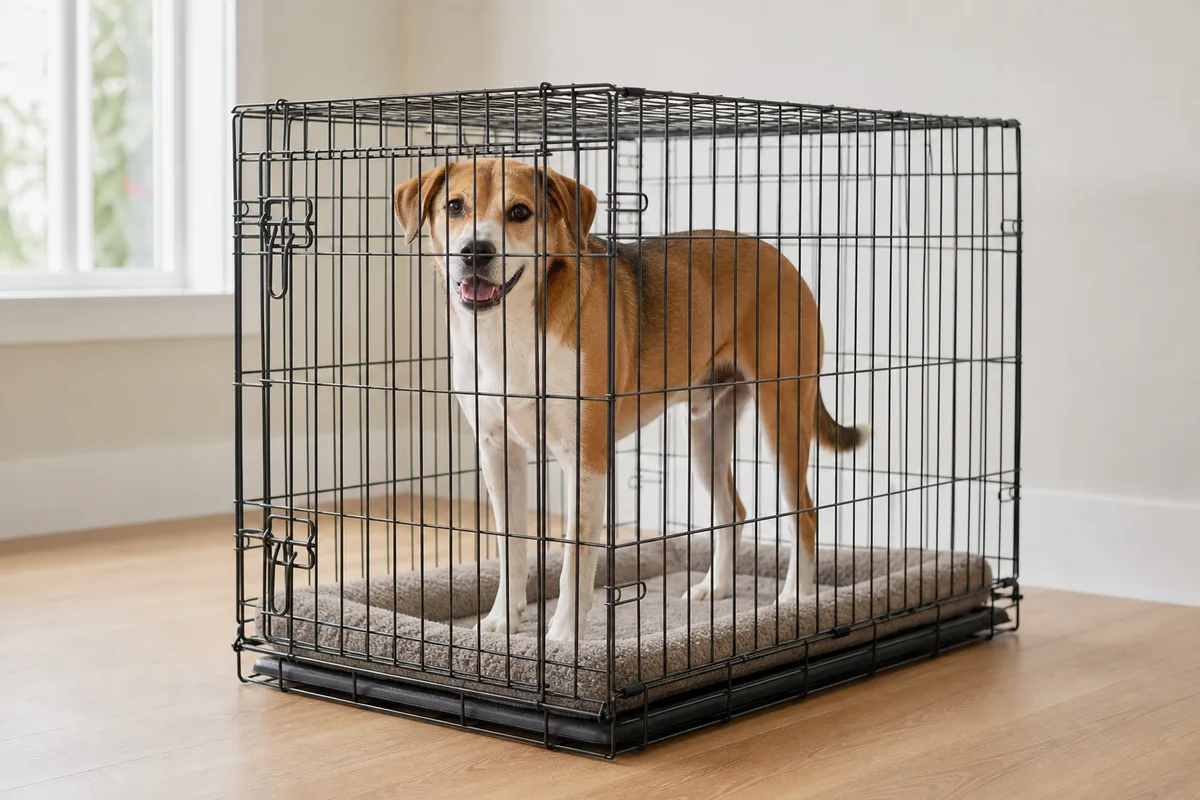 A dog standing comfortably inside a properly sized crate
To measure, put a tape on the dog rather than guessing from a weight chart. Measure length from the tip of the nose to the base of the tail, not the tail tip, and add roughly two to four inches. Measure height from the floor to the top of the head when the dog is sitting up, and add about two to four inches. Those two numbers are the interior dimensions you want. Manufacturers list crates by outside size and often by a breed-weight range, and those ranges run generous, so a chart that says "30 to 40 pounds" will frequently point you a size too large for a puppy still growing into that weight. Trust the tape over the chart. The chart is rounding up to move a bigger box; the tape has no such agenda.
One number that catches people: for a puppy, size to the dog's current body, not its adult size, or you recreate the too-large problem for the whole house-training stretch. The fix for the fact that the puppy will grow is not a bigger crate today. It is a divider, which I cover further down, and it is genuinely the detail that saves buying two or three crates.
Wire crates: pros and cons
The folding wire crate is the default for a reason, and for most first-time owners it is the one I would reach for, but it is not without real downsides and you should know them before you commit.
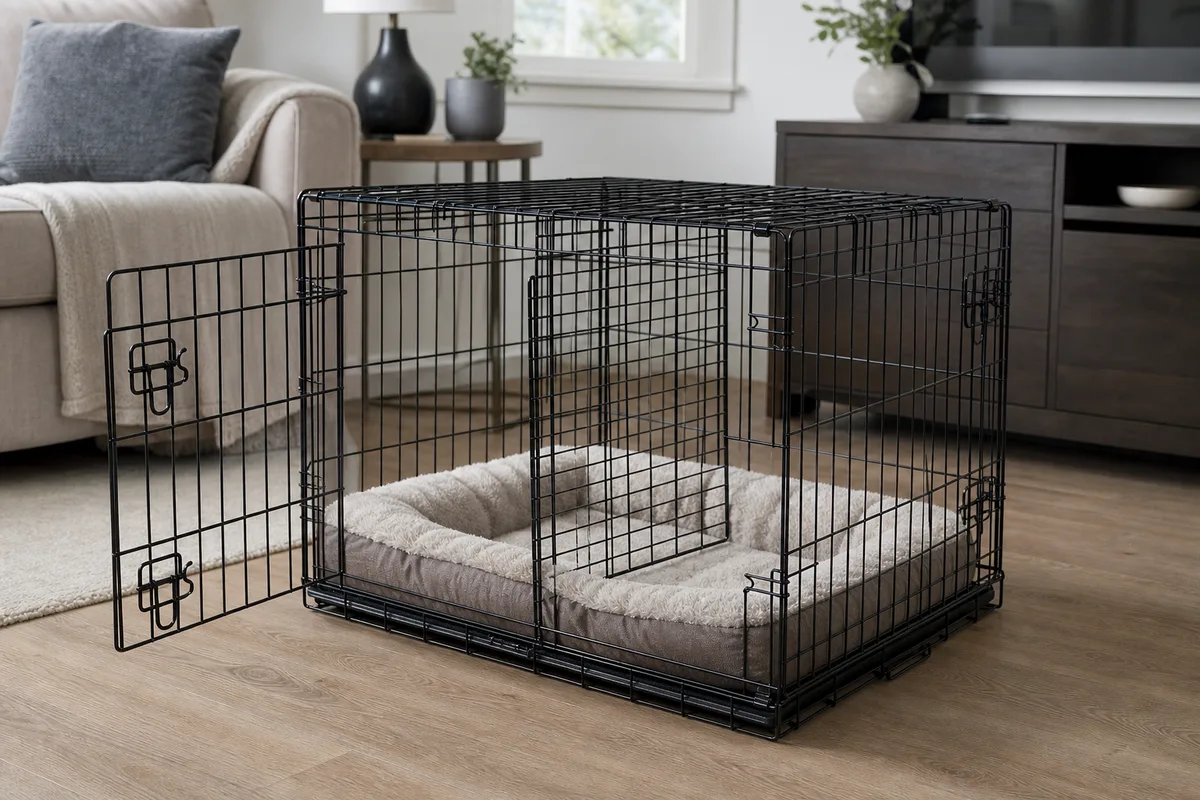
The strengths are practical. A wire crate folds flat like a suitcase, so it stores against a wall or slides under a bed when you are not using it, which matters if you only need it in bursts. It ventilates on all four sides, so it does not build up heat. It usually ships with a plastic tray on the floor that pulls out, so cleaning an accident is a matter of sliding the tray out, rinsing it, and sliding it back, rather than tipping the whole thing over a sink. And critically, most wire crates come with a divider panel, which is the feature that lets one crate grow with a puppy. If you are buying exactly one crate and want it to last, this is the format that does it.
The downsides are real and worth stating. Wire is drafty and loud. On a cold floor by an exterior wall, a wire crate offers no shelter from the draft, so you end up draping a blanket over part of it to make a wall, which then partly defeats the ventilation you were paying for. It is also noisy: a dog that shifts, scratches, or bumps the sides makes a metallic rattle that carries through a quiet house at night, and a determined dog can set up a rhythmic clang that is genuinely hard to sleep through, usually starting around two in the morning, when the house is quiet and the audience is captive. The dividers, while useful, can also become a chew or paw target at the seam, and a strong dog can occasionally bend a door latch or work a corner loose, so the cheapest thin-gauge models are a false economy for a big or anxious dog.
Price-wise these sit in the reasonable middle, and because they are the most common crate sold, they are also the easiest to find secondhand, which I would genuinely consider first. Dogs outgrow the small and medium sizes constantly, so used wire crates show up cheap and plentiful; wipe one down, check that the divider and tray are included and the door latches cleanly, and you have spent a fraction of new-price on the exact tool.
Plastic crates: pros and cons
The molded plastic crate, sometimes called a travel or airline crate, is the other mainstream option, and it solves some of the wire crate's problems while creating its own.
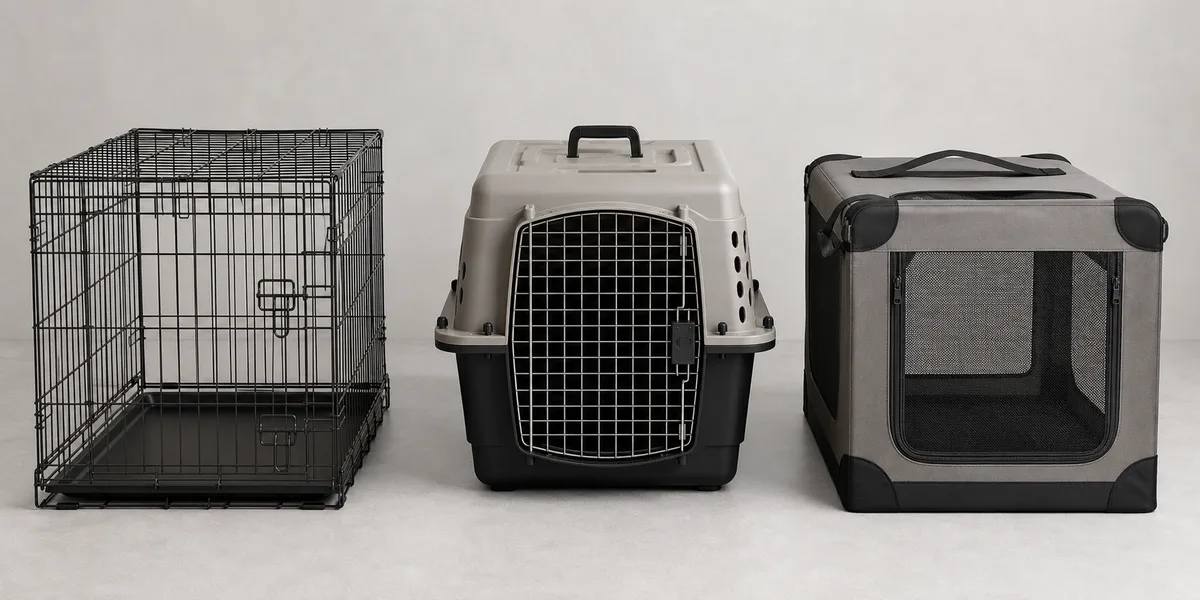 A wire, plastic, and soft dog crate compared side by side
The appeal is that it feels den-like. It has solid walls on three sides with a wire door at the front and vents along the upper edges, so a dog inside is enclosed and shielded, which suits a dog that settles better when it cannot see the whole room. That enclosure also cuts the draft problem the wire crate has, so on a cold floor it holds a pocket of warmer air. And because it is a rigid shell that latches or bolts together, it is the format most airlines require for cargo travel, so if you ever expect to fly a dog, this is the one you would need anyway. In a car it also gives real crash protection that a wire crate does not.
The downsides run the other direction. Solid walls trap heat, so in a warm room or a hot car the same enclosure that feels cozy in winter turns stuffy fast, and the top vents alone do not move much air. You have to think about where you put it and never leave a dog in one in a warm parked car, which is a serious hazard regardless of crate type. It is also bulky to store: a plastic crate does not fold, so an empty one is a large rigid box you have to find a closet or garage corner for, where it tends to sit looking like furniture nobody ordered, and the bigger sizes are awkward to carry through doorways. Cleaning is more of a chore too, because there is no slide-out tray; an accident means unclipping the two halves, carrying the base to a hose or tub, and reassembling. And plastic crates do not come with dividers, so for a growing puppy you either buy small and replace, or block off part of a larger one yourself with a safe barrier, which is fiddlier than the wire crate's built-in panel.
For a household that mostly needs a crate at home and only occasionally, the plastic crate's travel strengths go unused while its storage and heat drawbacks show up daily. It earns its place when travel or car safety is a real part of your use, not just a maybe.
Soft crates: the narrow right use
Soft crates are the fabric-and-mesh ones that pop up like a tent and pack down to almost nothing, and they photograph beautifully. They also have the narrowest correct use of the three, and buying one for the wrong dog is money set on fire.
Here is the honest boundary: a soft crate is for a calm, already-crate-trained adult dog, and nothing else. A chewer destroys one in a day. The walls are fabric and mesh, so a dog that mouths, scratches, or digs at the door works through it in minutes, either escaping or swallowing pieces of it, and the whole thing becomes both a failure and a hazard. A puppy in the middle of house-training is the exact wrong candidate, because puppies chew and because you cannot easily clean an accident out of fabric walls and a padded floor. So do not start here.
Where it is genuinely the right tool is the mellow adult dog that already understands a crate and needs a lightweight, packable option for a specific trip: a visit to relatives, a hotel that allows crated dogs, a folding chair-side spot at an outdoor event where the dog just naps. For that dog and that use, a soft crate weighs almost nothing, sets up in seconds, and disappears into a car trunk. It is a convenience layer on top of a dog that is already reliable, never the crate you train a dog in. If your dog is not there yet, skip it for now; you can add one later once the behavior is solid, and you will know the dog is ready because it settles quietly in a regular crate without working at the door.
The divider trick for growing puppies
This is the detail that turns one crate purchase into the only one you make, and it is the main reason I steer first-time puppy owners toward a wire crate. A growing puppy does not need a new crate at each size. A wire crate with a divider panel grows with the dog and saves buying two or three.
The mechanics are simple. You buy the crate sized for the dog's adult body, then use the divider panel to wall off the back so the usable space fits the puppy right now, following the standing-and-turning rule from the sizing section. As the puppy grows, you move the divider back a few inches at a time, opening up more floor to match, until eventually you remove it and the puppy has grown into the full crate you paid for once. Done this way, a single medium or large wire crate carries a dog from eight weeks to adult without ever being the wrong size for house-training.
A couple of judgment calls make or break it. Set the divider so the open area is snug, not roomy; the temptation is always to give a little extra, and a little extra is exactly what lets a puppy potty in the back corner. Err tight and open it up sooner rather than later. Watch that the divider seats flush against the floor tray with no gap a small puppy could wedge a paw or its head into, and check it every time you move it, because a loose panel is both an escape route and a pinch point. And move it in small steps tied to what you are seeing, not to a calendar: if the puppy is holding clean through the night, it has room enough; if it starts soiling one end, you opened it too far and should slide it back. The divider is not set-and-forget. It is a dial you adjust as the dog tells you what it can handle, and that responsiveness is the whole trick.
Cheaper alternatives: pens and gated rooms
Before you decide a crate is the answer, put the alternatives on the table honestly, because for a lot of households one of them does the job for less money and less fuss. The two that most often replace a crate outright are an exercise pen and a baby-gated room.
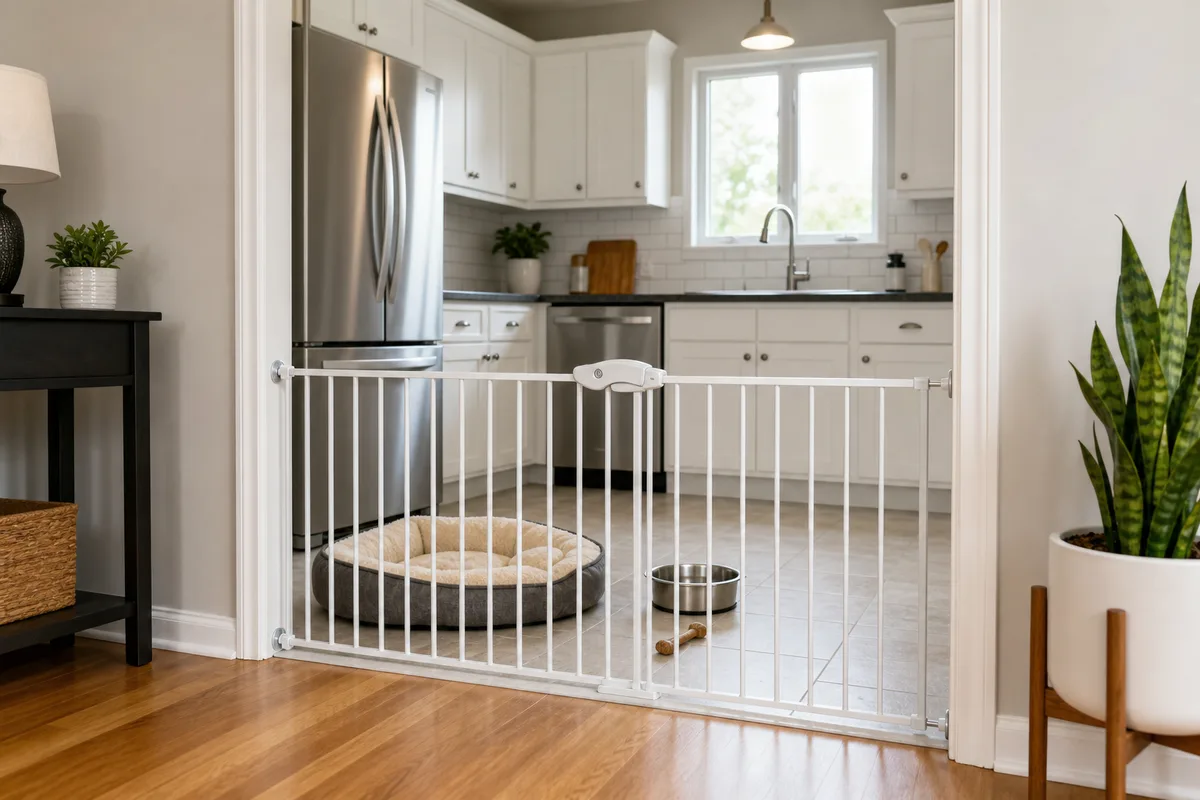 A gated kitchen area used as an alternative to a dog crate
An exercise pen is a ring of folding wire panels that stands on the floor and encloses an area rather than a box. It gives a dog room to move, stand, and shift position while still keeping it out of the rest of the house, and it folds flat for storage like a wire crate. It suits a dog that does fine with containment but chafes at the tight confinement of a crate, or a slightly older puppy that has earned a bit more space but is not yet trusted loose. The trade-off is that a pen is not a house-training tool the way a crate is, because a dog can move away from its bed to potty inside the pen, so you would typically pair it with pee pads or accept that it is a containment space, not a hold-it space. It also will not stop a determined climber or a dog that leans hard enough to walk the whole ring across a slick floor, so you come back to find both the pen and the dog several feet from where you left them.
A baby-gated room is often the simplest answer of all, and frequently the cheapest. You take a small, easy-to-clean space, a kitchen or a mudroom with a hard floor, clear the hazards and anything chewable, and close it off with a pressure-mounted gate. The dog gets a defined area that is bigger and more comfortable than any crate, you get the dog contained and off the good furniture, and cleanup is a wipe of a tile floor. For an adult dog that is calm but not fully trusted, or for daytime containment while you are home but busy, a gated kitchen is hard to beat. Its limit is the same as the pen's: it is not a house-training aid, and it does nothing for a dog that panics when confined, which no barrier solves.
And then there is the cheapest crate of all, which is a used one. Because dogs outgrow the small and medium sizes so quickly, secondhand crates and pens are common and cheap, and there is nothing wrong with a wire crate that has been wiped down and checked over. Look for a clean latch, an included and undamaged tray, and a divider if it is a wire model, and you have the same tool for a small fraction of new-price. I would check the used market before buying anything new, especially for a puppy that will only need the smaller configurations briefly.
Matching the choice to your dog
Pulling it together, the choice is not really "which crate is good." It is "which tool fits this dog, this home, and this stage," and the answer shifts as the dog grows. Here is how I would run the decision.
If you have a puppy under about five months and you are house-training, start with a wire crate sized to the adult dog and set with its divider to fit the puppy now. This is the case where a crate clearly earns its keep, the divider saves you from buying two or three, and the slide-out tray makes the accidents you will have easy to clean. Buy this one used if you can find a clean one. It pairs with the routine work in bringing home a new dog, which is worth reading first so the crate lands inside a plan rather than standing in for one.
If you have a calm, house-trained adult dog and a home that survives the dog being loose in one room, you may need nothing at all, or at most a gated kitchen for the odd busy afternoon. Do not buy a crate to solve a problem you do not have. If the dog later shows it wants a den, you can add an open-door crate as a bed and let the dog opt in. In that case the crate is really just a frame around the bedding, and what the dog is actually lying on matters more than the box; picking a dog bed that lasts covers what survives a dog that circles and digs before settling.
If travel or car safety is a genuine, recurring part of your life, that is when the plastic crate's downsides are worth accepting, because its enclosure protects in a crash and it meets airline cargo rules that a wire crate does not. For a dog that stays home, those strengths sit unused while the trapped heat and the storage bulk show up every day, so do not default to plastic for a homebody.
Reserve the soft crate for the dog that has already proven it settles quietly in a regular crate and just needs a light, packable option for trips. It is a convenience for a finished dog, not a starting point, and it fails the moment a chewer gets hold of it.
Whatever you land on, size to standing and turning, watch the dog rather than the weight chart, and remember the boundary that no crate crosses: it holds and settles a dog for a stretch, it does not store one all day, and it does not fix real panic. Get the size right, be honest about which of these three problems you actually have, and the cheapest tool that solves it is almost always the right one.