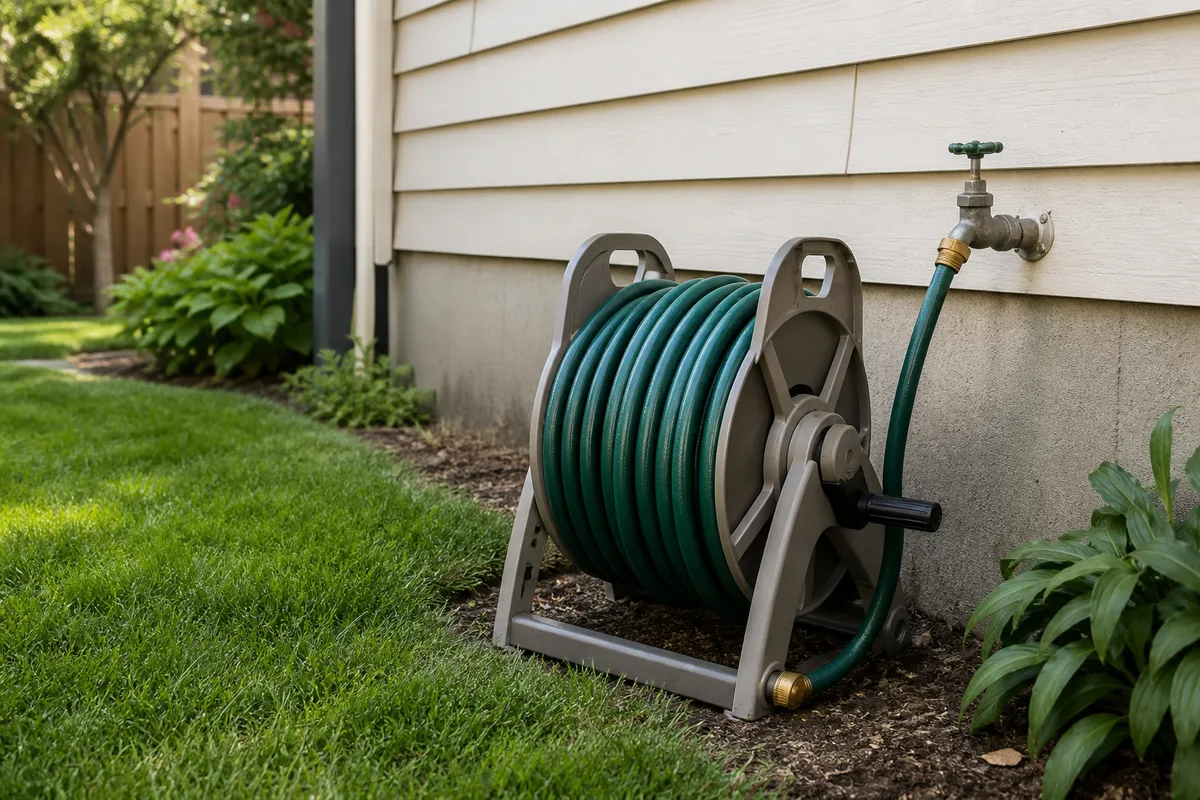
I have thrown away more garden hoses than I would like to admit, and every one of them failed in almost exactly the same way. It kinked at the spigot within the first month, so I dragged it, yanked it, and stepped on it to force water through. By the second summer the collar near the tap was crushed and weeping, and a foot down from there the vinyl had gone stiff and cracked. None of that was bad luck. A hose that costs twelve dollars is engineered to last about one season, and it does its job of lasting one season with grim reliability.
The good news is that the specs separating a hose that lasts one year from a hose that lasts ten are boring, printed on the packaging, and easy to read once you know what you are looking at. This is not a review of specific models, because models change and your yard is not my yard. It is a guide to reading a hose the way someone who has replaced a dozen of them reads one, so you buy once and stop thinking about it. I will also be straight about where spending more is wasted money, because a lot of the premium hose market is selling a promise the product cannot keep.
Why hoses fail so predictably
Walk down the length of any dead hose and you can usually read its cause of death like a timeline. There are only three failure points that matter, and they show up in the same order almost every time.
The first is the kink. A hose kinks when the wall of the tube is too thin or too soft to hold its round shape under a bend, so instead of curving it folds flat and pinches the water off. Once a spot has kinked, it has a memory, and it is not a forgiving one. The wall is creased, and it will fold in the same place from then on, usually right at the spigot where the hose has to make its tightest turn. Every kink is also a stress point, and repeated folding at one crease is what eventually splits a hose open there.
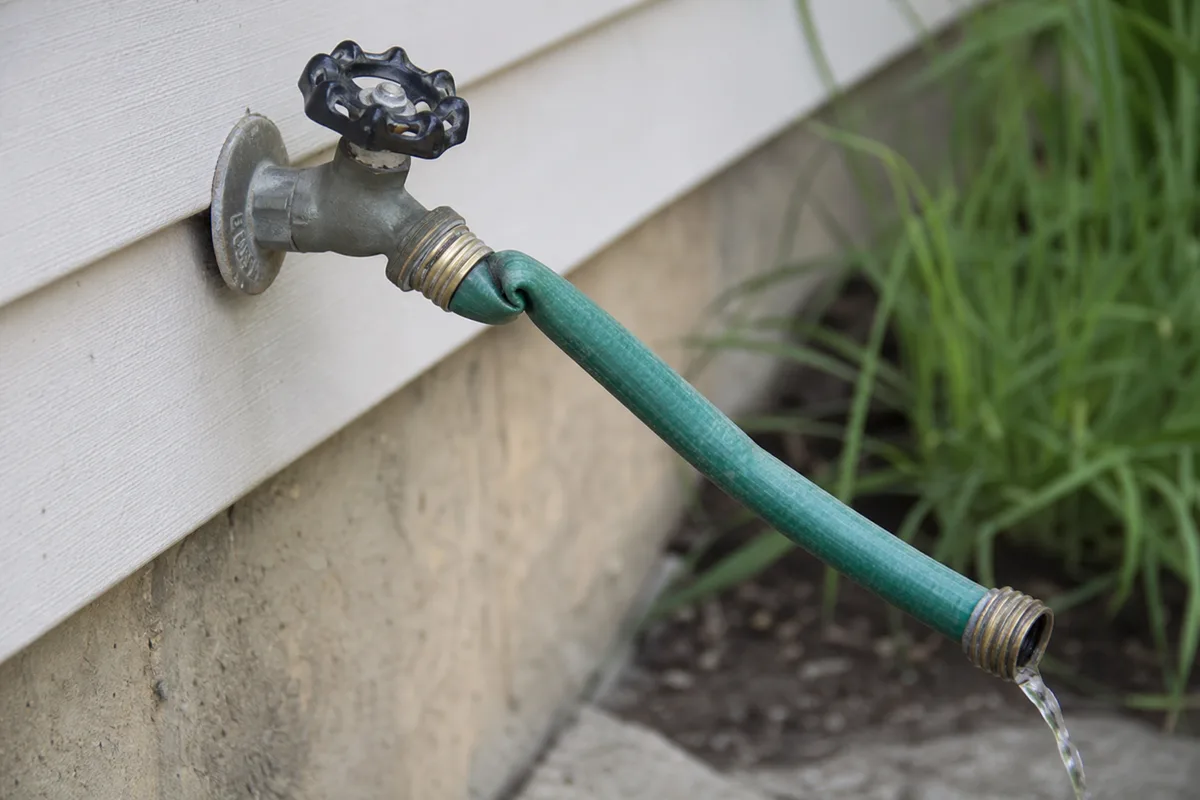 A garden hose kinked at the spigot restricting flow
The second failure point is the collar near the tap. This is the metal or plastic sleeve that connects the tube to the threaded fitting you screw onto the spigot. On a cheap hose that collar is a thin band of stamped metal crimped down over the rubber. It takes the entire weight of the hose every time you pull the line taut across the yard, and it takes a sharp bend every time you set the sprinkler down and walk away. Pull hard enough, often enough, and the metal crushes the tube inside it. Most hoses do not fail somewhere out in the middle of their length. They die at that crushed collar within arm's reach of the tap, which is worth remembering, because it tells you exactly where the quality of a hose actually earns its keep.
The third is sun and heat. Water sitting in a hose on a hot patio can get genuinely hot, and the tube itself bakes in direct sun day after day. Cheap vinyl responds to that by going hard and brittle, and brittle plastic under water pressure splits. This is the failure that arrives late, usually a summer or two in, and it is the one people blame on age when it is really blaming the material.
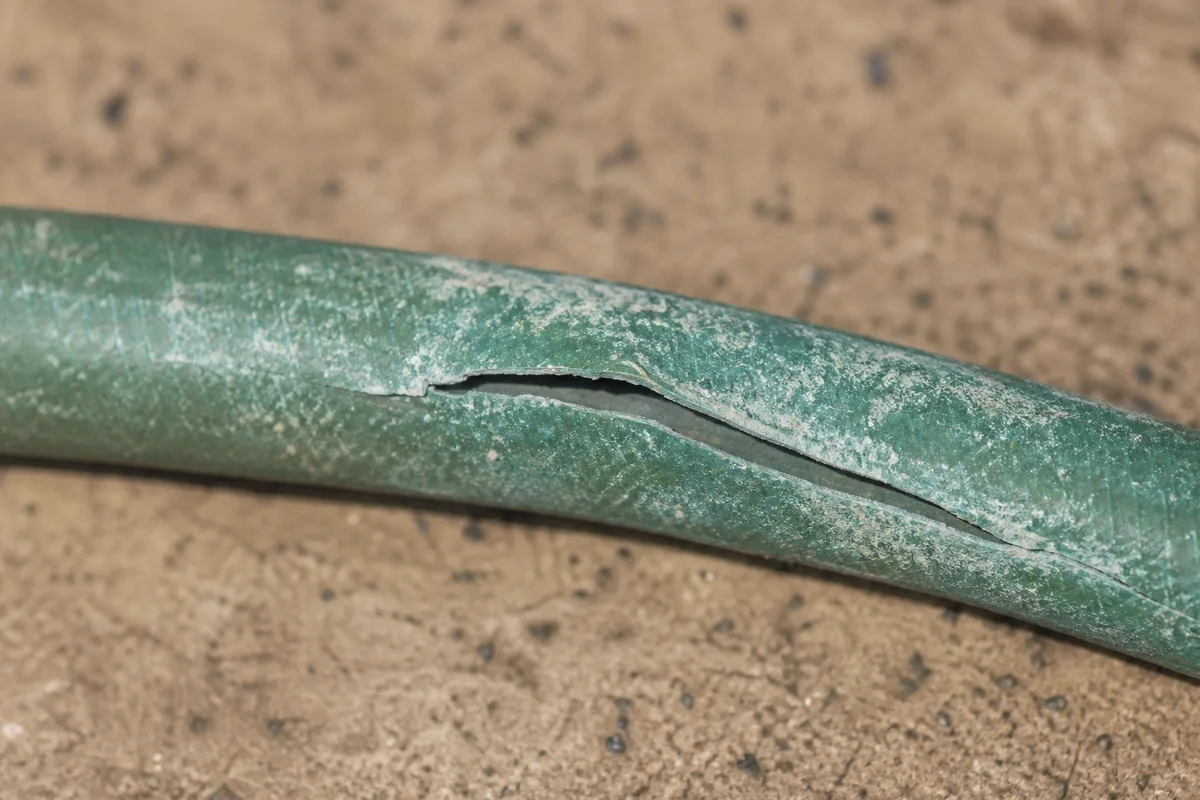 A split, sun-damaged section of an old vinyl garden hose
Notice that flow rate is not on that list. A hose does not slowly get weaker over the years. It works fine until one of these three things kills it, and then it is done. A hose does not ease into retirement; it works right up until the afternoon it quietly becomes a lawn ornament. So choosing well means choosing against these three specific failures, not chasing a vague sense of "quality."
The specs that actually matter
If you flip a hose package over, there is a lot of print, and most of it is marketing doing its best to sound like engineering. Only four things on that label decide whether you have bought a tool or a disappointment: diameter, material, fitting construction, and length. Everything else, including the reassuring words on the front, is noise until you have checked those four. The front of the package is where a hose makes promises; the back is where it accidentally tells the truth.
Diameter controls how much water the hose can move. Material controls how it survives sun, cold, and being dragged. The fitting is where it will most likely fail, so its construction predicts the death of the whole hose. Length is the one you are most tempted to over-buy, and buying too much of it quietly makes every other problem worse.
I want to be honest about a limit here. No spec sheet can tell you how a hose feels to handle, and feel matters more than people expect, because a hose that is miserable to coil is a hose you will drag instead of lift, and dragging is what crushes collars and creases walls. So read the specs first to rule out the hoses that will fail, then, if you can, handle the survivors before you commit. The label narrows the field. Your hands make the final call.
Diameter and flow
Here is the piece of advice that saves the most grief and that almost nobody leads with: for water flow, diameter matters far more than length. People shop for hoses by how far they reach and treat the width of the tube as an afterthought. It is backwards.
Garden hoses come in three common inside diameters: 1/2 inch, 5/8 inch, and 3/4 inch. That half-inch spread sounds trivial. It is not, because flow depends on the cross-sectional area of the tube, and area grows with the square of the diameter. A 5/8-inch hose has meaningfully more open channel than a 1/2-inch one, and the difference shows up most where you least want it: at the far end of a long run, feeding something thirsty.
This is exactly where a cheap hose betrays you. A bargain hose is almost always 1/2 inch, because thinner walls and a narrower bore are cheaper to make. Run a sprinkler at the end of a 1/2-inch hose stretched across the yard and you will watch it throw a weak, short arc while the same sprinkler at the tap sprays properly. The narrow hose is starving it. Swap in a 5/8-inch line and the sprinkler wakes up, because the hose is finally delivering the volume the sprinkler head was designed to throw. If you have ever blamed a sprinkler for being weak, the hose feeding it was often the real culprit.
For almost every home yard, 5/8 inch is the practical sweet spot. It carries enough water to run a sprinkler or fill a watering can quickly without being a fire hose to wrestle. The 3/4-inch size moves more water still, but it is heavier, stiffer, and more than most household spigots and tasks call for. I reserve that recommendation for someone with a very long run, a high-flow well pump, or a job that genuinely needs volume. Reach for 5/8 inch by default and only step up if you have a specific reason. What you put on the end of the hose shapes the choice too; if you are weighing a drip line against watering by hand, drip irrigation versus hand watering lays out which approach suits which garden.
One caution on flow that no hose can fix: the hose can only pass what the spigot and the fittings allow. If your tap has low pressure or you have stacked several couplers and a kinked splitter in the line, a fat hose will not rescue you. Diameter sets the ceiling on flow. It does not raise a low floor set somewhere upstream.
Material: rubber vs vinyl vs hybrid
Material is the single biggest decision for how long a hose lives, and the honest version of this comparison has real trade-offs rather than a clear winner.
Vinyl is the light, cheap, standard hose. It is easy to carry, easy to coil, and easy on your wallet, and those are genuine virtues. The cost shows up in the sun. Vinyl goes stiff and then brittle after a summer or two baking in the heat, and a brittle hose splits at its creases. If your hose lives coiled in the shade, gets used a few times a week, and comes indoors or under cover for winter, a vinyl hose can serve fine for a few seasons. Leave it stretched across a hot patio all summer and it will not see a third year.
Rubber is the opposite trade. A rubber hose costs more and it is genuinely heavy; a 50-foot rubber hose is a real armful, and if you have to haul one up steps or around a big yard, you will feel it every time, and probably start rethinking the route. In return it shrugs off exactly the conditions that kill vinyl. It handles sun and hot surfaces without going brittle, stays flexible in cold, and resists the kinking that plagues thin-walled hoses because its wall is thick enough to hold its shape through a bend. For a hose that lives outdoors, in the sun, in hard use, rubber is the one that survives. The weight is the price of that survival, and it is a fair trade only if you actually leave the hose out in punishing conditions.
Hybrid hoses are the middle ground that has gotten genuinely good in recent years. They use a polymer blend that aims for most of rubber's sun and cold tolerance at a fraction of the weight, and they tend to lie flat and coil without the stubborn memory of a stiff rubber line. They are not indestructible, and a hybrid will not outlast a heavy contractor-grade rubber hose in the roughest use. But for a homeowner who wants a hose that resists kinks, tolerates sun better than vinyl, and does not fight you every time you move it, a mid-grade hybrid is the choice I point most people to first. It is the most forgiving balance of the three.
There is no universally correct answer here, only a correct answer for your situation. Shade and gentle use forgive vinyl. Sun and abuse demand rubber. Most people live in between, and that is where the hybrid earns its place. If you are still building out the yard and figuring out how much watering you will really do, my article on starting a home garden walks through sizing your setup to the space and the time you actually have, which makes this hose decision easier.
Fittings: where hoses really die
Remember that the collar near the tap is where most hoses die. The fitting is the collar, and its construction is the most reliable predictor of a hose's lifespan that you can read off the package.
There are two ways a hose fitting is made. Stamped fittings are bent and crimped from thin sheet metal. They are light, they are cheap, and they are why cheap hoses fail where they fail. A stamped fitting bends if you step on it, cross-threads easily because the threads are shallow and soft, and crushes the tube inside its collar under the everyday stress of a hose being dragged taut. Once that collar crushes, the hose pinches shut or weeps at the connection, and no repair short of cutting the fitting off will bring it back.
Cast-brass fittings are the alternative, and they outlast stamped ones by years. A cast-brass fitting is a solid, machined chunk of metal. The threads are deep and clean, so it seats squarely on the spigot without cross-threading. It does not bend when you step on it or crush when you pull the line taut. It grips the tube with a proper collar that spreads the load instead of biting through it. When people talk about a hose that lasts a decade, they are almost always describing a hose whose brass fittings never gave out, protecting the vulnerable collar where lesser hoses die.
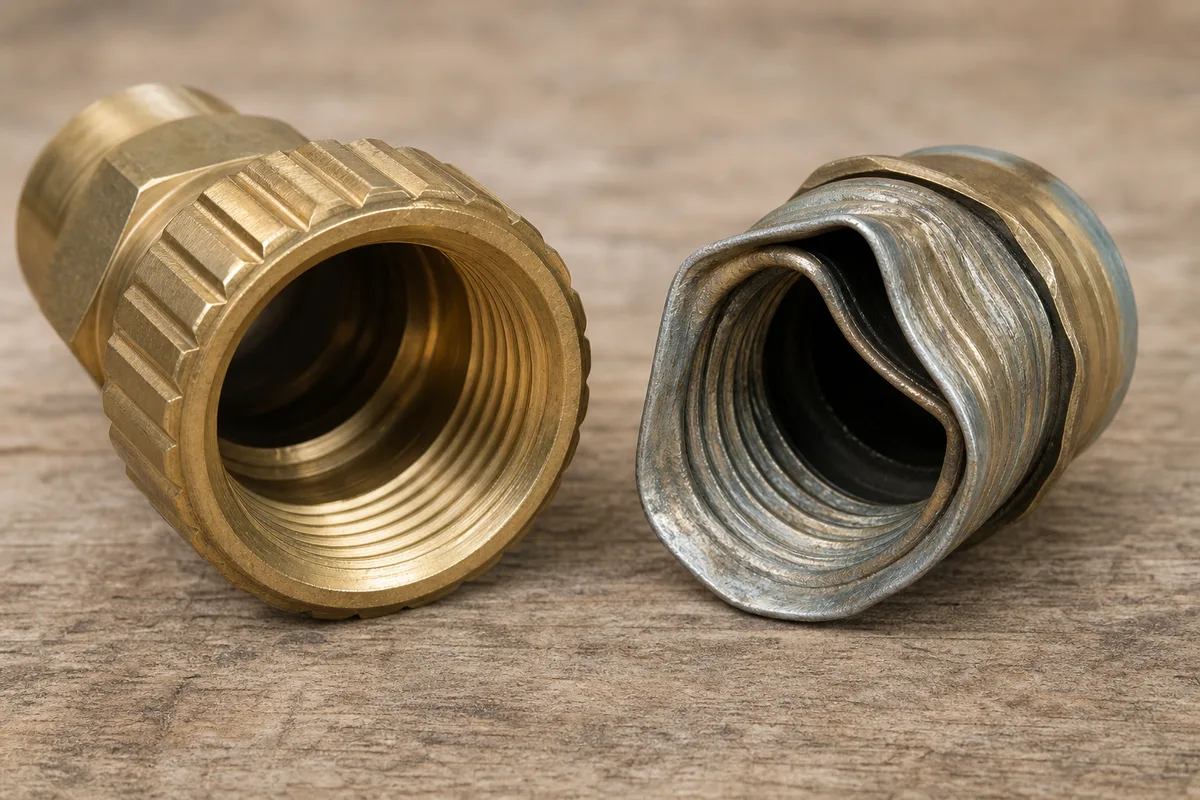 A brass hose fitting compared with a bent stamped fitting
You can feel the difference before you buy. Pick the hose up by the fitting. A cast-brass one has a dense, solid weight to it and the threads look crisp and evenly cut. A stamped one is light and tinny, and the threads often look slightly soft or uneven. That two-second heft test tells you more about how long the hose will last than any claim printed on the front of the package. Brass has no marketing department, and it is the more honest for it.
One more detail that saves aggravation: an octagonal or squared-off fitting shape lets you get a wrench or pliers on it when a connection is stuck, which happens often once mineral deposits build up. A smooth round collar gives you nothing to grip, and you will end up straining at a stuck connection with wet hands and a few choice words. It is a small thing that you will be grateful for on the day it matters.
Length without the tangle
Length is the spec people over-buy, and the temptation makes sense: you never want to come up short of the far corner of the yard. But every extra foot you buy is weight you carry, water volume you have to push, surface area exposed to the sun, and hose you have to coil and store. A too-long hose is not just clumsy. It is more failure waiting to happen.
The fix is to measure honestly rather than guess generously. Walk the actual distance from your spigot to the farthest thing you water and add a little slack for turning corners and reaching, but resist rounding way up. A common mistake is buying a single 100-foot hose to cover a yard that a 50-foot hose reaches with room to spare. That extra 50 feet then drags behind you, kinks, and lives in a heap you never bother to coil, quietly sunbathing its way to an early grave.
If you genuinely need to reach far, a better approach than one enormous hose is two shorter ones you couple together with a solid brass connector when you need the reach, and separate again for smaller jobs. A 50-foot hose is far easier to handle, coil, and store than a 100-foot one, and two 50s give you flexibility one 100 never will. This is where the quality of the coupling matters again, so pair shorter hoses with brass connectors rather than the stamped ones that come loose and leak.
Storage is part of the length equation. A hose that is a pain to coil is a hose you will leave sprawled in the sun, which is exactly the abuse that kills it. A reel or a simple wall hanger that lets you loop the hose in wide, even coils keeps the wall from creasing and gets the line up off the hot ground between uses. It is the least glamorous part of a hose setup and one of the most useful, because the enemy of a hose is not water, it is the sun and the crease, and coiling it away defeats both.
Cheaper and longer-lasting trade-offs
Now the honest money conversation, because plenty of the hose market is selling promises the product cannot keep, and a couple of "budget" choices are false economies.
Start with the marketing to distrust. Premium "no-kink" claims often do not hold in practice. Kink resistance comes mostly from wall thickness and material stiffness, and a thin hose branded as kink-proof still folds at the spigot where the tightest bend lives. Some premium hoses genuinely resist kinks because they are built of thick rubber or a good hybrid, but you are paying for the material, not the slogan. Read the diameter and the material and ignore the promise on the front.
Be especially wary of expandable hoses. They look great in the box and in the yard the first few weeks, coiling down to almost nothing and expanding under pressure into a light, flexible line. The catch is durability, which tends to show up right around the time the novelty wears off, usually the week after you have told a neighbor how great it is. The inner latex tube that does the expanding is thin and takes the full brunt of the water pressure, and these hoses are prone to bursting and wearing out fast, often within a season, especially if left pressurized in the sun. If you have a small balcony or a tight storage spot and you accept that you are buying convenience for a limited life, fine, go in with eyes open. As a main yard hose meant to last, an expandable one is a poor bet.
At the other end, the cheap 1/2-inch vinyl hose is a false economy for a different reason. It is not just that it fails fast. It is that while it lives it starves your sprinklers and slows every fill, so you are paying in poor performance the whole time and then paying again to replace it. Cheap up front, expensive in use and in the landfill.
Here is the middle path I actually recommend for most people, and it is cheaper over time than either extreme. Buy a mid-grade hybrid hose in 5/8 inch with decent fittings, and keep a brass fitting repair kit on the shelf. When the fitting end eventually fails, and on any hose it is the most likely thing to fail, you do not throw the whole hose away. You cut off the ruined end and clamp on a new brass male or female fitting from the kit. The repair takes about ten minutes with a utility knife and a screwdriver, costs a few dollars, and gives a decent hose several more years of life. Since most hoses die at the collar near the tap, being able to rebuild that end is the single highest-value skill in hose ownership. A repair kit turns a disposable hose into a repairable one, which is the whole game.
There is a real place for a premium rubber hose, to be clear. If you run a hose hard in full sun every day, a heavy cast-brass-fitted rubber hose is worth the money and the weight, because it will outlast several cheaper hoses and you will stop replacing them. Just buy it for the punishing conditions that justify it, not because a package told you it was the finest hose made.
Matching the hose to your yard
All of this comes together differently depending on the yard you actually have, so here is how I would decide in a few common situations.
If you have a small yard or a set of raised beds close to the tap, you do not need much hose or much hose. A 25- or 50-foot mid-grade hybrid in 5/8 inch, kept on a reel in the shade, will handle years of gentle use, and its light weight means you will actually coil it away instead of leaving it out. If your watering is mostly close-in and precise, a hose is only part of the picture anyway; my guide to planning a backyard vegetable bed covers laying beds out so watering stays quick and a shorter hose reaches everything.
If you have a large yard with long runs and thirsty sprinklers, prioritize diameter and fittings over everything. Go 5/8 inch at minimum, consider 3/4 inch only if a genuinely long run leaves your sprinklers weak, and insist on cast-brass fittings because a long hose puts more drag on that collar every time you pull it taut. Two coupled 50-foot hoses beat one unwieldy 100-footer for handling and storage.
If your hose lives in brutal sun on a hot patio or a south-facing wall, material is the decision that matters most. This is the one situation where I would pay for rubber and accept the weight, because vinyl will go brittle and split and a hybrid will wear faster here than anywhere else. Pair it with a reel or hanger so the line spends its idle hours off the baking ground.
And whatever you buy, treat the fitting end as the part to protect and, eventually, to repair rather than mourn. Do not step on it, do not yank the hose taut against it, seat it on the spigot squarely so the threads do not cross, and keep a brass repair kit ready for the day it finally gives. The tools you keep on hand shape how long everything in the yard lasts, and choosing durable ones is a theme worth its own attention; the same logic that picks a hose that lasts a decade also picks hand pruners that last instead of rusting shut in a season.
A hose is a humble tool, and it does not reward much thought. But the small amount of thought it does reward pays off for years. Read the diameter and choose 5/8 inch. Match the material to your sun and your patience for weight. Heft the fitting and choose cast brass. Buy only the length you measured. Keep a repair kit for the collar that will eventually fail. Do that once, and the hose stops being a thing you replace every summer and becomes a thing you barely notice, which is exactly what a good tool should be.