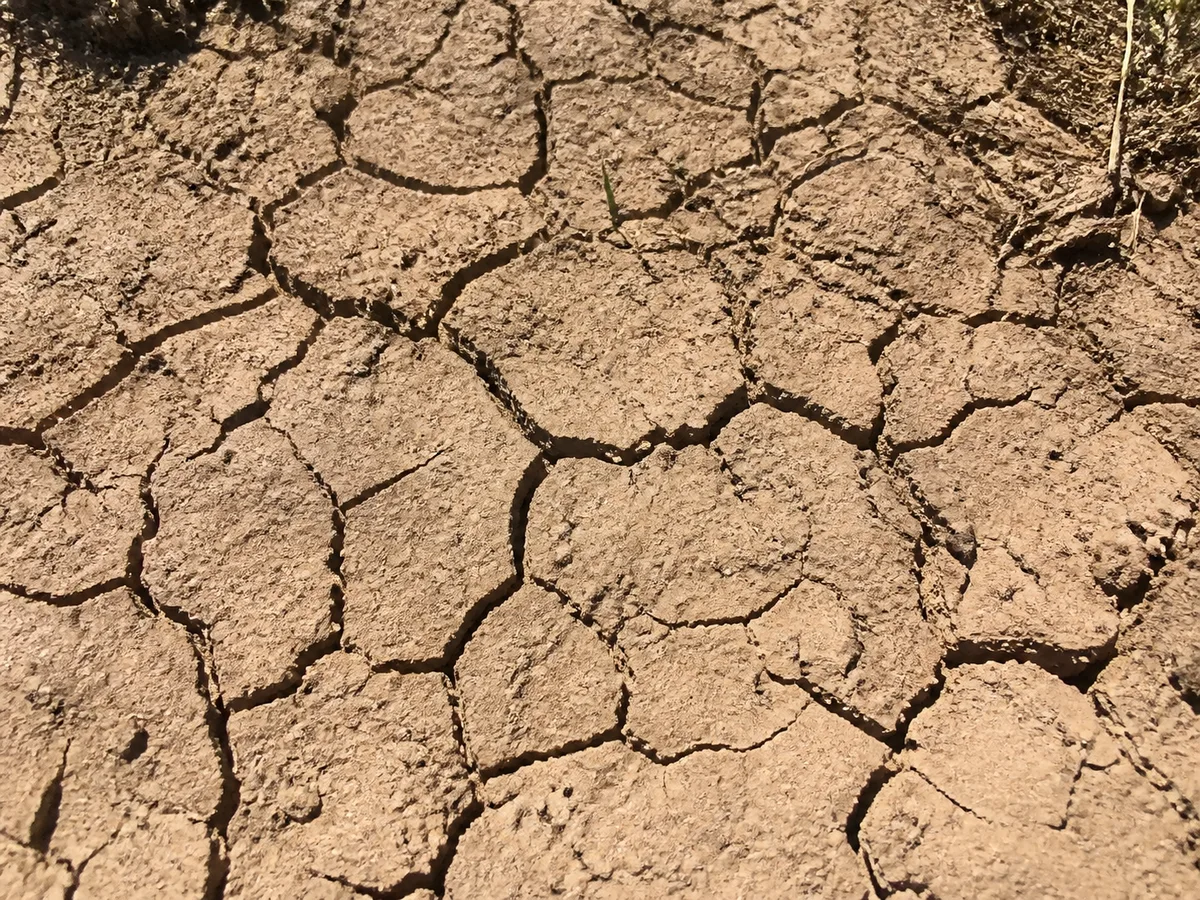
The first bed I ever tried to plant in a heavy-clay yard fought me for two years before I understood what I was actually looking at. In July the surface baked into a gray crust with cracks wide enough to lose a pencil in. In October the same spot held a puddle for a day and a half after an inch of rain. Tomatoes went in green and hopeful and just sat there, half the size they should have been, roots balled up in the top three inches because that was the only air they could find. I did what most people do first: I bought a bag of sand and dug it in. That made it worse, which felt like a personal insult at the time, and it took me a while to figure out why.
Clay soil is not bad soil. That is the thing to hold onto through all of this. Clay holds more nutrients and more water than sand ever will, which is exactly what a plant wants once you can get roots into it. The problem is never the clay itself. The problem is compaction, and compaction is fixable. It is just not fixable in a weekend, and most of the quick fixes people reach for either do nothing or set the whole mess up like concrete. This is the patient version, the one that actually works, laid out in the order I wish someone had given me.
The hard, cracked, puddling yard problem
You can usually spot serious clay compaction from standing height before you touch a shovel. In a dry stretch the surface goes pale and hard and splits into a network of cracks, sometimes a quarter inch wide, sometimes wide enough to swallow a marble. Those cracks are the clay shrinking as it loses water, and they close back up the moment it rains, which is why the ground feels like a brick in August and a sponge in November.
Water is the loudest complaint. On healthy ground a hard rain soaks in within a few minutes. On compacted clay it beads, runs off toward the lowest point, and pools there. I have watched water stand in a low corner of a bed for the better part of two days after a single storm. Meanwhile the plants tell you the rest of the story: growth stalls, leaves go pale, and everything looks stunted even though you fed and watered on schedule. When you finally pull a struggling plant, the roots are flat and shallow, spread sideways in the top couple of inches instead of reaching down, because down is a wall they cannot push through.
If your yard does two contradictory things depending on the week, hard as pavement when dry and swampy when wet, that swing is the signature of compacted clay, the least useful magic trick a yard can learn. It is not a watering problem and it is not a fertilizer problem, and no amount of either fixes it. Getting a real garden going here starts with soil, not seeds, which is the same order I walk through in the broader guide to planning a first garden season. Skip the soil and you spend the season fighting the ground instead of growing in it.
What compaction actually is
Clay is made of extremely fine, flat mineral particles, far smaller than a grain of sand. Under a microscope they stack like a deck of wet playing cards. Between and around those stacks, in healthy soil, is a whole architecture of pore spaces: bigger gaps that hold air and let water drain through, smaller ones that hold water for roots to sip. That pore space is not a minor detail. In good soil roughly half the volume is not solid at all, it is pores. Roots breathe through those pores, water moves through them, and the soil life that feeds plants lives in them.
Compaction is the collapse of that pore space. Push the particles together, squeeze the air out, and those flat clay plates pack down flush against each other with almost nothing between them. Water can no longer travel through, because the channels it traveled through are gone. Roots can no longer push through, because there is no soft gap ahead of them to grow into. Air does not exchange, so the soil life that would normally keep the structure open dies back or moves on. The soil becomes a solid mass instead of a crumbly network.
Clay compacts easily for the same reason it holds water well: those tiny particles have enormous surface area and pack tightly by nature. It does not take much to collapse the pores. Foot traffic across a wet bed does it. A single pass of a mower or a wheelbarrow over soggy ground does it. Rain hammering bare, unmulched soil does it, packing the surface into that sealed crust. And here is the trap that catches almost everyone, myself included: digging clay while it is wet does it worst of all. When you push a shovel through saturated clay, you do not loosen it. You smear the particles into a slick, sealed face and squeeze out whatever air was left. You think you are fixing the problem while you are actively making it. Understanding how the soil is supposed to move water and hold nutrients makes all of this click, and I go deeper on that mechanism in how soil holds water and nutrients.
A simple drainage test with a hole
Before you spend a dollar on amendments, spend twenty minutes proving to yourself what you are dealing with. A dug test hole tells you more about a drainage problem than any mail-order soil kit, and it costs nothing. Soil test kits are useful for pH and nutrient questions, but they cannot see compaction. Only water can.
Dig a hole about a foot deep and a foot wide, straight-sided. Fill it to the top with water from a hose and let it drain out completely once, so the surrounding soil is pre-wetted and you are testing drainage rather than how thirsty the dry ground is. Then fill it a second time and watch the clock.
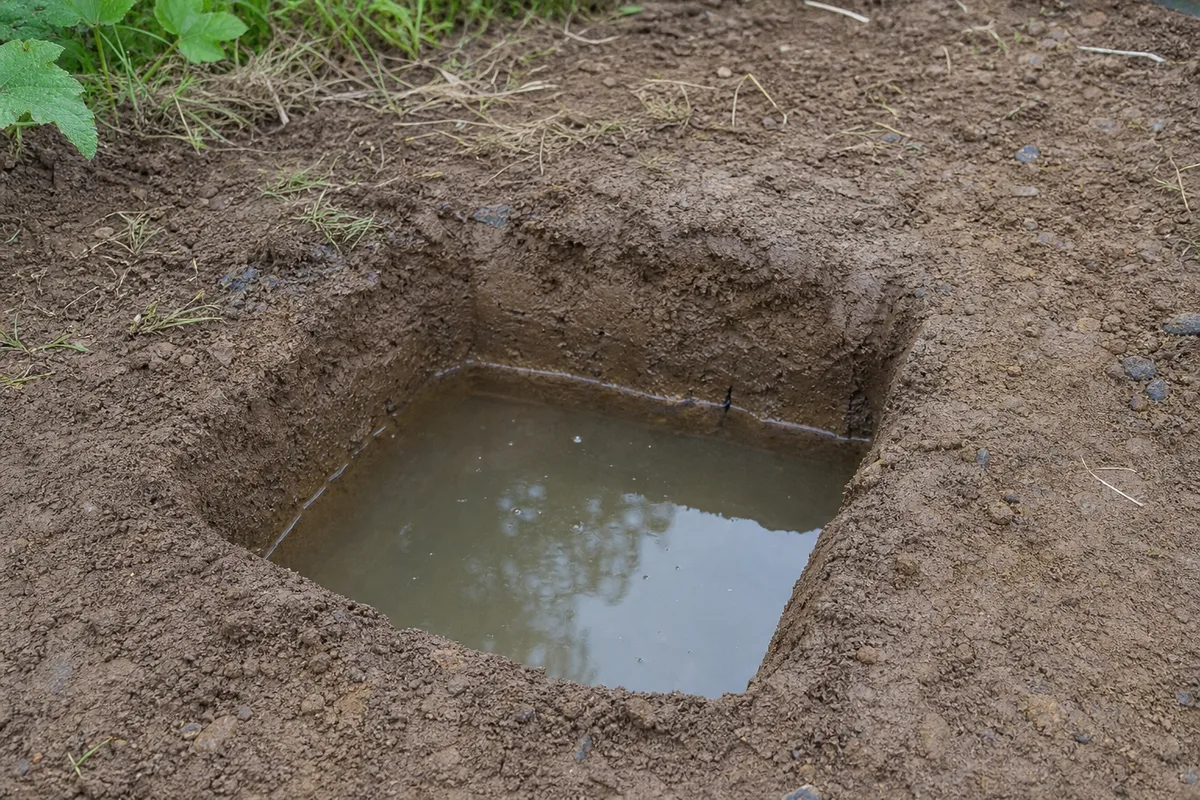 A test hole filled with standing water to check soil drainage
Healthy, well-drained soil drops that second fill at something like one to two inches an hour, sometimes more. On my worst bed the water fell less than an inch in the first hour and the hole still had standing water in it four hours later. Anything slower than about an inch an hour tells you drainage is genuinely poor, and water standing in that hole for hours after a rain is the confirmation you are looking for. If it drains in fifteen minutes, your problem is something else and you can stop reading about clay. If it sits there like a little pond well into the afternoon, you have compaction, and now you know the scale of it.
Do this test in two or three spots. Compaction is rarely even. The strip along a path where everyone walks will be far worse than the middle of a bed nobody steps on. Knowing which parts of the yard are worst tells you where to concentrate the work, and it gives you a baseline. Dig the same test hole a year into the fix and watch that drain time shrink. That number is how you know the patient approach is working when the surface still looks stubborn.
Why sand is the wrong first move
This is the mistake I made, and it is the single most common piece of bad advice handed to people with clay. The logic sounds airtight: clay is fine and dense, sand is coarse and loose, so mix sand into clay and you get something in between. The trouble is that soil does not average out that way. Under the right proportions, clay plus sand plus water gives you something much closer to the raw material of masonry than to garden soil.
Here is what happens. Those fine clay particles fill in every gap between the sand grains, packing the spaces solid instead of propping them open. Instead of the sand creating channels, the clay seals around it. The mixture sets up dense and hard, and once it dries it can hold that hardened shape stubbornly. To actually dilute clay enough to change its texture with sand, you would need to add sand on the order of the volume of soil you are trying to fix, tons of it, worked deeply through the whole root zone. Add a couple of bags to a bed and you have not diluted anything. You have bought the clay a gift and helped it pack tighter.
The fix for clay is not a different mineral. It is organic matter. Sand changes nothing you want changed at any dose you would realistically apply, and at partial doses it actively backfires. Skip the sand entirely. Put that money and effort into compost, and the same effort buys you a bed that keeps improving instead of one that sets like a slab.
Organic matter: the real fix, over time
Organic matter is what opens clay up, and it works by a different mechanism than sand ever could. As compost, aged leaves, and other decayed material break down in the soil, they feed earthworms, fungi, and the whole underground community. Those organisms burrow, bind, and glue soil particles into small crumbs called aggregates, with pore spaces between them. That crumb structure is exactly the pore architecture compaction destroyed. Organic matter does not physically pry the clay apart on its own so much as it powers the biology that rebuilds the structure. If you want the mechanics of how that material actually rots down into something the soil can use, how compost breaks down walks through the whole process.
The way to apply it is generous and repeated. Spread a layer of compost two to three inches thick over the bed. On badly compacted ground where you can dig, fork it into the top six to eight inches, breaking up clods as you go without pulverizing them to dust.
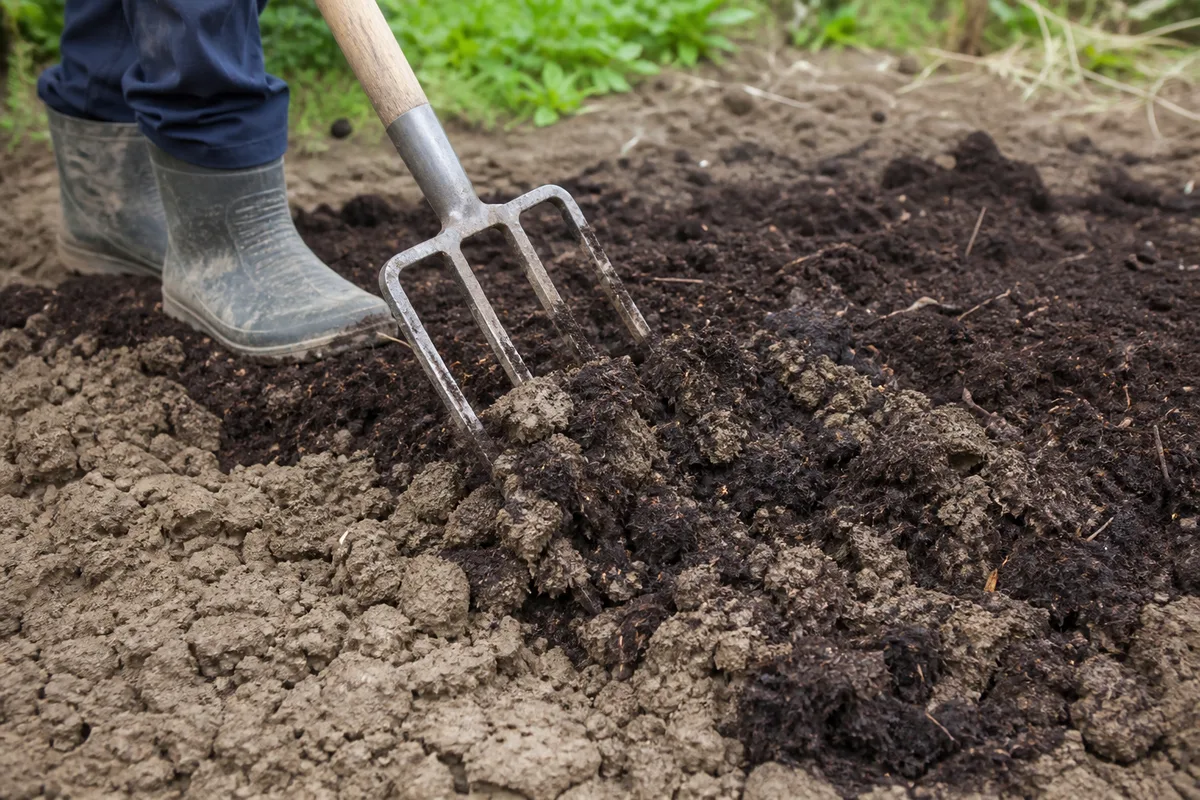 Working compost into heavy clay soil with a garden fork
Then do it again the next season, and the one after. This is the part people do not want to hear: one application of compost does not fix compacted clay. It nudges it. The real transformation comes from adding organic matter every season, letting it break down, adding more, until the top several inches turn dark and crumbly and hold their structure. On a bed I worked this way it took the better part of three seasons before I could push a trowel in by hand where a shovel had bounced off before. Two full inches of the surface had gone from gray brick to something that crumbled in my fingers.
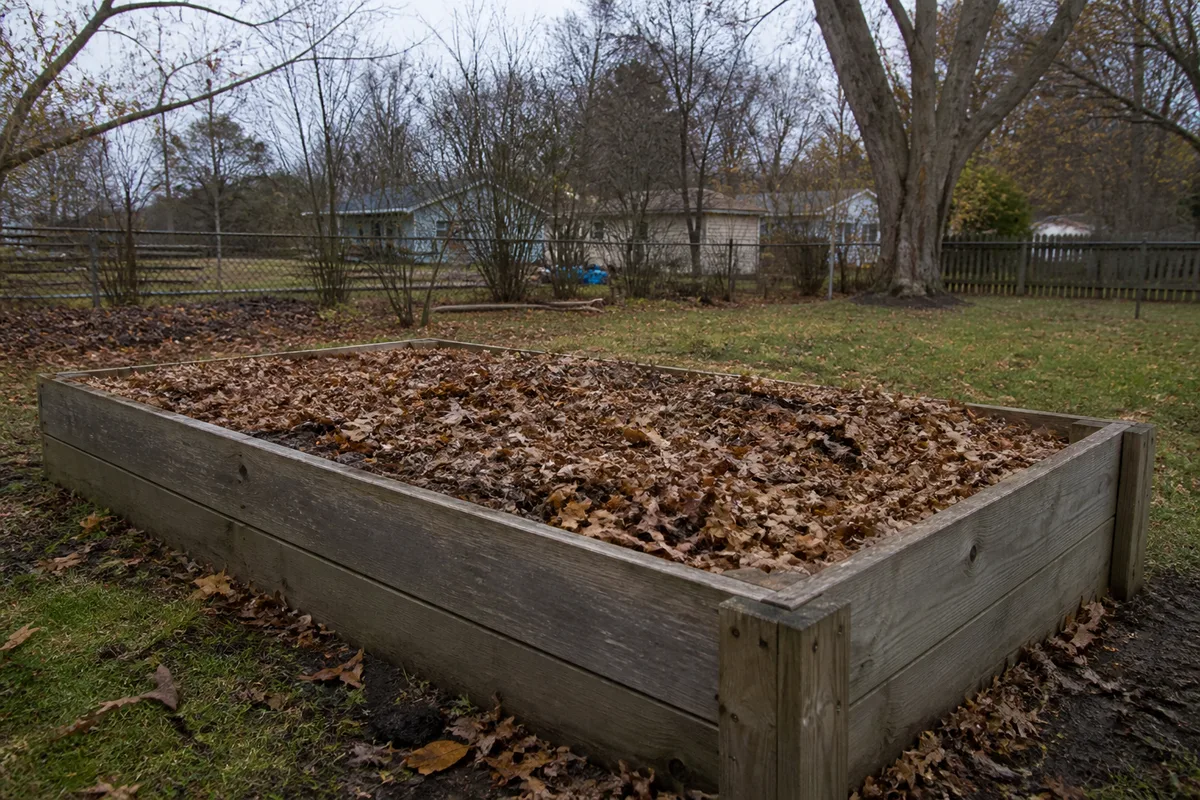
There is a lower-effort version that works if you are patient, and it is the one I lean on now for large areas. Rather than dig, lay the compost on top, cover it with a few inches of mulch such as shredded leaves or wood chips, and let earthworms carry it down for you. It is slower than forking it in, maybe an extra season, but it never risks the smearing damage that digging clay invites, and the worms do the work while you do nothing, which is the most agreeable division of labor in all of gardening. Mulch matters here beyond feeding the soil: a covered surface never forms that sealed crust from rain impact, and it holds the in-between moisture that keeps clay workable longer.
One honest limit: if your compaction runs deep, packed down a foot or more by construction equipment or years of vehicle traffic, surface organic matter improves the top layer but will not reach the hardpan below for a long time. In that case the top few inches become workable while the layer beneath stays dense, and you either wait years for biology to reach it or you shift strategy, which is where raised beds come in later.
Working clay only at the right moisture
You can undo a whole season of patient improvement in one afternoon by working clay at the wrong moisture, and moisture is the variable that matters most with this soil. The rule is simple to state and easy to ignore when you are impatient: never dig or till clay when it is wet, and do not bother when it is bone dry either. Wet clay smears and compacts under the tool, sealing the pores you are trying to open. Bone-dry clay is so hard you cannot get a tool into it without a fight, and you end up hammering clods rather than loosening soil.
What you want is the in-between window, the crumbly stage. There is a quick field test for it. Scoop up a handful of soil from a few inches down and squeeze it into a ball. Then poke the ball with a finger. If it is too wet, it packs into a slick, shiny lump that holds its shape and smears, and it may release water; put the shovel away, that soil will smear if you dig it. If it is too dry, the ball will not form at all and just crumbles to loose dust in your hand. When it is right, the ball forms but breaks apart cleanly into crumbs the moment you poke it, with no shine and no smearing.
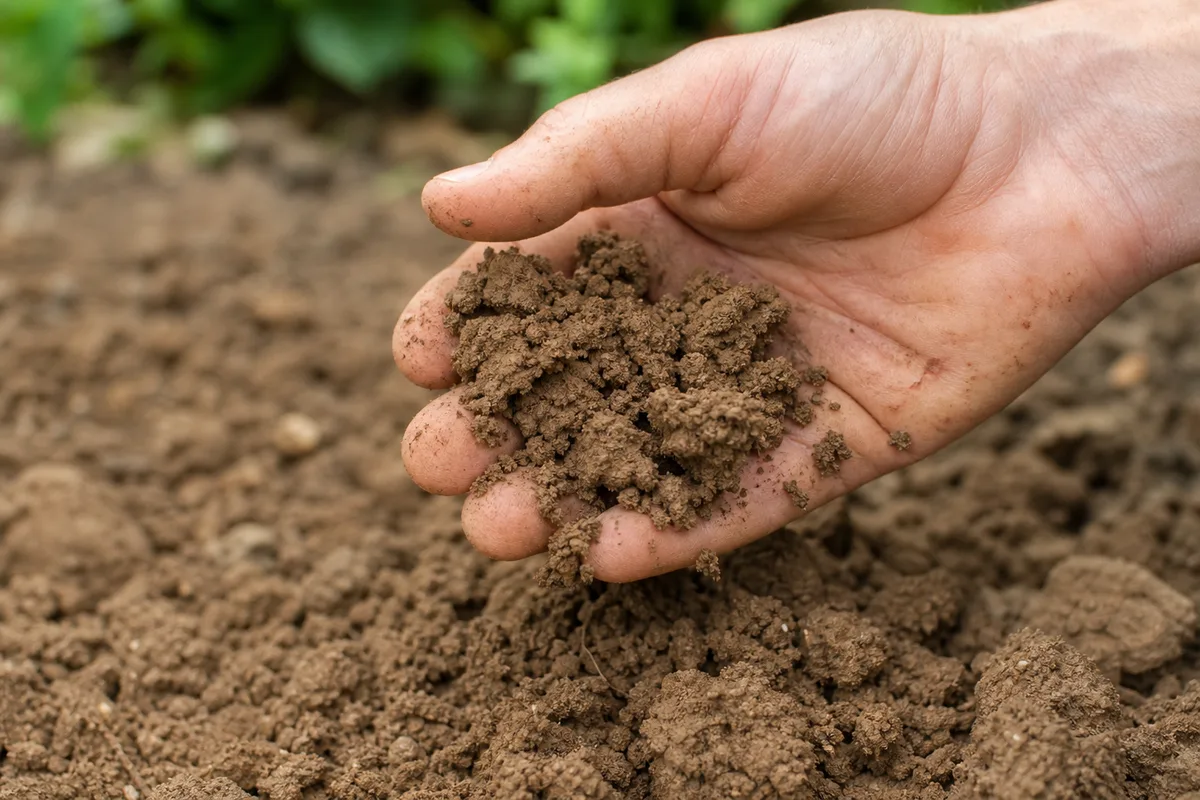 Crumbling clay soil at the right moisture for working
That window can be narrow with heavy clay, sometimes only a day or two after a good rain before it swings from too wet to too dry, and in a hot spell it may pass in an afternoon. The trick is to watch the weather and get out there in that slot, even if it is not the day you had planned. If you miss it, wait. Digging soggy clay because it is the weekend and you feel like gardening is precisely how the ground got smeared and compacted in the first place. Patience with the moisture is not a nice-to-have here, it is the whole game. And a bed kept under mulch stays in that crumbly range longer, giving you a wider window to work in.
Faster help: raised beds and deep-rooted plants
Rebuilding compacted clay in place is the durable fix, but it is slow, and you may want to grow something this year while the ground catches up. Two approaches buy you time.
The first is to stop fighting the native soil and build above it. A raised bed, even a low one six to twelve inches deep, filled with a good soil-and-compost blend, gives roots a workable zone from day one. You are gardening on top of the clay rather than in it. This is the fastest route to a productive bed on bad ground, and it has a second benefit: because you never walk inside a raised bed, and the frame gives you a polite reason not to, the soil in it never gets compacted the way an open bed does. The honest downsides are cost and that the clay underneath is still clay, so drainage out the bottom stays slow. Keep the bed deep enough that roots have room above the native layer, and site it where water is not actively pooling. On the worst-draining spots, leaving the bed bottomless and loosening the clay directly beneath it before you fill lets the two layers slowly knit together over a few seasons.
The second approach is to let plants do the digging. Certain deep-rooted plants, particularly cover crops with taproots like daikon-type forage radish, drive roots down through compacted layers. When those roots die back and rot, they leave channels behind, vertical pores that air, water, and future roots can follow. It is sometimes called biological tillage, and on a bed you are not using over winter it costs almost nothing to try: sow the cover crop, let it grow, let the cold kill it, and let it decompose in place. It is not a fast fix and it will not break a deep construction hardpan, but it works with the same grain as the organic-matter approach rather than against it, and it feeds the soil as it goes.
Neither of these replaces the long game. They are ways to grow while the long game plays out underneath.
A season-by-season improvement plan
Here is the whole thing sequenced, so you can see how a compacted clay bed becomes a growing bed over a couple of years without any single overwhelming push.
First fall or spring, whichever comes first. Run the drainage hole test in two or three spots and write down the drain times; that is your baseline. Stop all foot traffic on the beds. Spread two to three inches of compost across the surface. If the soil is at that crumbly moisture and you have the energy, fork it into the top six to eight inches; if not, just lay it on and cover it with a few inches of mulch and let the worms start. Do not add sand. Do not dig when it is wet.
First growing season. If you need to grow now, build a raised bed or two over the worst ground and plant into good blended soil there while the open beds improve. Keep every bed mulched so the surface never crusts and the soil holds workable moisture. Water deeply and less often rather than a little every day, so roots are drawn downward.
First winter. On any bed you are resting, sow a deep-rooted cover crop and let the cold kill it. Leave the residue and the roots in place to rot and open channels. The sowing deadline, the mulch fallback if you miss it, and the rest of the fall shutdown are covered in putting the garden to bed for winter.
Second spring. Add another two to three inches of compost. By now the top inch or two of the worked beds should feel noticeably different, darker and more crumbly, and a trowel should go in with less fight. Re-run the drainage test in the same spots and compare the times to your baseline. On my beds the drain time roughly halved by the second year, and that number told me it was working even when the surface still looked rough.
Second summer and beyond. Keep the cycle going: compost and mulch on top every season, no wet digging, no traffic, cover crops on resting beds. Somewhere in the second or third year the compacted clay stops being a problem you are fixing and becomes soil you are gardening in, holding water without drowning roots and taking in a hard rain without pooling.
The honest summary is that clay is fixable but not overnight, and the shortcuts that promise overnight results are the ones that set you back. Skip the sand, feed the soil organic matter season after season, respect the moisture window, and lean on raised beds and deep roots to grow in the meantime. Do that and the same ground that baked and puddled and stunted everything for you turns into the richest, most forgiving soil in the yard, because underneath all that trouble, clay wanted to be good soil the whole time.