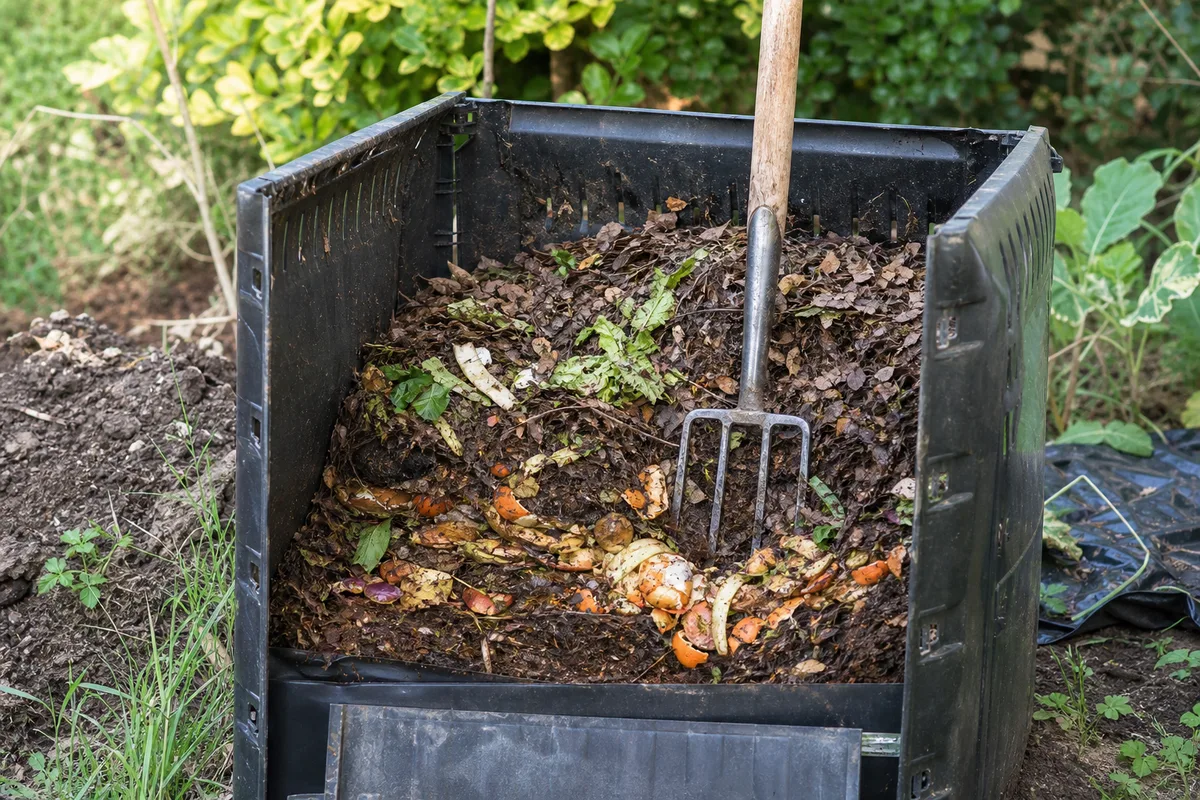
Almost everyone who starts a compost pile hits the same wall. You do what the back of the bag or the well-meaning neighbor told you: throw the kitchen scraps in a corner, add some leaves, wait. Then months pass and you go out to check, and there it is, more or less exactly as you left it. The banana peels have gone dark and flat, the eggshells are still eggshells, and the whole thing smells faintly of a swamp. Nothing is turning into the dark crumbly stuff you were promised. It just sits there.
I have run piles that stalled like that, and I have run piles that finished in a season, and the difference was never a magic additive or a special bin. It was understanding what the pile actually is, which is a colony of microbes eating your scraps, and giving those microbes the four things they need to do the work fast. Once you see the pile that way, every stalled heap starts to explain itself. This article walks through the mechanism first, then uses it to diagnose and speed up a slow pile.
The pile that just sits there
Let me describe the classic stalled pile, because you can usually spot which kind of failure you have from across the yard.
There are two common versions, and they look and smell opposite. The first is the dry, inert pile: a heap of leaves and twigs and maybe some old scraps that has not shrunk, does not heat up, and crumbles apart dry when you poke it. It has been sitting for six months and looks like it will sit for six more. The second is the wet, sour pile: a dense, matted, slumped mass, often mostly grass clippings, that squelches when you step near it and gives off a sharp, sulfurous, ammonia-and-rot smell. It is doing something, but not the something you want.
Both piles are stuck, and both are stuck because one of the microbes' basic needs is missing. The dry pile is usually starved of moisture and nitrogen. The wet sour pile is drowning and starved of air. Neither one is broken in a way that needs a product to fix, no matter what the garden center would like you to believe. Each one is a legible signal, once you know what the workers in the pile are asking for.
The reason it matters to get this right is that finished compost is genuinely worth the effort. It is the single most useful thing you can add to a garden, because it improves nearly any soil you have. That is a longer story told in the companion piece on how soil holds water and nutrients, but the short version is that compost is the amendment that helps sandy soil hold moisture and helps heavy soil drain, all at once. A stalled pile is a pile of that benefit sitting locked up. So it is worth understanding why it stalls.
What's actually doing the work
Here is the mental shift that changes everything: you are not composting. The microbes are. You are running a livestock operation, and the livestock are billions of bacteria and fungi too small to see. Your entire job is to keep those workers fed, watered, breathing, and warm enough to stay busy. Think of yourself less as a gardener and more as middle management for the very small. Every composting rule you have ever heard is really a rule about keeping that invisible workforce happy.
When conditions are right, the pile goes through a rough sequence. First, fast-multiplying bacteria wake up and start eating the easy stuff, the sugars and soft tissues, and as they eat they give off heat as a byproduct, the same way a crowd warms a room. A working pile climbs into a genuinely hot range, warm enough that steam rises off it on a cool morning and the center is uncomfortable to hold a hand in. This is the pile "cooking," and it is a good sign, not a problem. That heat is the metabolic exhaust of a huge, thriving population working through your scraps.
As the easy food runs out, the fast bacteria taper off, the pile cools, and a slower crew takes over: fungi and larger organisms that chew through the tougher, woodier material the bacteria left behind. This is why a pile heats up, cools down, and then keeps quietly shrinking for weeks afterward. Finally, at ambient temperature, the last of it is worked over by fungi, earthworms, and other small creatures that turn the coarse remains into fine, dark crumb. Understanding this sequence tells you something practical: heat means the fast phase is running well, and the absence of heat in a fresh pile means the workforce never got going. A pile that never warms up is a pile whose workers are missing one of their four basic needs.
The four things microbes need
Every stalled pile I have ever fixed came down to restoring one of exactly four things. Get all four roughly right and decomposition is close to automatic; the microbes will do the rest whether you understand them or not. Miss one badly and the whole process stalls no matter how much you fuss with the others.
The four needs are:
- Food, in the right mix. The microbes need both a carbon source and a nitrogen source, in a rough balance. In compost terms these are called browns (carbon) and greens (nitrogen), and getting their ratio right is the single most common thing people get wrong. This gets its own section below.
- Air. The microbes you want are aerobic, meaning they breathe oxygen. A pile that gets packed down and airless switches over to a different, anaerobic crowd that works slowly and smells terrible.
- Moisture. The workers live in the thin film of water coating every particle. Too dry and they go dormant; too wet and the water blocks out the air.
- Enough mass to hold heat. A pile has to be big enough to insulate its own hot core, or the heat the microbes generate just leaks away into the surrounding air faster than they can produce it.
Think of these four as legs on a stool. It does not matter how solid three legs are if the fourth is missing; the whole thing tips over. Nearly all composting advice, stripped of the folklore, is just a way of tending these four. The rest of this article takes them in the order that trips people up most often, starting with the food mix.
Greens and browns, and the balance that matters
This is where most piles live or die, so it is worth being precise. The microbes need carbon for energy and nitrogen to build their bodies, and they need them in a particular proportion. Too much nitrogen and the pile turns into a wet, stinking mess. Too much carbon and it just sits there inert for a year. The whole art is in the balance.
In everyday terms, greens are the wet, fresh, nitrogen-rich materials: grass clippings, kitchen fruit and vegetable scraps, coffee grounds, fresh plant trimmings, spent flowers. They tend to be moist and to break down fast on their own. Browns are the dry, older, carbon-rich materials: dry fallen leaves, straw, shredded plain cardboard and paper, small twigs, sawdust from untreated wood. They tend to be dry and to hold their shape for a long time by themselves.
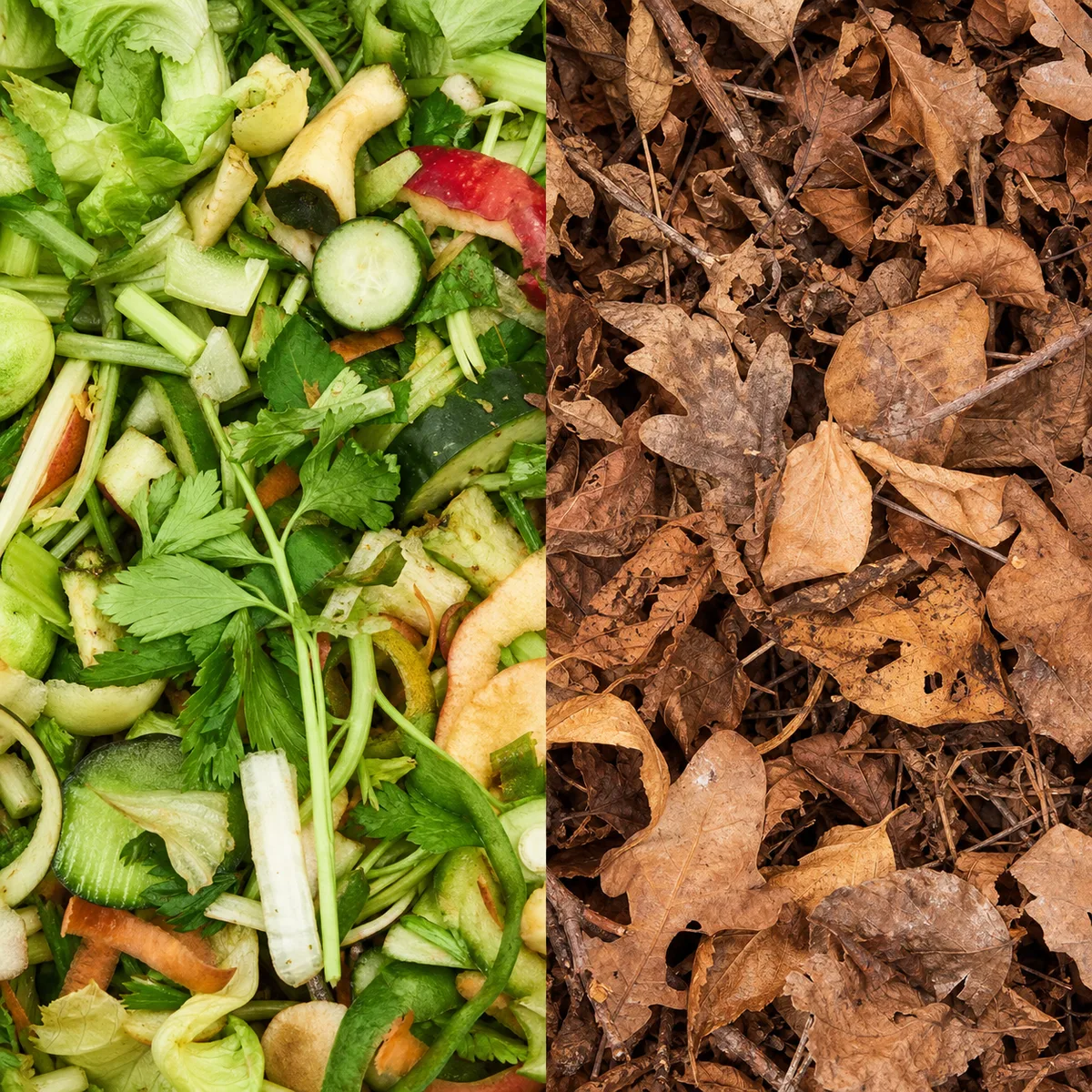 Green kitchen scraps beside brown dry leaves for composting
The balance that keeps a pile working is roughly two to three parts browns to one part greens by volume. Not by weight, by rough eyeballed volume, because you are building this in a yard, not a laboratory. Three loose buckets of dry leaves to one bucket of kitchen scraps is a fine working target. The exact number does not matter much; the ballpark does. If you remember one ratio for the rest of your composting life, remember roughly two-to-one or three-to-one browns to greens.
Now watch what happens when the ratio goes wrong, because this explains the two stalled piles from the start. The all-grass-clippings pile is the wet-sour failure. Grass is nearly pure green, all nitrogen and water and no carbon. Piled up, it packs into a dense airless mat, the water it carries can't drain, and the nitrogen has no carbon to pair with, so it goes slimy and sour and gives off that ammonia reek. It is not "too little compost activity," it is the wrong activity, the anaerobic kind. The fix is not an additive; it is a wheelbarrow of browns, dry leaves or shredded cardboard, mixed through it to soak up the excess and open it up.
The opposite failure is the pile of nothing but dry leaves and twigs, which is the dry, inert heap. It is almost all carbon with barely any nitrogen, so the microbes have energy food but nothing to build their bodies with, and the population never grows enough to generate heat. It can sit for a year looking untouched. The fix here is greens: grass clippings, kitchen scraps, or in a pinch a scatter of a nitrogen source, mixed in and moistened.
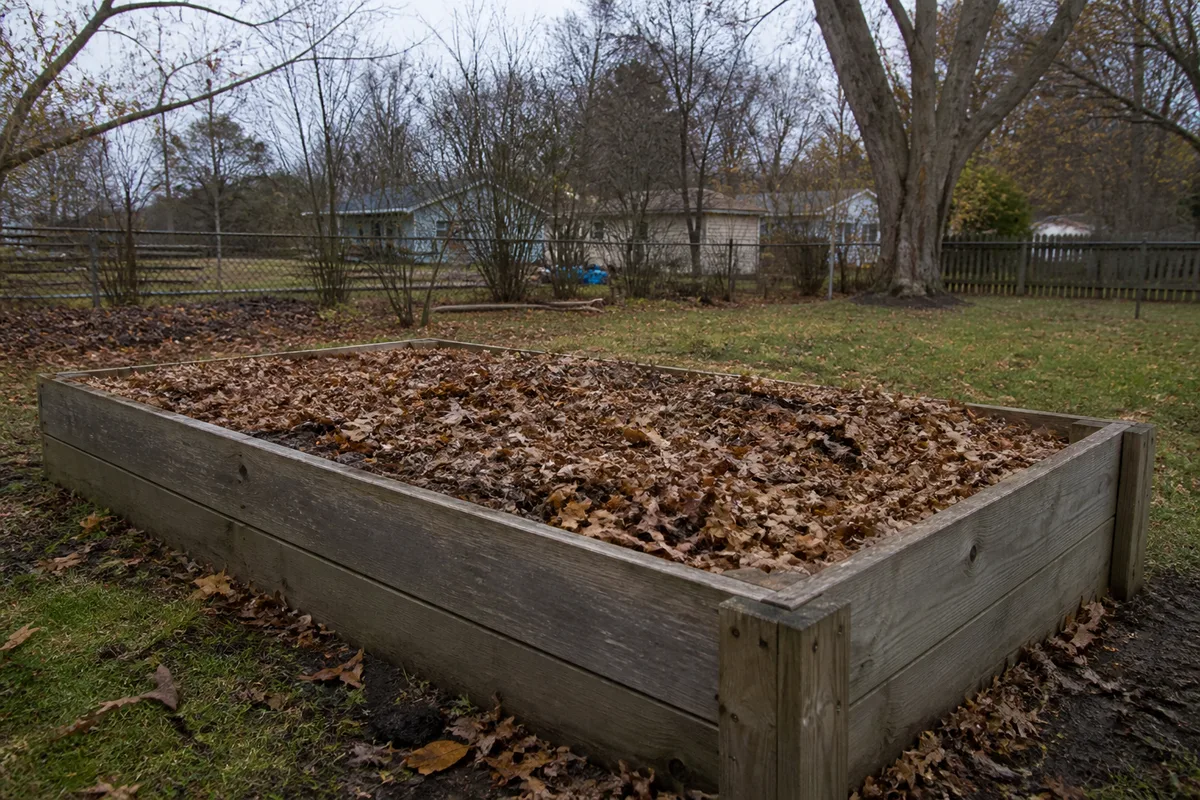
The practical habit that keeps you out of both ditches is to keep a stash of browns on hand. Greens arrive on their own schedule, a bag of kitchen scraps every few days, a mow's worth of clippings on a Saturday. Browns are seasonal, mostly autumn leaves. So most people drift green-heavy simply because greens keep showing up and browns run out, the way the fridge is always full of things you did not plan to buy. Stockpile a few bags of dry leaves in fall, keep them dry beside the bin, and add a couple of scoops every time you add a load of scraps. That one habit prevents the majority of sour, slimy piles. Fall is also when the garden itself hands you a load of material at once, and sorting what belongs in the pile from what should be thrown out is part of putting the garden to bed for winter.
Air, moisture, and pile size
With the food mix handled, the other three needs are quicker to describe but just as decisive. All three often go wrong together, and all three are fixable in an afternoon.
Air
The microbes you want breathe oxygen, and a pile uses that oxygen up fast in its hot phase. When the interior runs out of air, the aerobic workers suffocate and the slow, smelly anaerobic ones take over. A pile that is wet, packed, and smelly is almost always short of oxygen, not short of some additive. People reach for a store-bought "compost accelerator" when what the pile actually needs is to breathe.
The way you add air is by turning the pile: lifting it apart with a fork and restacking it so the packed middle gets fluffed and the outside edges move to the center. Turn a pile every week or two while it is hot and it will finish dramatically faster than one left alone, because you keep feeding the fast aerobic crew the oxygen they need to stay at full population.
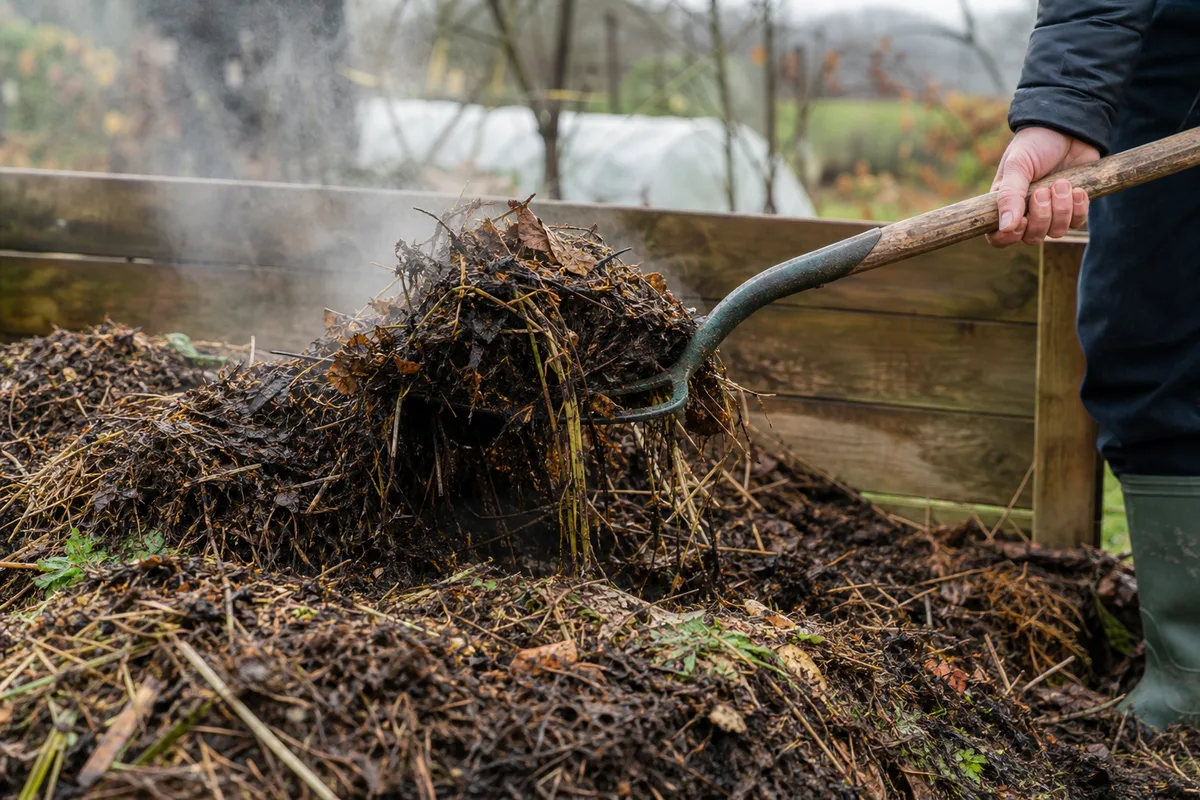 Turning a compost pile with a garden fork
You do not have to turn. A pile left completely alone will still compost eventually through the slower cold process, over a year or more. But turning is the single biggest lever you have on speed, and it is the honest answer to "how do I make this go faster." The trade is pure labor: more turning, faster compost. Nobody has ever sold a shortcut around a garden fork, though plenty have tried. If you build the pile with enough browns for structure in the first place, it stays looser and needs less turning to keep air moving, which is another reason the ratio matters.
Moisture
The workers live in a thin film of water on every particle, so a bone-dry pile goes dormant and a waterlogged one drowns. The target that every experienced composter describes the same way is a wrung-out sponge: damp to the touch, but you cannot squeeze standing water out of a handful. Grab a fistful from the interior and squeeze. A drop or two is perfect. A dry crumble means add water, ideally while turning so it wets evenly. A trickle running out means the pile is too wet, and the fix is browns and turning to open it up and let it breathe off the excess.
Moisture and air are linked, which is why they fail together. Too much water fills the air spaces and suffocates the pile; that is exactly what happens in the grass-clipping mat. So when a pile is both soggy and smelly, you are not solving two problems, you are solving one: mix in dry browns and turn, and you fix the water and the air in the same motion.
Pile size
This one surprises people. A compost pile needs to be big enough to insulate its own heat, or the warmth the microbes generate escapes into the surrounding air faster than they can make it. Below roughly a cubic yard, about a three-foot cube, a pile struggles to hold a hot core, especially in cool weather. This is exactly why a thin scattering of scraps tossed in a corner never really cooks: there is not enough mass to trap the heat, so it can only ever break down the slow, cold way.
The practical takeaway is to build in batches rather than sprinkle. If you can accumulate materials and assemble a pile that is at least a cubic yard all at once, well mixed and moistened, it will heat up and run through the fast phase in a way a slowly-dribbled heap never will. In a very small yard where a full cubic yard is not realistic, an enclosed bin helps, because the walls trap some of the heat that an open heap would lose, partly making up for the smaller mass. It will still run cooler and slower than a big pile, and that is a fair trade for the small footprint, as long as you go in expecting a slower finish rather than a hot fast one.
Reading a stalled pile and fixing it
Now put the mechanism to work. When a pile stalls, you do not guess and you do not buy anything. You read the two most obvious signals, smell and moisture, and they point straight at which of the four needs is missing. Here is the whole diagnostic, cheapest and most likely first.
Symptom: it smells sour, like ammonia or rot, and it is wet and slumped. This is too many greens, too little air, too much water, usually all three at once because they cause each other. It is the grass-clipping failure. The fix: mix in a generous helping of dry browns, shredded cardboard or dry leaves, and turn the whole pile to introduce air. Within a few days the smell should fade as the aerobic crew takes back over. If it is genuinely waterlogged, this also lets it dry toward that wrung-out-sponge target.
Symptom: nothing is happening, and the pile is dry and crumbly. This is too little moisture, often paired with too little nitrogen. The fix: water it while turning so it dampens evenly to the sponge target, and if it is mostly browns, mix in a load of greens, fresh clippings or kitchen scraps, to feed the workers the nitrogen they were missing. A pile that was inert for months can start warming within a week of this.
Symptom: nothing is happening, moisture looks fine, mix looks reasonable. Check the size. A small heap with good ingredients still may not hold heat. The fix: build it bigger, or consolidate several small piles into one, or accept a slower cold finish and just wait. Also check whether the pieces are simply large. A pile of whole branches and thick stalks has very little surface area for microbes to attack, and chopping or shredding material smaller genuinely speeds things up because it gives the workers more surface to work on.
Symptom: it was cooking nicely and then went cold before it looked finished. This is often normal, the fast phase simply ran out of easy food. A turn usually restarts it by exposing fresh un-decomposed material and adding air; if a turn brings the heat back, it was just resting. If a turn does nothing and the material already looks broken down, it may actually be finished, which is the next section.
The thread running through all of this: the pile is telling you what it needs. Sour and wet means air and browns. Dry and dead means water and greens. Cold and small means more mass. You are reading signals from a workforce, not troubleshooting a machine, and the signals are consistent enough that you rarely need to guess twice.
One honest limit: some things just break down slowly no matter what, and no amount of turning rushes them. Thick woody stems, avocado pits, corn cobs, and citrus rind take far longer than soft green scraps, and a stubborn pit can pass through an entire finished batch looking exactly as smug as the day it went in. That is not a stalled pile, that is the wrong expectation. Either chop those items small before adding them, or simply fish the survivors out at the end and toss them into the next pile for another round.
Knowing when compost is finished
The last question is how you know it is done, because using compost before it is finished can actually work against your garden. Compost that is still actively decomposing keeps drawing on nitrogen to feed its microbes, and if you dig unfinished material into a bed, that draw competes with your plants for the same nitrogen. So it is worth recognizing the finish line.
Finished compost has three tells, and it is worth checking all three rather than trusting any one alone. First, look: it is dark brown to nearly black, and crumbly, with a loose, even texture. The original ingredients are mostly unrecognizable; you should not be able to pick out individual banana peels or leaves, though a few tough survivors like a twig or a pit are normal and fine to screen out. Second, smell: finished compost smells like a forest floor after rain, earthy and clean and pleasant. It does not smell like rot, ammonia, or last Tuesday's dinner. If you can still smell food, it is not done. Third, temperature: it has cooled to the surrounding air temperature and stays there even after you turn it, because the fast microbial work is over and there is nothing left to generate heat.
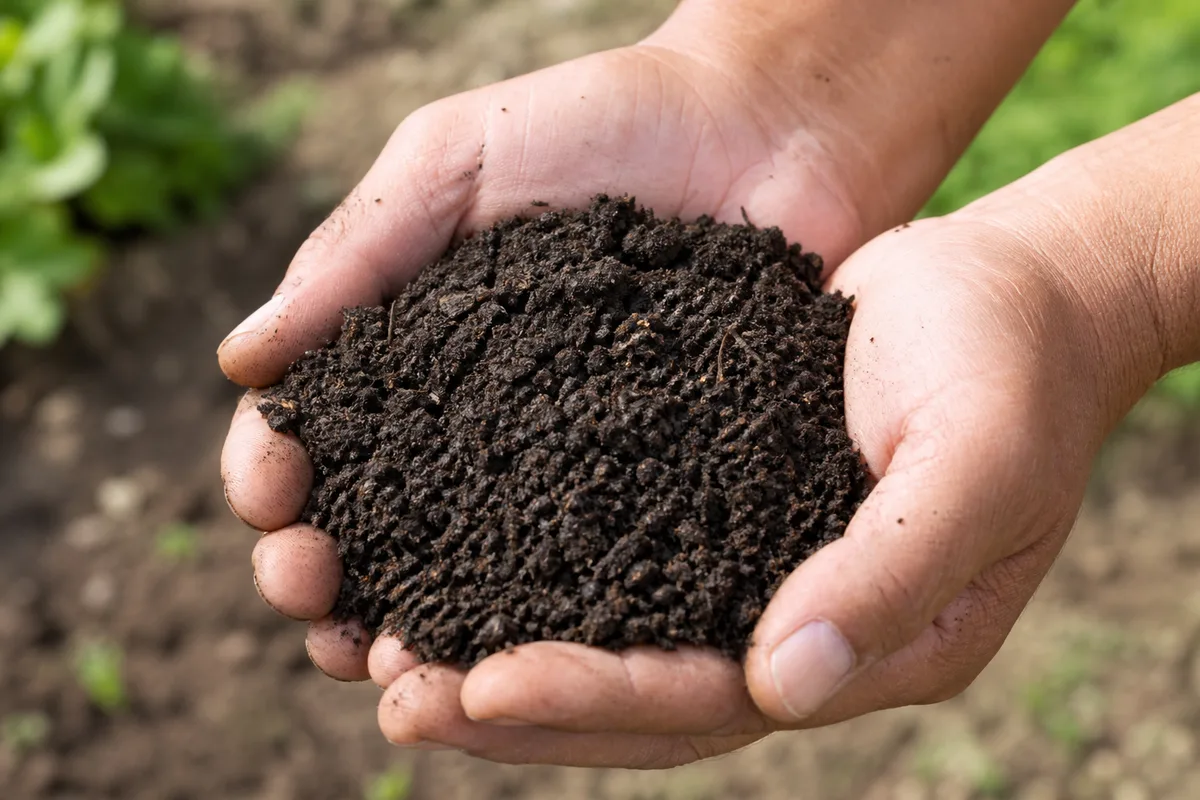 Hands holding finished dark crumbly compost
There is a simple confirmation test if you are unsure: seal a handful of the compost, lightly moistened, in a closed bag or jar for a couple of days, then open it and smell. Finished compost still smells earthy and clean. If it comes out sour or sharp, there are still active microbes at work and it needs more time. This is a more reliable check than eyeballing alone, and it costs nothing.
From a cold, sit-there pile, expect the timeline to run long, six months to a year or more, because cold decomposition is slow. A well-built, well-turned hot pile (right ratio, right moisture, big enough, turned every week or two) can give you usable compost in as little as a couple of months in warm weather. The gap between those two outcomes is entirely the four needs and how attentively you tend them. There is no shortcut product that closes it; there is only greens, browns, air, moisture, mass, and turning.
Once you have finished compost, the payoff is broad. Worked into a bed it is the starting point for beginning a home garden, and it is the main tool for loosening and reviving heavy ground, which is the whole subject of the guide to fixing compacted clay soil. A stalled pile is a solvable problem, and once you understand that the pile is a living workforce with four simple needs, you stop guessing and start reading it. The heap that "just sits there" almost always turns out to be short of one thing you can add in an afternoon, and after that, the microbes take it the rest of the way.