The owners who struggle with house-training almost never have a stubborn puppy. They have a scheduling problem they have not named yet. The dog is fine. The plan is missing. When someone tells me their eight-week-old keeps having accidents "even though we take him out," I already know what I am going to find: the trips outside are happening on the human's schedule, not the puppy's, and the gap between the two is exactly where the mess lands.
House-training is not obedience and it is not a battle of wills. It is a logistics job. You are managing a small animal that physically cannot hold it very long, whose bladder empties on a predictable rhythm, and who learns by what happens in the two seconds after an action. Get the timing right and supervision tight, and the accidents drop off on their own. Get the timing wrong and no amount of patience or firmness will save you, because you are asking the puppy to do something its body is not yet built to do. This article lays out the actual schedule, the interval math behind it, and the fixes for when it stalls.
Why schedules beat scolding
The whole thing turns on one fact about how puppies learn: they connect a consequence to an action only if the two happen within a second or two of each other. That is the entire mechanism. A puppy that squats on the rug at 2:00 and gets scolded at 2:00:30 does not think "I should not have gone inside." It thinks "the human got scary while I was near this spot," or worse, "the human got scary when I went to the bathroom in front of them." The reasoning behind that split-second window is worth understanding in its own right, and the piece on how dogs learn through reward timing walks through why the gap between action and consequence decides everything.
Here is the part most people get backwards. Punishing an accident does not teach a puppy to hold it. It teaches the puppy to avoid going where you can see it. The pup that got a stern voice for peeing in the open learns that peeing in the open is what caused the trouble, so it starts slipping behind the couch, into the spare room, under the dining table. Now you have a dog that is not any more house-trained but is much harder to catch in the act and much harder to redirect outside. I have watched this exact backfire play out in more than one house, and the owner is always baffled that "being firm" made things measurably worse.
A schedule works because it does the opposite. Instead of waiting to react to a mistake, you get the puppy to the right spot before the mistake, so the only thing that ever happens is success. Every time the puppy goes in the correct place and gets a calm reward, that spot and that behavior get a little stickier. You are stacking wins, not correcting losses. Scolding is you fighting the puppy's biology; scheduling is you working with it. That reframe (this is a timing problem, not a discipline problem) is the single most useful thing to hold onto through the messy first weeks.
The interval math by puppy age
You cannot build a schedule without knowing how long the puppy can actually hold it, and there is a rough rule that gets you close enough to start: a puppy can hold it about one hour per month of age, plus one. So a two-month-old can manage roughly three hours between breaks, a three-month-old about four, a four-month-old about five. It is a ceiling, not a target, and it applies to a calm, resting puppy. The moment the pup eats, drinks, plays, or wakes up, that clock resets and shrinks.
Treat that number as the maximum stretch you would ever leave, not the interval you aim for. In the first week or two, I take a young puppy out far more often than the formula allows, closer to every hour or two while awake, because the cost of an extra trip outside is a few wasted minutes, and the cost of guessing wrong is a mess plus a small step backward in learning. It is cheaper to over-take than to under-take, and the puppy will not hold the extra fresh air against you. As the pattern gets reliable and the accidents disappear, you stretch the intervals out toward the age ceiling.
Overnight is the exception that surprises people. A sleeping puppy's body slows down, so a pup that needs a break every three hours awake can often go noticeably longer asleep, especially if you stop food and water a couple of hours before bed. Even so, a very young puppy usually needs at least one overnight trip out for the first few weeks, and setting an alarm for the middle of the night beats waking up to a soiled crate. Skipping that trip to protect your sleep tends to cost you more sleep in cleanup and setbacks than the alarm ever would. Nobody enjoys standing in a dark yard in a robe at 3 a.m., but it is a short chapter of your life, and the alternative is a longer one.
Two honest limits on the math. Small breeds have smaller bladders and often need more frequent breaks than the formula suggests. And the rule describes physical capacity, not desire. A puppy that is excited or distracted may empty out well before the interval is up, which is why the trigger moments in the next section override the clock entirely.
The four trigger moments to never miss
The clock tells you the maximum. The triggers tell you the guaranteed moments, and if you learn nothing else from this article, learn these four. There are four events after which a puppy will almost certainly need to go, regardless of what the interval math says: after waking, after eating, after play, and after any excitement. Miss these four and you will be on the floor with a rag; catch them and you prevent most accidents before they can happen.
After waking is the most reliable of all. A puppy that has been asleep, a full night or a twenty-minute nap on the couch, needs to go almost immediately on waking. Do not stop for coffee, however much your brain votes otherwise. The trip outside happens before anything else, ideally before the puppy's feet have finished touching the floor. I carry young pups straight from the crate to the door for the first weeks precisely because those thirty seconds of walking are enough for an accident.
After eating runs on a short fuse. A puppy's digestive system pushes things along fast, and a meal often triggers the need to go within five to thirty minutes. This is why feeding on a fixed schedule helps house-training so much: predictable meals make for predictable output, and you can plan the trip outside around it. Feed, wait a short while, go out. Free-feeding, leaving food down all day, scrambles this signal and makes the whole schedule harder to read.
After play catches people because it does not feel like a bathroom cue. A burst of active play gets everything in the puppy moving, and a pup will often stop mid-romp and squat. Watch for the pause in play; it is frequently the tell. Any real physical activity should be followed by a trip out before the next thing.
After any excitement is the catch-all: a visitor arriving, being picked up, a sudden loud noise, coming back from a walk, the general chaos of a household getting home. Strong stimulation loosens a young puppy's control. When something exciting has just happened, assume a break is due. These four moments are not suggestions layered on top of the clock. They are the schedule's backbone, and the timed intervals just fill the gaps between them.
Choosing and marking the spot
Puppies key in on where they went last, so consistency of location does a large share of the work for you. Pick one spot outside and use it every single time in the early weeks. Same door out, same patch of ground. The scent that builds up there becomes a signal, and the puppy starts to understand that this particular place is the bathroom the same way it understands the food bowl is where food happens.
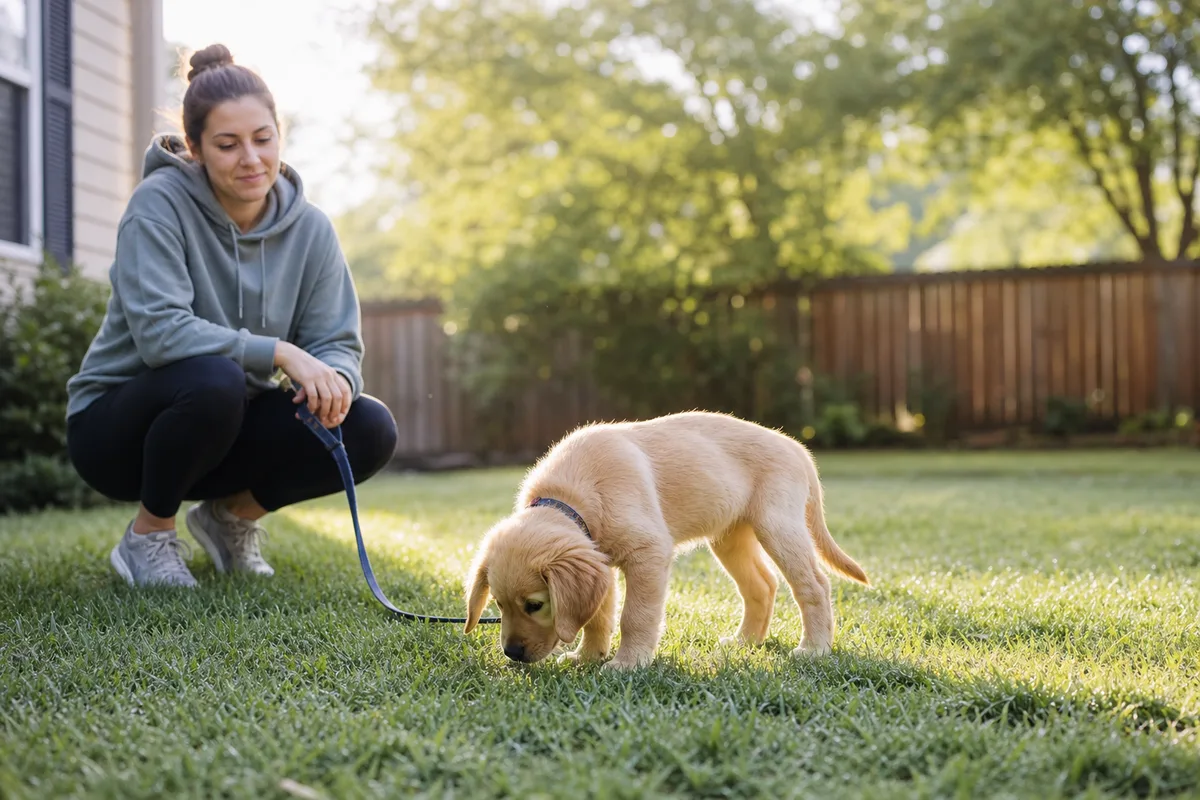 A puppy on a leash at a designated potty spot in a backyard
Take the puppy to the spot on a leash, even in a fenced yard, for the first weeks. This is not about control; it is about focus. A loose puppy in a yard investigates, chases a leaf, forgets what it came out to do, and then does its business two minutes after you have given up and come inside, which feels personal but is not. On a short leash you keep the pup in the small area of the chosen spot and let boredom do its job: nothing else to do out here but the one thing. Stand still and quiet. If you talk, walk around, or play, you become the entertainment and the pup never settles enough to go.
Give the moment a calm word. Pick a plain phrase ("go potty," "be quick," whatever you will actually remember to say) and say it quietly as the puppy is in the act, not before. Said during, over enough repetitions, the phrase starts to become a cue the puppy associates with the action, which is genuinely useful on a cold morning when you want to speed things along. Said before, it is just noise. And the instant the puppy finishes, mark it with a calm, warm "yes" or "good" and a small treat right there at the spot, not back at the house. The reward has to land at the spot, within a second or two, or the timing lesson blurs.
One limit worth naming: if you intend the dog to use one area of the yard long-term, choose that area now, because moving the established spot later means partly starting over. Pick a place you can live with in all weather and at night.
A sample day-by-day schedule
Numbers are easier to follow than principles at 6 a.m., so here is a concrete day for a roughly three-month-old puppy. Adjust the intervals up or down for a younger or older pup using the hour-per-month rule, but the shape of the day holds across ages.
- First thing on waking (say 6:30): straight out to the spot, no detours. This is the surest trip of the day.
- After breakfast (7:00 feed, out around 7:20): the meal triggers a break within the half hour.
- Mid-morning, every couple of hours while awake: a trip out on the clock, plus one after any play session.
- After lunch and again after the midday nap: eating and waking are both triggers, so these two often stack close together.
- Afternoon, every couple of hours, and after each play burst.
- After dinner (feed on a fixed time, out within the half hour).
- Pull water up a couple of hours before bed to make the night easier.
- Last trip out right before bed (say 10:30), as late as you can manage.
- One overnight trip for a young puppy: set an alarm for roughly the middle of the stretch rather than hoping.
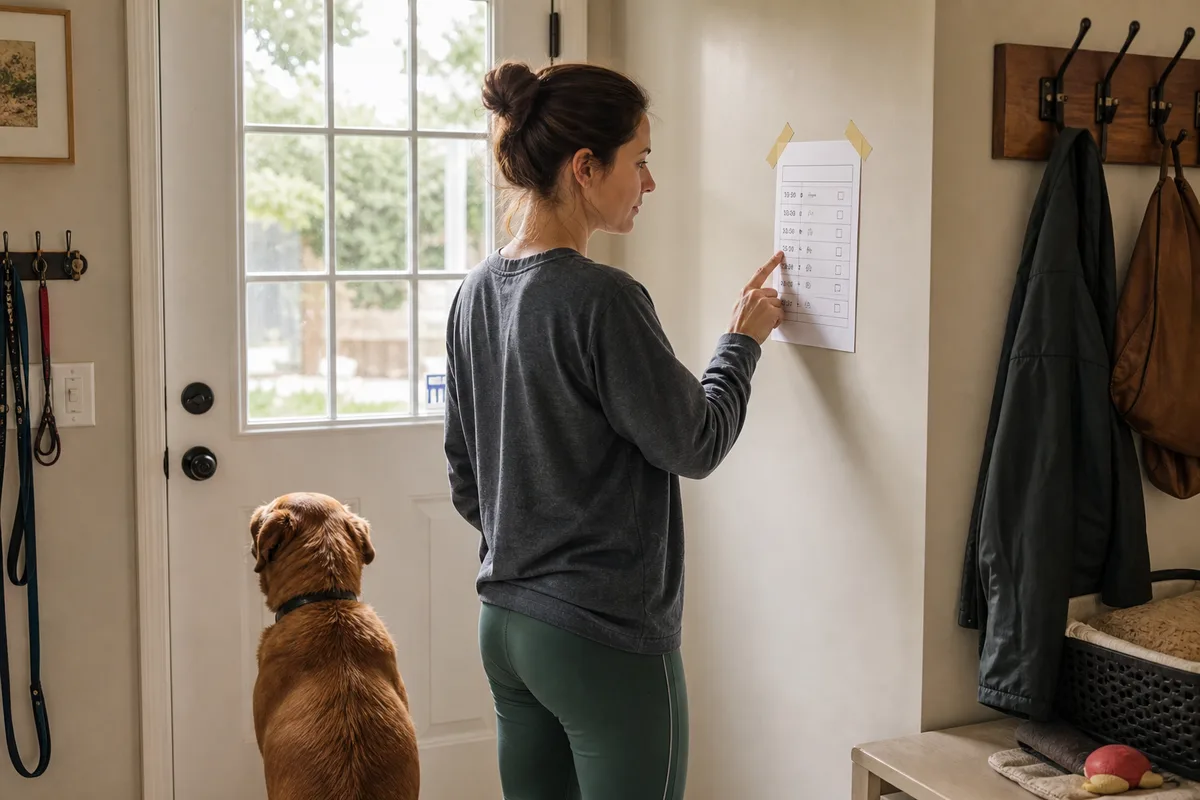 A house-training schedule taped near a back door
Write this down and tape it by the door. I mean that literally: a sheet of paper on the wall where everyone in the house can see it. House-training falls apart fastest when two people each assume the other took the puppy out, and the puppy, sensing the loophole, takes full advantage. A shared, visible schedule that everyone follows is worth more than any clever technique. Getting a whole household onto one consistent routine is a theme that runs through settling any new dog in, and the broader guide to bringing home a new dog covers coordinating the household so the puppy gets one clear set of rules instead of four different ones.
Expect to compress this schedule for the first week (more trips, shorter gaps) and stretch it as accidents vanish. The day above is a mid-point, not a starting point.
Supervision and confinement between breaks
Here is the rule that ties the whole system together: a puppy that is not directly supervised is either in the yard or in a confined space where it will not want to go. There is no third option in the early weeks. Almost every accident happens in the gap where a puppy had free run of the house and nobody was watching. Close that gap and the accidents have nowhere to happen.
Active supervision means eyes on the puppy, watching for the pre-go signals: the sudden sniffing and circling, the drifting away from you toward a corner or a rug, the abrupt stop mid-play. When you see those, you move: scoop the pup and get to the spot. Supervision is a job, not a background state; if you are cooking or on a call and cannot watch, that is exactly when confinement takes over.
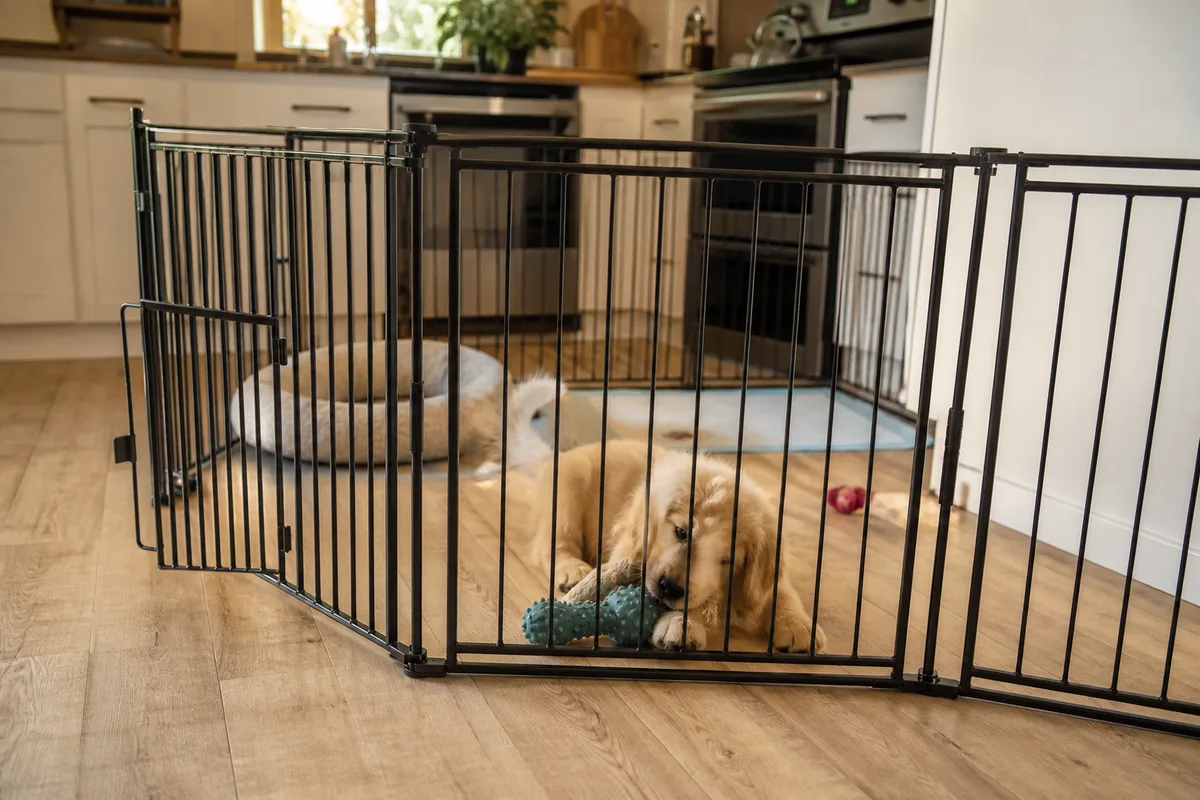 A puppy in a gated kitchen area used for supervised house-training
Confinement uses a puppy's own instinct. Dogs generally avoid soiling the small space where they rest, so a properly sized crate or a small gated area becomes a holding zone the puppy would rather not mess. The crate has to be sized right: just big enough to stand, turn, and lie down. Too large and the pup will use one end as a bathroom and sleep at the other, which defeats the point. A gated kitchen or laundry area works as a middle ground for times you want the pup contained but not crated, though a larger space gives more room for a mistake, so it demands closer listening. Confinement is not punishment and should never feel like it; it is simply a smaller world where the right choice is the easy one, used for the stretches between supervised time and trips out.
The honest limit: confinement respects the interval math, it does not override it. A crate does not extend how long a puppy can hold it. Leave a young pup crated past its physical limit and it will be forced to soil the crate, which breaks the very instinct you are relying on and sets you back. Confinement buys you the gaps within the schedule; it is not a substitute for taking the puppy out on time.
Handling accidents and cleaning them right
Accidents are not failures of the puppy or of you. They are data. Every accident tells you the schedule had a gap, and the useful response is to look at what happened right before (was it after a nap you missed, a play session, a stretch that ran too long?) and tighten that spot. Blame teaches nothing; adjusting the timing teaches everything.
If you catch the puppy mid-act, do not scold. Interrupt gently (a calm, neutral sound, not a sharp one) enough to pause the flow, then get the pup to the spot to finish, and reward finishing there. The goal is to redirect, not to frighten. If you find an accident after the fact, even a minute later, there is nothing useful to do but clean it. The puppy cannot connect your reaction to something it did earlier, so a scolding over a cold puddle only teaches that puddles make the human unpredictable. Clean it and move on, and take the note about your schedule.
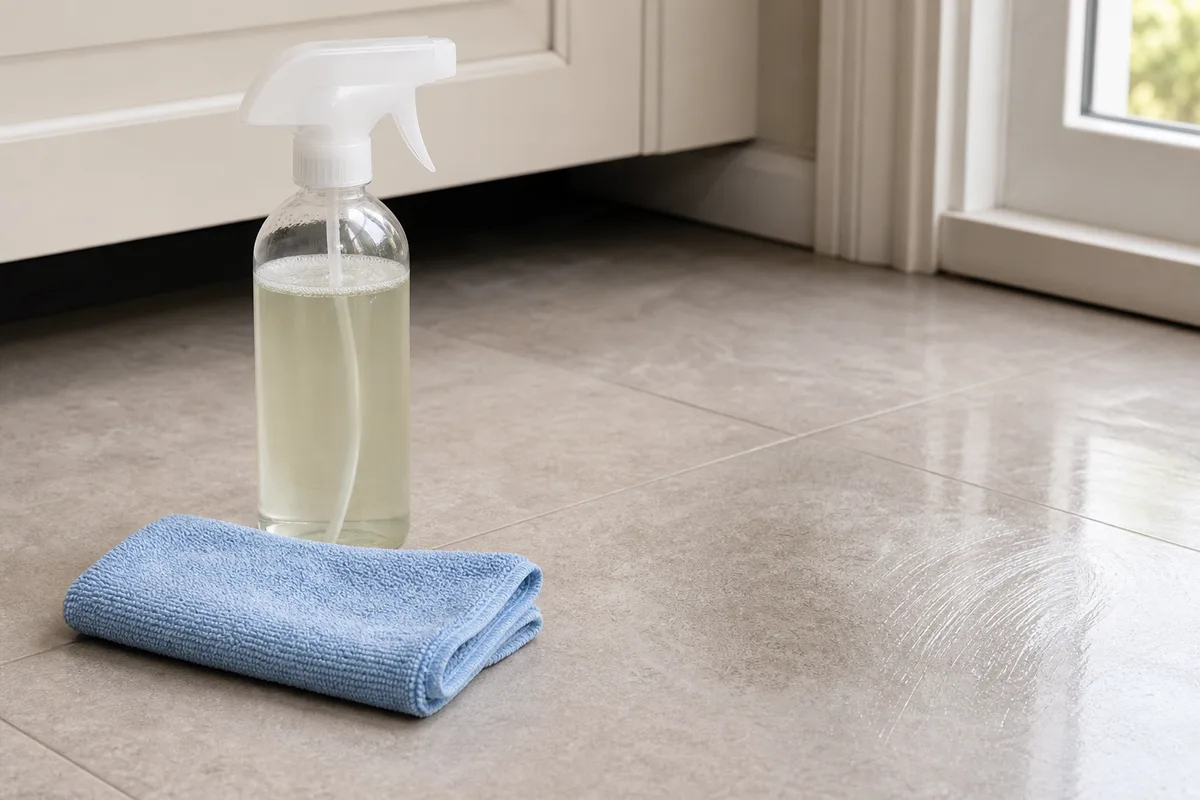 Cleaning a floor accident spot with an enzyme cleaner and cloth
Cleaning matters more than people think, because it is not really about the visible mess. It is about the scent. A puppy returns to soil where it smells previous soiling, and ordinary household cleaners, especially anything with ammonia, do not remove that scent signal and can even resemble it. An enzyme-based cleaner is the one that actually breaks down the residue a dog's nose keys on, so the spot stops advertising itself as a bathroom. Blot up as much as you can first, then soak the area, not just wipe it, and let it dwell as long as the product directs before blotting dry. A quick surface wipe leaves the underlying scent, and the puppy, whose nose is far better than your mop, will find that same spot again next week. Keeping the floor genuinely clean is part of the daily rhythm of living with a dog, and the routines in everyday pet care at home fit house-training cleanup into the wider set of small habits that keep a household running smoothly.
When it should "click," and what to do if it stalls
Owners want a date, and I understand why, but house-training clicks on a range, not a deadline. For many puppies, accidents become rare somewhere in the neighborhood of a few weeks of consistent scheduling, and a genuinely reliable dog, one you would trust with more freedom, is often more like four to six months of age, sometimes longer for small breeds. The wide range is normal. A puppy is not broken because it takes longer than the neighbor's did. Progress shows up as fewer accidents and, eventually, the puppy going to the door or giving a signal on its own, not as a sudden finish line.
What "reliable" really means is worth stating plainly: it is not the first accident-free day. One clean day is luck as much as learning. Reliable means a long stretch, weeks, of no accidents while the puppy still has only supervised freedom. You expand the puppy's roam of the house after that stretch, gradually, one room at a time, not as a reward for a good week. Give too much freedom too soon and you will see accidents come back in the new room, because the pup has not learned that the new territory is also off-limits.
When it stalls, resist the urge to add discipline and go back to the logistics instead. A stall almost always traces to one of a few things: the intervals crept too long as you relaxed, supervision got loose and unwatched gaps opened up, a cleaned spot still holds scent and keeps drawing the pup back, or freedom expanded faster than the training earned. Work down that list. Tighten the schedule back to the shorter early intervals, close the supervision gaps, re-clean any repeat spots thoroughly with enzyme cleaner, and pull the puppy's freedom back in. In most stalls, one of those four is the culprit and fixing it restarts progress within days.
One real limit to keep in mind: a puppy that was doing well and suddenly regresses hard, or one that seems unable to hold it at all despite a tight schedule, may have something going on beyond training, and that is a conversation for the people who look after the animal's care rather than something a schedule alone will fix. Setting that aside, the ordinary stalls are logistics problems with logistics answers. Hold the routine, keep the wins stacking, and the puppy gets there, usually right about the time you have stopped expecting it to and started bragging to the neighbors a little too soon.